Haplogroup R1b1a1b1a1a1d

– 5 min read


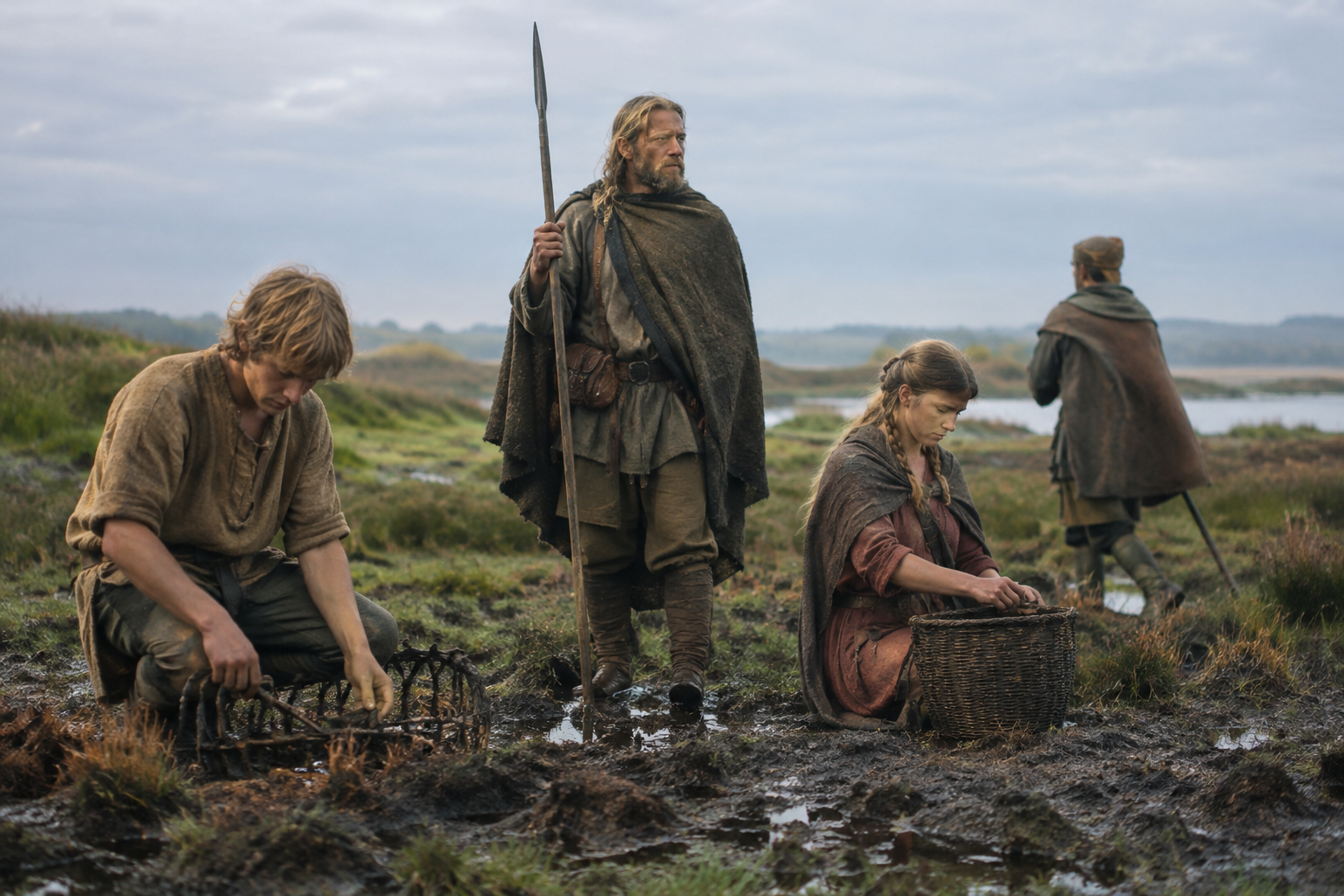
At Alken Enge in Jutland, archaeologists uncovered one of the grimmest deposits in early northern Europe: the remains of men placed in a bog landscape after a large episode of violence in the Early Roman Era. One of the individuals from this setting, sample CGG019205, dated here to around AD 110, is associated with the Y-DNA haplogroup R1b1a1b1a1a1d. That matters because it places this paternal line not in an abstract family-tree diagram, but in a very specific historical world: northern Jutland at a time when war, mobility, and local identities were reshaping the societies beyond Rome's frontier.
A second clue comes from the same peninsula but an earlier age. Sample CGG106485, from the Skole Samling collection in Jutland and dated here to about 200 BC, links the same reported paternal branch to the Nordic Bronze Age or its immediate aftermath in Denmark. We should be careful: Y-DNA traces only one direct male line, not a person's whole ancestry or ethnic identity. But taken together, these two Danish finds suggest that this branch of the wider R1b family had a place in southern Scandinavian population history before the Viking Age and before medieval dynasties ever enter the picture.
R1b1a1b1a1a1d is a narrow subclade inside the much larger R1b family, one of the major paternal lineages in western Eurasia. The wider R1b story is enormous and stretches across many regions and periods, but that does not mean every small branch shares the same exact history. For this article, the safe ground is narrower: the evidence in hand places this reported subclade in ancient Denmark, with two male individuals from Jutland separated by roughly three centuries.
That is already interesting. A branch found in both a later prehistoric context and an Early Roman Era conflict landscape hints at continuity of paternal lines within the region, even while the social world around them changed. It does not prove one unbroken local dynasty, and it does not allow us to label these men with a specific tribal name purely from genetics. What it does offer is a firm reminder that some paternal lines associated today with northwestern Europe were already established in the Danish peninsula in the centuries around the turn of the era.
Denmark's deeper genetic background
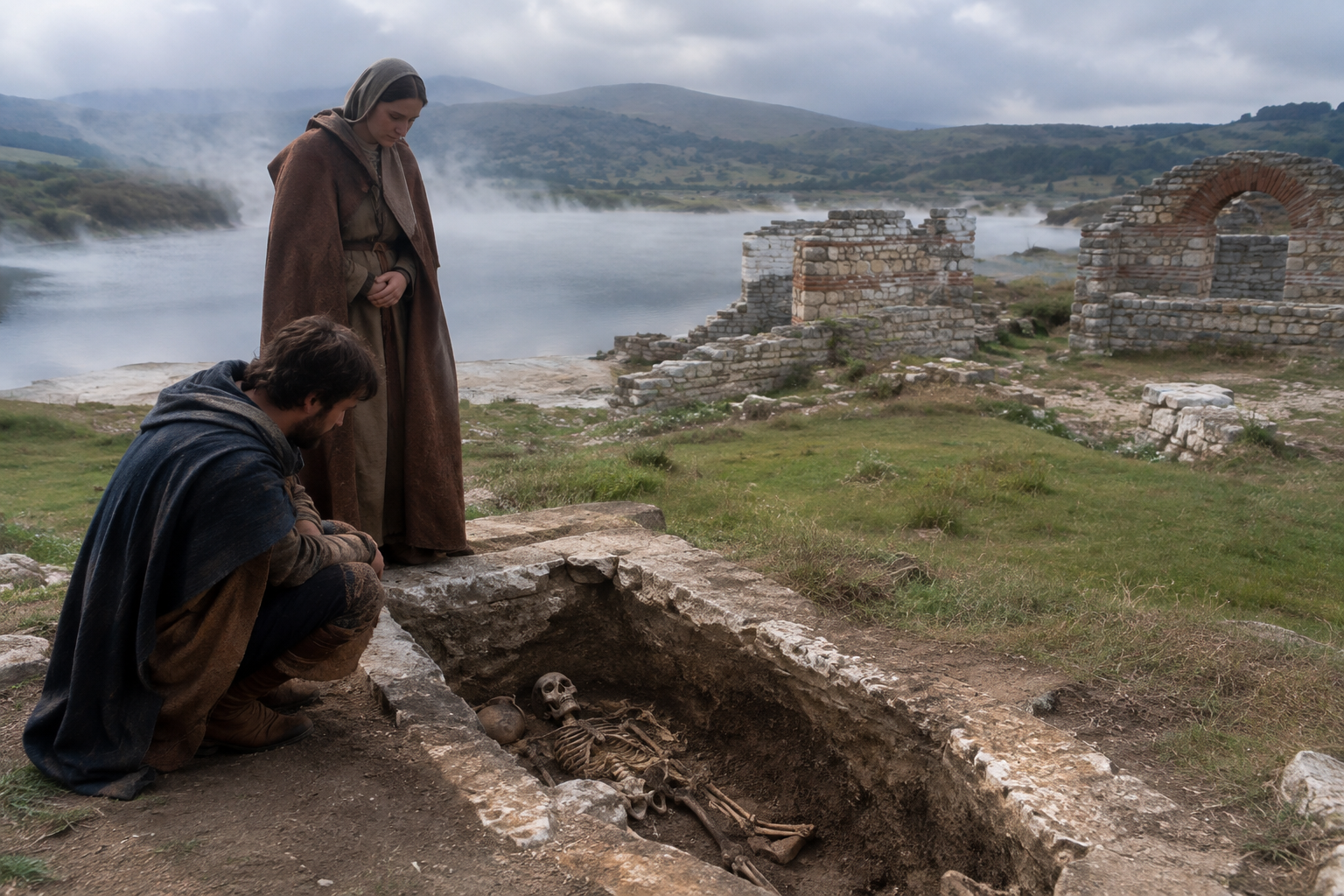
Alken Enge is not memorable because it produced a single elite burial. It is memorable because it preserves the aftermath of organized violence on a disturbing scale. The site, in eastern Jutland, has become central to discussions of warfare in Iron Age Scandinavia. Sample CGG019205, associated with R1b1a1b1a1a1d and dated here to around AD 110, belongs to that world.
The historical setting is important. This was the Early Roman Era in southern Scandinavia, when communities north of the imperial frontier were not isolated from continental developments. Roman goods, military pressures, and shifting alliances all formed part of the background. Yet Alken Enge shows that local conflict had its own force and scale. A paternal lineage like this one therefore appears not in a peaceful genealogical ledger, but amid the harsh realities of Iron Age power struggles.
Because the available record here is brief, it would be wrong to invent details about this particular man's grave treatment, equipment, or kinship. Still, the site context alone gives the sample unusual weight. Many ancient Y-DNA assignments come from ordinary cemeteries or isolated burials; this one comes from a famous conflict assemblage, tying the branch to a moment when Jutland was deeply enmeshed in the wider transformations of northern Europe.
Research on ancient populations from Scandinavia and adjacent regions continues to refine how these Iron Age groups were related and how language and mobility may have spread across the north. For broader context on the genomic study of early Germanic-speaking populations, see this ancient DNA research on the region.
Germanic languages and ancient genomics
The earlier sample, CGG106485, comes from Jutland as well, with a date here of about 200 BC. The label given is "Nordic Bronze Age Denmark Jutland Skole Samling," which deserves a little caution. Around 200 BC, we are chronologically at the far end of the Bronze Age tradition or into the early pre-Roman Iron Age world, depending on the classification system being used. So the safe historical point is that this is an earlier Jutland male from the later prehistoric transition before the Roman period.
That earlier appearance matters because it broadens the branch's setting. Instead of popping up only in a dramatic war deposit, R1b1a1b1a1a1d is also reported in a man from an earlier Danish context. This makes the Alken Enge result easier to read as part of a regional paternal landscape rather than an isolated anomaly.
Jutland is one of those places where archaeology constantly reminds us how connected the so-called edge of Europe could be. Long before written medieval kingdoms, the peninsula sat between the North Sea and the Baltic worlds, with routes running south toward the continent and east into Scandinavian exchange networks. A Y-line turning up there in both later prehistoric and Early Roman contexts is precisely the sort of pattern that becomes more meaningful as ancient sampling grows denser.
It is tempting to leap from a haplogroup to a people: to say this is "Jutish," "Germanic," or the mark of one named migration. Ancient DNA rarely lets us be so tidy. But Jutland is still the right stage on which to think about this lineage, because it was a contact zone where communities were forming, reforming, and connecting to larger northern European networks.
If both CGG106485 and CGG019205 are correctly associated with this same narrow branch, the simplest reading is that R1b1a1b1a1a1d had a presence in Denmark across multiple centuries around the end of later prehistory and the start of the Roman-era north. That does not mean every man in Jutland carried it, nor that the branch originated there. It does mean the lineage belongs comfortably within the archaeological story of ancient southern Scandinavia.
This is also where genetics helps correct older habits of historical writing. Earlier scholarship often liked neat ethnic blocks: Celts here, Germans there, tribes moving as if under bright labels. Ancient DNA tends to reveal something more awkward and more human: continuity in some lines, change in others, and populations that cannot be reduced to one ancestry or one name.
Ancient DNA in post-Roman Britain
Although these two samples are from Denmark, their wider significance reaches into the North Sea sphere. Southern Scandinavia mattered enormously to the later history of migration into Britain and to the formation of early medieval northern European populations. That does not entitle us to draw a straight line from these Jutland men to any later surname, clan, or kingdom. It does, however, place this branch in a region that would remain historically important for centuries.
For people researching this haplogroup today, that is often the most useful historical insight: not a fantasy pedigree, but a grounded landscape. The relevant landscape here is Jutland, seen first through an earlier later-prehistoric sample and then through the violent evidence of Alken Enge in the Early Roman Era. The branch was present in a place that would become central to North Sea interactions, language spread, and the making of early Germanic Europe.
North Sea migrations to Britain
With only two ancient samples, this is not a haplogroup article built on quantity. It is built on context. R1b1a1b1a1a1d appears here in ancient Jutland twice: once in an earlier later-prehistoric Danish setting, and once in the stark aftermath of conflict at Alken Enge around AD 110. That is enough to place the branch firmly in southern Scandinavian history, and to suggest that for modern carriers, one plausible deep backdrop for their paternal line lies in the communities of ancient Denmark that lived through the transition from later prehistory into the Roman-age north.
Comments