Haplogroup R1b1a1b1a1a1c2b2b1a1a1

– 5 min read


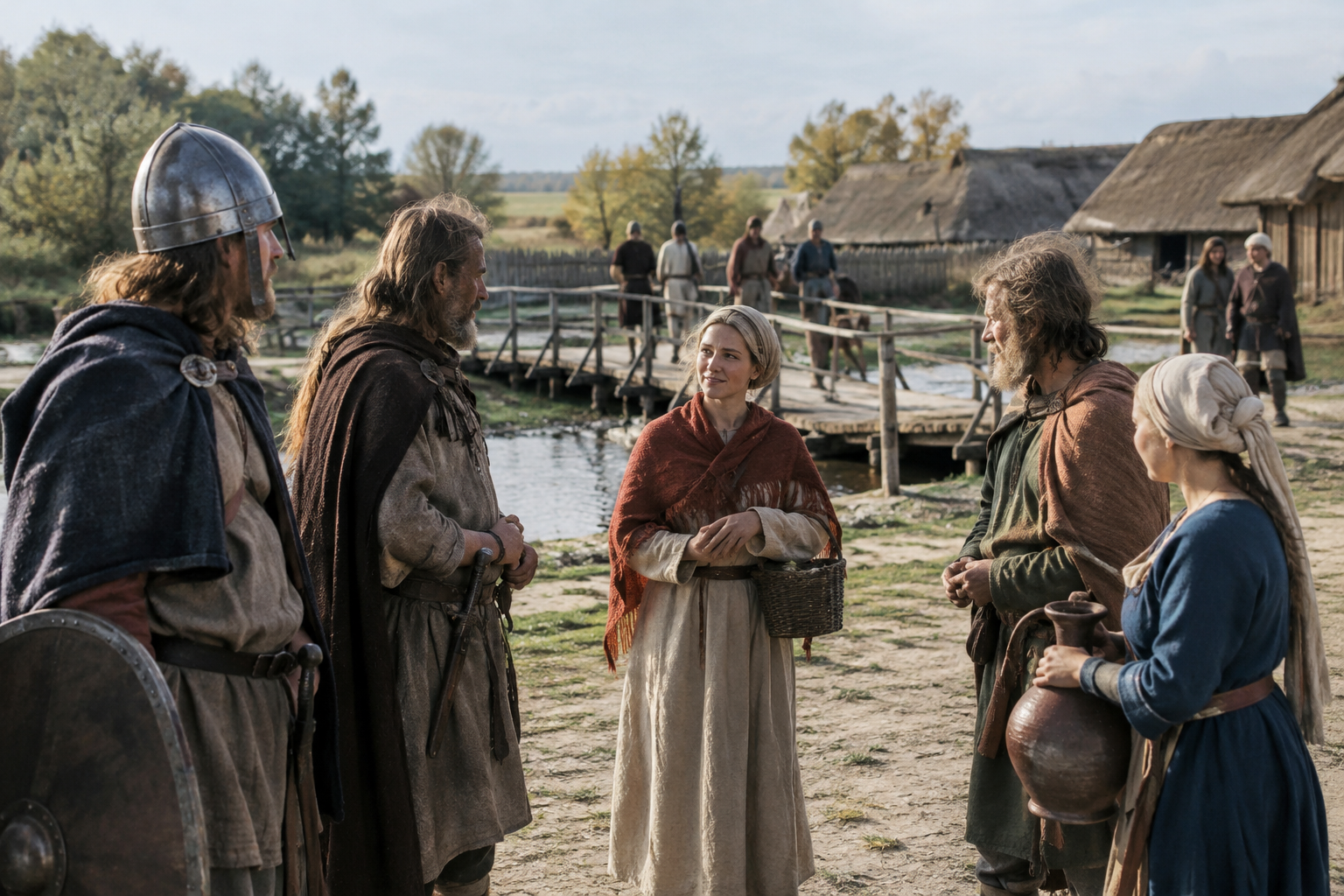
At Bruecken in Saxony-Anhalt, two men dated to around AD 500 stand out for anyone tracing the deep paternal trail of haplogroup R1b1a1b1a1a1c2b2b1a1a1. They are recorded as BRC054x, described as a Nordic tribe individual from Saxony-Anhalt, and BRC053x, identified as a Saxon from the Migration Period at the same site. That pairing matters because it places this very specific Y-chromosome branch in a real early medieval frontier landscape, at the moment when northern and central Europe were being politically and culturally rearranged after Roman power in the west had collapsed.
This is exactly the sort of evidence ancient DNA is best at handling when treated with a bit of discipline. Y-DNA follows one direct paternal line only - father to son across generations - so it does not define a whole person or an entire people. But when the same narrow branch appears in early medieval Germany, in a Germanic-period burial from England, and again among medieval settlers in the Elbe-Saale region, it gives us something solid to think about: not a mythic founding ancestor, but a durable male line moving through the world of Saxons, settlers, and shifting frontiers.
The Bruecken samples are the clearest starting point because they place this lineage in a specific historical zone. Around AD 500, Saxony-Anhalt sat in a region where late antique Roman influence had long since faded, while new political identities were hardening among groups later described as Saxons and other Germanic-speaking communities. BRC053x and BRC054x do not prove that every man around them shared the same paternal background, of course, but they do show that this branch belonged to that early medieval North Sea and central German world.
What makes Bruecken especially interesting is the double occurrence. One sample might be a curiosity; two at the same site begin to suggest local persistence, or at least repeated presence, of a particular paternal line. That is still not the same thing as proving close kinship or a ruling family, but it does nudge us away from the idea that such a branch was merely passing through.
An ancient DNA project linked with these burials is associated with https://www.ebi.ac.uk/ena/browser/view/PRJEB81250, which is relevant because it places the discussion within the expanding body of genomic work on early medieval European populations rather than old-style guesswork based only on artefacts or later written labels.
The sample OAI001 from Oakington in England, dated to about AD 470, adds a second setting to the story. Oakington belongs to the early Anglo-Saxon horizon in eastern England, that complicated period when communities with links across the North Sea were establishing themselves in former Roman Britain. The appearance of the same article haplogroup here does not mean one can draw a neat arrow from one grave in Germany to one grave in England, but it does place the lineage inside the broader world usually associated with Saxon and related migrations.
That matters historically because early medieval England was not created by a single invading bloc. It was formed through movement, settlement, intermarriage, and adaptation. A paternal line like R1b1a1b1a1a1c2b2b1a1a1 appearing in both Saxony-Anhalt and Oakington fits that messier reality rather well: a line embedded in the wider North Sea zone, not confined by modern borders, and certainly not reducible to a one-word ethnic label.
The older genomic research often cited in discussions of Anglo-Saxon migration, including http://biorxiv.org/content/early/2015/07/17/022723, helped open this debate by showing that early medieval English communities could indeed preserve measurable continental connections. Even without forcing a direct link to this exact subclade, the broader context is clear enough: eastern England and northern Germany were tied together by people as well as things.
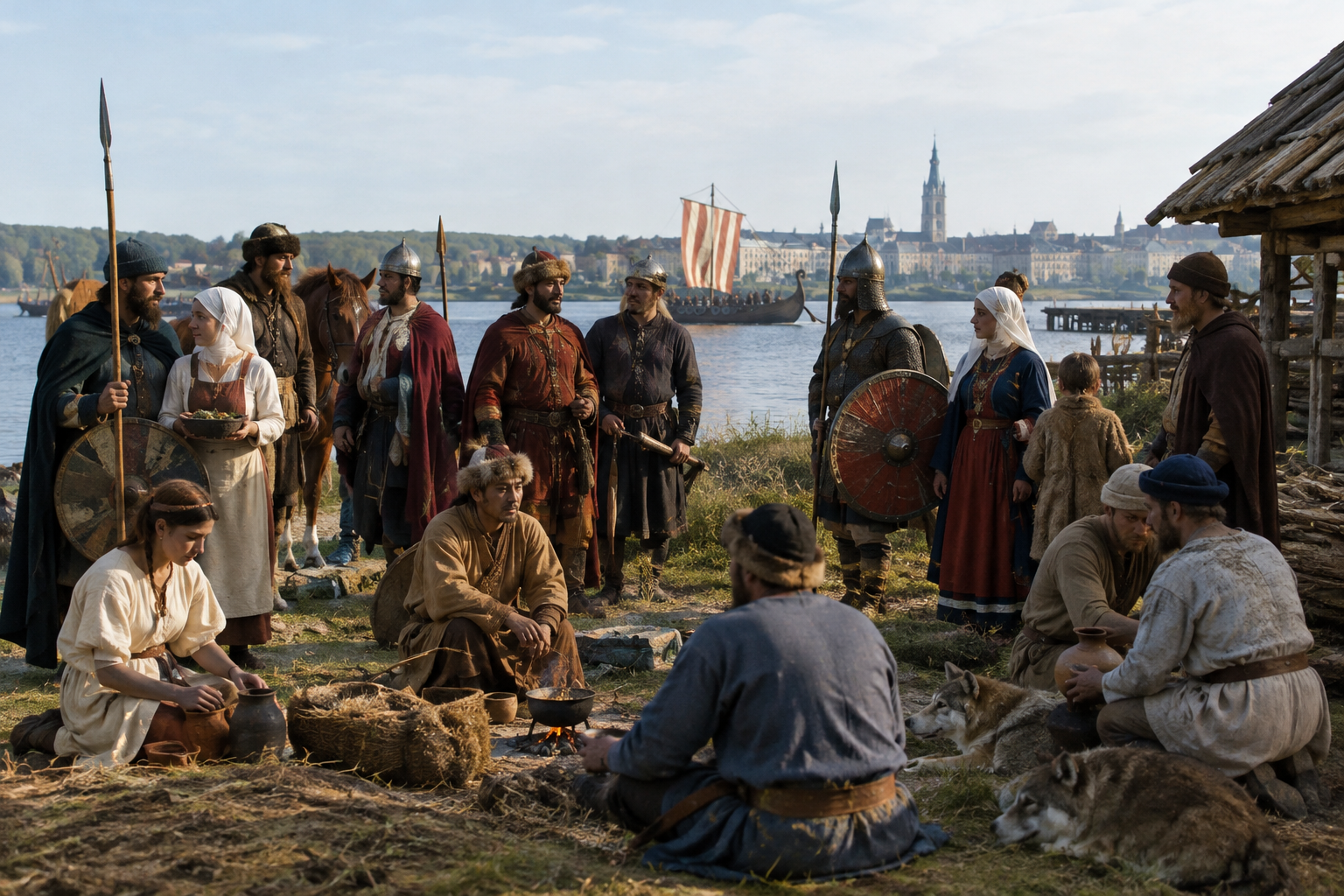
Then the plot shifts eastward, or rather the labels do. Two later individuals from Steuden in Sachsen-Anhalt - SDN035 and SDN036, both dated to around AD 1050 - are described as Western Slav settlers. This is a splendid reminder that the same paternal lineage can outlast major cultural and linguistic change. By the 11th century, the Elbe-Saale region was a frontier and contact zone where German-speaking and Slavic-speaking communities met, mixed, competed, and settled.
So here we have the same narrow Y-chromosome branch turning up in individuals classified within a medieval Slavic settler context. That does not mean the lineage was "Slavic" in any simple biological sense, just as its earlier presence in Saxon contexts does not make it permanently "Saxon." What it shows is continuity of a male line across changing political and cultural landscapes in central Europe.
Archaeologically, this is the really useful point. Historians often write as though peoples arrive with fixed identities, remain tidy for a few centuries, and then politely hand over to the next group. Ancient DNA is much ruder than that. A paternal branch may persist while languages, loyalties, burial customs, and community labels all change around it.
The exact label here - R1b1a1b1a1a1c2b2b1a1a1 - is a very fine-grained descendant within the wider R1b family. That wider family is extremely widespread in western Europe, but one must not lazily transfer the whole grand history of R1b onto a much narrower branch. The evidence in hand is more specific and more modest: this particular paternal line is documented in early medieval and medieval contexts linked to Saxony-Anhalt, early Anglo-Saxon England, and a later Western Slav settler horizon in the same broad central European region.
That is already historically valuable. It suggests a branch that was present in the North Sea-continental interface during the Migration Period and that remained part of central European male-line diversity into the High Middle Ages. In other words, this is not a lineage pinned to a single "tribe" in amber. It appears in settings shaped by mobility, colonisation, and frontier life.
It is also worth noting what makes these samples distinctive as a cluster: they are close enough in date and geography to tell a coherent story, but varied enough in cultural labels to stop us becoming complacent. Early Saxon-associated and later Western Slav-associated contexts are precisely the kind of juxtaposition that warns against simplistic genetic nationalism.
If one were forced to describe the historical setting of this haplogroup in a single phrase, "North Sea and Elbe frontier" would do better than any modern nationality. Oakington points toward the maritime world linking continental homelands and early England. Bruecken shows the lineage in the post-Roman reorganisation of central Germany. Steuden shows that the line did not disappear when the region's demographic and political profile changed in the centuries that followed.
That pattern sits comfortably beside broader MyTrueAncestry discussions of post-Roman Britain and continental movement. The useful comparison is not with a royal pedigree or a romantic origin myth, but with the hard historical fact that early medieval Europe was built from overlapping communities rather than sealed populations.
For someone carrying haplogroup R1b1a1b1a1a1c2b2b1a1a1 today, the strongest supported insight is not a promise of one famous ancestor, but a historically grounded setting. The ancient evidence places this paternal line in the world of early medieval Saxony-Anhalt, early Anglo-Saxon England, and later medieval settlement zones shaped by Slavic-German interaction. That is a wonderfully specific kind of past: not abstract "Europe," but a corridor of movement and continuity across some of the most important centuries in the making of medieval northern Europe.
It is, in short, a lineage that seems to have endured through the very untidy business of migration, settlement, and cultural change.
Comments