Haplogroup R1b1a1b1a1a1c2b2b1a1

– 5 min read


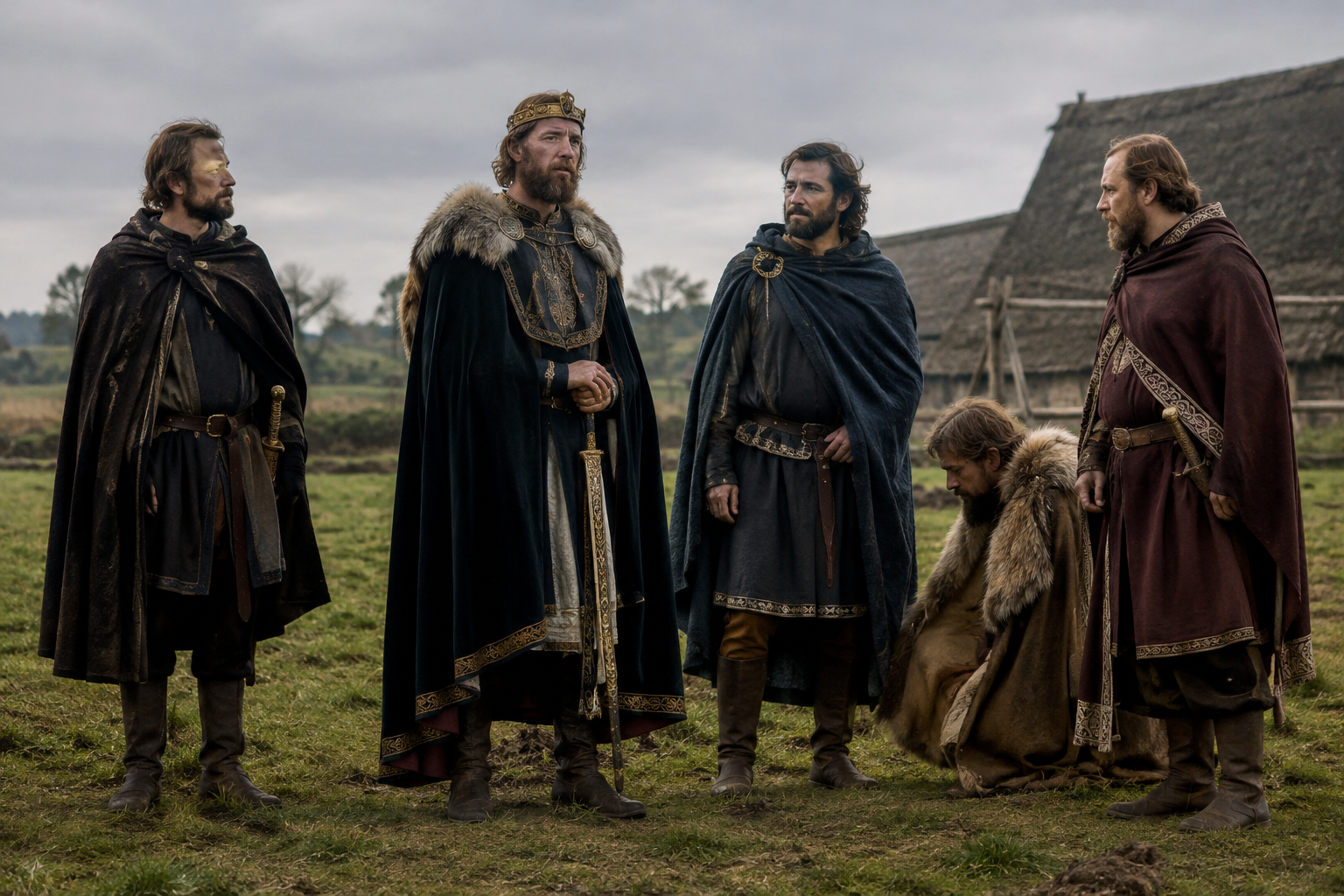
At around AD 605, a small cluster of high-status graves from the Merovingian world produced an unusually neat little puzzle in paternal ancestry. Five men identified in the record as NS9, NS12b, NS12c, NS1, and NS3a appear as a tightly dated group: a “Merovingian Lord,” several “Merovingian Noble” burials, and one “Nordic Alemannic Merovingian Burial.” They are associated here with the Y-DNA haplogroup R1b1a1b1a1a1c2b2b1a1, a very specific paternal branch nested deep within the wider R1b family.
That matters because Merovingian cemeteries are one of the places where ancient DNA becomes especially good at exposing the difference between labels and lives. “Merovingian,” “Alemannic,” and “noble” are historical or archaeological descriptions; a Y-chromosome lineage is something narrower, tracing only one direct male line. But when the same branch appears repeatedly in one early medieval burial cluster, it gives us a rare glimpse of how elite male ancestry could persist inside a politically mixed frontier society.
The five individuals listed here are all dated to about AD 605, which immediately suggests that we are not looking at a long, slow spread over centuries but at a snapshot. NS9 is described as a Merovingian lord; NS12b, NS1, and NS3a as Merovingian nobles; and NS12c as a Nordic Alemannic Merovingian burial. Even with these short labels, the pattern is striking. This is not one isolated male line turning up by chance in one grave, but a repeated appearance in what looks like a socially prominent group.
That does not automatically mean all five men were close paternal relatives. Archaeology is full of tempting shortcuts, and this is one of them. Yet repeated occurrence in a narrowly dated elite context does suggest that this branch had a place within the male networks of Merovingian-era power, whether through a single family, an allied kindred, or a broader regional noble stratum.
A useful wider backdrop comes from reporting on ancient DNA work on an early medieval warrior cemetery in southern Germany, where researchers found that supposedly uniform “Germanic” burial grounds could in fact include men of varied origins and histories. That broader context is discussed in this Science news report, which helps explain why a label like “Alemannic” should be handled with care.
German frontier mixing, 400-700 CE
R1b1a1b1a1a1c2b2b1a1 is a terminal-style designation, far more specific than simply saying “R1b.” That distinction is important. The wider R1b umbrella has a vast prehistoric and historic spread across western Eurasia, but it would be careless to pour all of that history straight into one very narrow descendant branch. The evidence here is much more modest and much more interesting: this specific line is associated, in the data provided, with a cluster of early medieval men in a Merovingian setting.
So what can be said responsibly? First, that this was a living paternal line present among elite or high-status men in the early seventh century. Second, that its appearance alongside the description “Nordic Alemannic Merovingian” hints at the sort of blended frontier society familiar from post-Roman central Europe, where political allegiance, burial style, and ancestry could overlap without ever becoming identical things. What cannot be said from these records alone is that the branch belonged to a single named dynasty, tribe, or ruling house.
The Merovingian centuries followed the collapse of western Roman imperial rule, but they were not a clean break with the Roman world. In regions along the upper Rhine and into southern Germany, old provincial populations, incoming groups, military retinues, and local aristocracies all interacted. Cemeteries from this period often look temptingly “ethnic” when viewed through artefacts or later chronicles, yet ancient DNA keeps showing that communities were more mixed and mobile than tidy historical labels imply.
That is where NS12c becomes especially interesting. The description “Nordic Alemannic Merovingian Burial” sounds, at first glance, like a perfectly boxed identity. In reality, it is better read as an archaeological and interpretive shorthand for a man buried within an Alemannic-Merovingian milieu, perhaps showing traits linked by researchers to northern connections. The fact that he is grouped here with men assigned to the same paternal branch suggests continuity across what might otherwise be treated as separate identity categories.
In other words, the Y-line does not prove anyone’s language or self-understanding. It does, however, show that at least one male lineage could move comfortably inside the social world we call Merovingian, even where that world drew on different regional traditions.
Diverse origins in a 7th-century cemetery
Three of the men here are described plainly as nobles, and one as a lord. Those are not trivial labels. Even if we strip away any modern romance about “nobility,” such terms imply that the graves were interpreted as socially elevated within their cemetery context. When the same Y-line appears more than once in that setting, the historical question becomes sharper: are we seeing the persistence of a local aristocratic paternal line, or the success of one branch within a wider military-political network?
NS9, the Merovingian lord, is a good place to focus that question. His importance lies not in any invented biography but in the simple fact of rank. If a man of that status carried this branch, then R1b1a1b1a1a1c2b2b1a1 was not merely present somewhere in the countryside; it had reached, or remained within, the upper social layers of a post-Roman kingdom. NS1, NS3a, and NS12b then reinforce the point by repetition rather than by drama.
This is exactly the sort of pattern ancient DNA is good at catching. One grave can be anecdotal. A cluster of similarly dated, similarly ranked males is something more substantial, though still not a blank cheque for genealogical certainty.
The broader historical setting is worth pausing over. Around AD 605, the Merovingian kingdoms governed a patchwork landscape in which older Roman provincial habits, Frankish power, and Alemannic regional identity all intersected. The term “Alemannic” itself often points more to geography and political-cultural context than to a biologically distinct people marching unchanged through time.
That is one reason this haplogroup cluster is useful. It sits in precisely the kind of zone where historians have long argued over continuity and migration. Rather than solving the whole argument, these men show how one paternal line could be embedded in that mixed world. Their branch may represent local continuity, the success of a mobile warrior family, or the fusion of both. Early medieval Europe was rather good at that sort of untidiness.
If your paternal line falls under R1b1a1b1a1a1c2b2b1a1, these Merovingian-era men offer a grounded historical anchor rather than a fantasy pedigree. The clearest supported point is that this branch appears in a concentrated group of high-status males around AD 605 in the Merovingian sphere, including individuals labelled noble and lordly, and at least one burial described in an Alemannic context. That places the lineage inside the complicated political and social world of the post-Roman upper Rhine, where ancestry, status, and identity were constantly being renegotiated.
It is a small window, but a good one: not a mythical founder, not a sweeping tribal claim, but a real early medieval cluster of men whose direct paternal line can still be traced today.
Comments