Haplogroup R1b1a1b1a1a1c2b2a1b4

– 5 min read


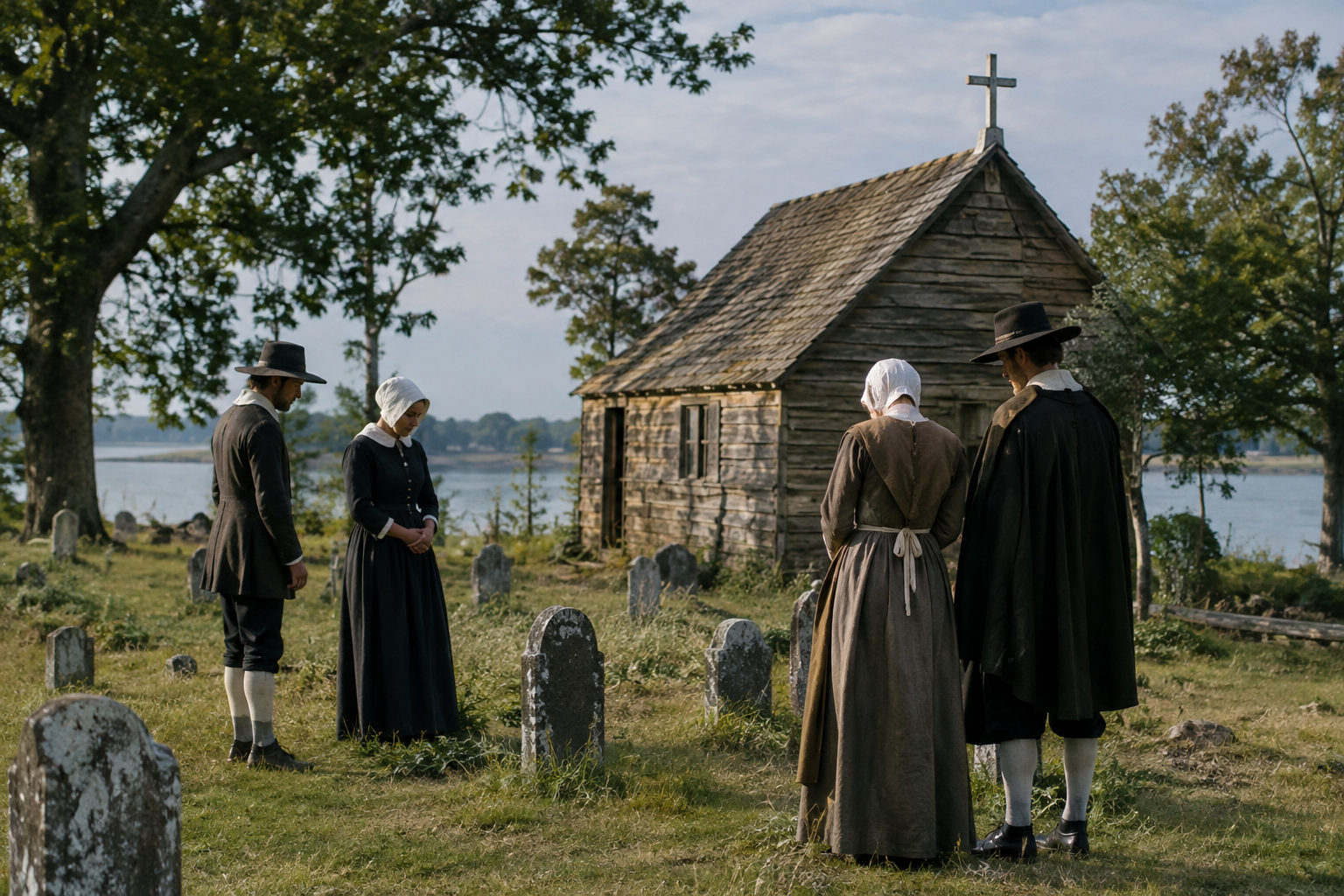
One of the most arresting points of contact between this very specific Y-chromosome line, R1b1a1b1a1a1c2b2a1b4, and the historical record comes not from a prehistoric barrow or a princely tomb, but from early colonial Maryland. The ancient individual identified as I15302, from the Historic St. Mary City Chapel Field Cemetery, belongs to the first generation of England's Catholic colony founded in 1634 AD. That alone makes him unusual. He stands at the meeting point of archaeology, documentary history, and the paternal lineages carried across the Atlantic in the first century of English settlement.
There is something wonderfully sobering about that. Y-DNA traces one direct paternal line only: father to son, and so on, through just one thread of a person's ancestry. But when a thread can be tied to a named archaeological context as exact as St. Mary's City, it becomes historically vivid. In this case, the branch is a narrow subdivision within the vast and widespread R1b family, a family of lineages deeply common in western Europe but enormously varied once one looks closely at its finer branches. What matters here is not a grand claim about all R1b men, but that this particular subclade appears in a securely colonial-era burial from one of early English America's most important sites.
St. Mary's City was the first capital of Maryland, established on the western shore of the Chesapeake in the 1630s. It was a place of experiment as much as settlement: a planned colonial town, a Catholic-led proprietary venture, and a frontier community living amid older Indigenous landscapes and the pressures of Atlantic expansion. The Chapel Field Cemetery, where I15302 was buried, belongs to that fragile opening chapter.
The importance of I15302 is not that he can single-handedly explain the ancestry of Maryland, still less that one burial can define the history of a haplogroup. It is that he gives this branch a firm archaeological foothold in a setting where migration, kinship, and identity can be studied together. Research on the broader population of colonial St. Mary's City has shown how valuable such burials are for reconstructing who these settlers were and how closely their genetic profiles matched populations from the British Isles and nearby parts of Europe. A related MyTrueAncestry discussion of that colonial community can be found here:
An ancient DNA study focused on the site's population context is linked through research on the genetic legacy of 17th-century St. Mary's City. Even without over-claiming what can be known for one man, that work makes clear why a burial like I15302 matters: it anchors a paternal lineage in a precisely dated colonial landscape shaped by migration from the Old World and settlement in the New.
The clade name R1b1a1b1a1a1c2b2a1b4 is, admittedly, not the sort of thing anyone would carve over a church door. But its length tells you something important. This is not a broad umbrella lineage; it is a highly downstream branch, one of many twigs on a huge Y-DNA tree. The parent haplogroup R1b is associated with many different historical populations across Europe, especially in the west, but the narrower branch in this article should not be treated as if it automatically carries the whole story of R1b with it.
That distinction matters because readers understandably want to leap from a modern or early modern result straight into the Bronze Age. Archaeology is less obliging. With the evidence here, the defensible statement is that this branch is represented by a man buried in early colonial Maryland, in a community formed largely by migrants from Britain and the Atlantic world. That makes the most plausible historical setting for this lineage one tied to western European paternal ancestry carried into seventeenth-century English America, not a direct, proven line to any one prehistoric people.
Early American colonies are often imagined as unusually well documented, and compared with prehistory they are. Yet the written record is patchy, socially selective, and often silent about ordinary settlers. Cemeteries like Chapel Field help correct that. They preserve the bodies of people who may leave faint or ambiguous traces in documents, while genetics adds a different scale of evidence: kinship, ancestry, sex, and paternal or maternal lineage.
That is why I15302 is more than a technical haplogroup label. He belongs to a cemetery embedded in a real town, in a colony founded in a known year, under known political and religious circumstances. Genetic work on such sites can reveal whether a burial community was tight-knit or mixed, whether its ancestry looks locally coherent or diverse, and how the first colonial generations relate to later populations in the Chesapeake. In that sense, a narrow Y-line such as R1b1a1b1a1a1c2b2a1b4 becomes part of a bigger social history: the making of a settler society.
For readers interested in how population history and language movement can sometimes be studied through ancient genomics at a much broader scale, this post offers a useful comparison:
Because St. Mary's City was an English colonial foundation, the historical context of this lineage is best sought in the populations feeding migration into the Chesapeake: primarily England, with wider links across the British Isles and the Atlantic. That does not mean every carrier of this branch was English in any simple sense, nor that the branch can be assigned to a single county, class, or surname from the evidence here alone. But it does place the lineage in the world of seventeenth-century Atlantic mobility rather than in some vague pan-European mist.
This is where archaeology is especially useful. Colonies were not static transplants. They were places where local birth, new mortality regimes, social sorting, and repeated arrivals all changed the genetic picture very quickly. One burial from 1634-era Maryland therefore tells us about movement, but it also tells us about establishment: this paternal line was not merely passing through; it was part of a community putting down roots in a new colonial capital.
Readers who want a broader background on paternal and regional transformations in Britain over longer periods may also find this relevant:
There is a temptation, when an article has only one directly cited ancient individual, to think the evidence is too slight to be meaningful. But single samples can be historically powerful when their context is strong. I15302 is not floating in abstraction. He comes from a famous colonial settlement, a datable cemetery, and a period of intense demographic change whose historical framework is exceptionally well understood.
That makes him a useful waypoint for anyone carrying or studying R1b1a1b1a1a1c2b2a1b4 today. He shows that this paternal line was present in the early English Chesapeake at the very beginning of Maryland's colonial history. He does not prove noble descent, ethnic exclusivity, or a unique migration saga. What he does provide is something better: a real human anchor in a real place, where genetics and archaeology meet.
Another worthwhile comparison, especially for thinking about how colonizing populations could already be genetically mixed before or during overseas expansion, is this study of early colonial Lanzarote:
For this haplogroup, the most distinctive insight is not a sweeping origin myth but a precise historical placement. R1b1a1b1a1a1c2b2a1b4 is tied here to I15302 from the Chapel Field Cemetery at Historic St. Mary City, around the founding generation of Maryland in 1634 AD. If this is your paternal branch, the evidence responsibly suggests a lineage present in the early modern western European world that took part in the first English colonial societies of the Chesapeake.

Comments