Haplogroup R1b1a1b1a1a1c2b1b2

– 5 min read


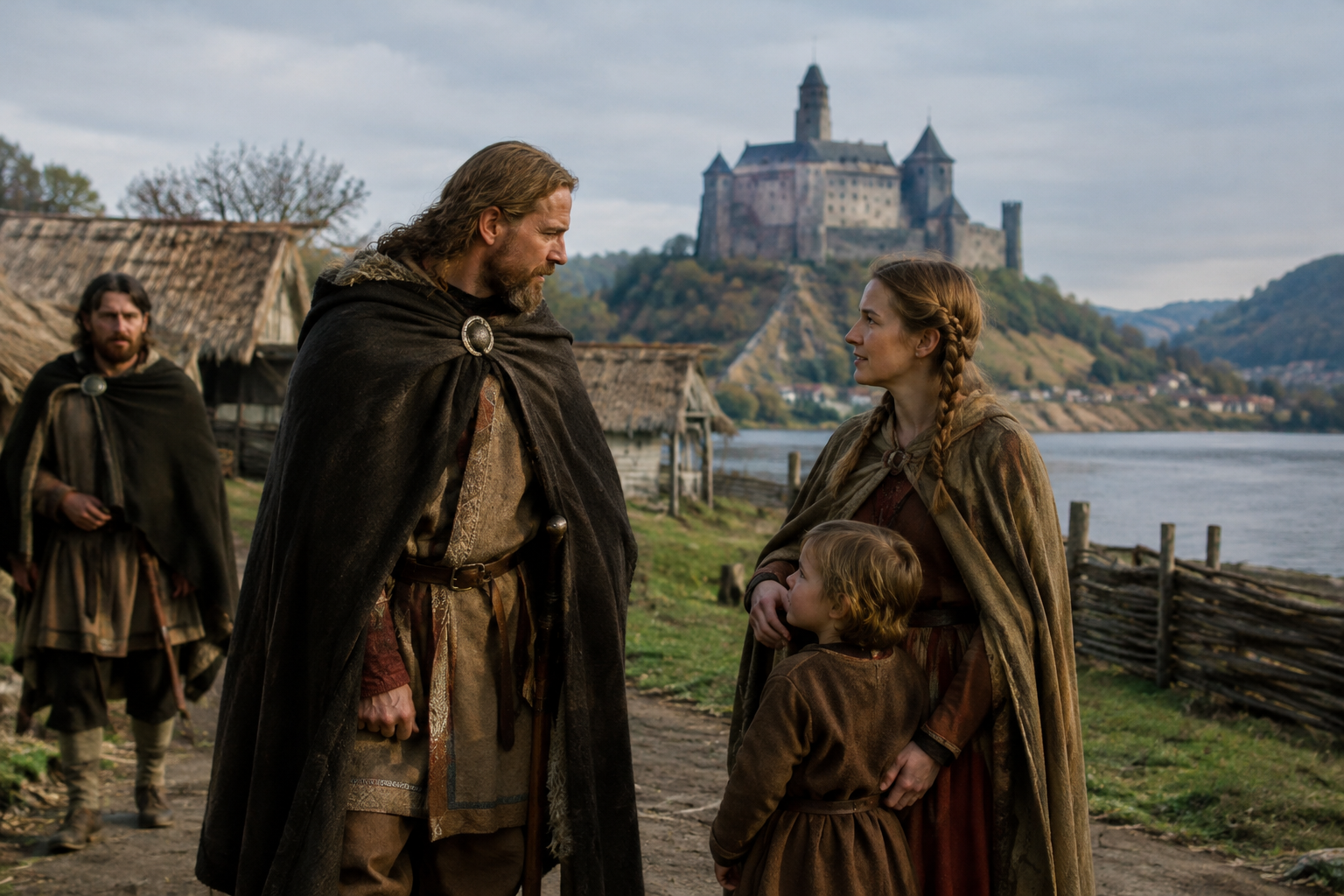
In the middle Rhine region, at Eltville in Germany, one excavated man from the Late Merovingian period carries an unexpectedly precise paternal clue. The individual labelled EV7, dated to about AD 655, is associated here with the Y-DNA haplogroup R1b1a1b1a1a1c2b1b2. That string of letters and numbers may look forbidding, but it matters because it places one direct male line inside the world of the early medieval Franks, at exactly the moment when post-Roman western Europe was being politically and linguistically remade.
That is the fascination of a sample like EV7. We are not looking at "Frankish DNA" in any total sense; Y-DNA traces only one narrow paternal line among thousands of ancestors. But one direct male line, securely placed in a seventh-century Frankish setting on the Rhine, can still tell us something important about how elite and ordinary male lineages were embedded in the societies that emerged after Rome.
Eltville lies in a landscape that had long been a corridor rather than a frontier. The Rhine connected the Roman world, the post-Roman kingdoms, and the trading and farming settlements of central Europe. By the seventh century, this was Frankish territory: Christianizing, politically layered, and full of local continuities beneath new ruling structures.
EV7 belongs in that historical setting. Even with limited published detail attached here beyond place, date, and identifier, the context itself is revealing. A man buried around AD 655 in the Rhine-Main region lived in a world shaped by Merovingian kings, local landholding families, older Roman infrastructure, and shifting identities that were not neatly divided into "Roman" and "Germanic."
This matters for haplogroup work because lineages do not move through history as tidy ethnic badges. A branch found in a Frankish-period burial tells us that this paternal line had become part of that society by the seventh century. It does not, by itself, tell us whether the man's deeper paternal ancestors had arrived centuries earlier, whether they came through local continuity, or whether they were tied to one migrating group among many. But it does anchor the branch in a real archaeological place and time.
Germanic Languages and Genomics
R1b1a1b1a1a1c2b1b2 is a very narrow twig on the much broader R1b tree, one of the major paternal lineages in western Europe. That wider fact is useful background, but the narrower branch should not be lazily treated as if it carries the whole history of R1b on its back. The deeper story of R1b reaches far beyond the Merovingian world; this article's branch is simply one late-surviving and historically placed offshoot within that larger paternal framework.
That distinction is more than technical fussiness. In public discussions of DNA, there is a constant temptation to jump from a broad lineage to a very specific identity claim. Yet a fine-grained branch like R1b1a1b1a1a1c2b1b2 is most valuable when it is used carefully: not as a grand slogan about "who the Franks were," but as a marker that can connect present-day testers with one documented strand of male-line ancestry in early medieval western Europe.
In other words, EV7 does not stand for all Franks, all Germans, or all western Europeans. He represents one attested paternal line in one community at one date. That is narrower, but also more historically honest.
The seventh century is one of those periods that can seem maddeningly opaque in written history. We have law codes, saints' lives, royal politics, and scattered chronicles, but the social texture is often hard to grasp. Ancient DNA changes that by giving us actual individuals located in cemeteries and settlements rather than merely named peoples in texts.
For the Frankish world, this is especially important. The Merovingian kingdom was not a sealed tribal block. It ruled former Roman provinces, absorbed regional populations, and participated in the long transition from late antiquity to the medieval order. A Y-line such as that of EV7 is therefore most interesting not because it proves a dramatic migration on its own, but because it sits inside a society built from mixture, inheritance, and local adaptation.
That broader picture fits well with recent archaeogenetic work on early medieval Europe, where the older language of simple invasions has steadily given way to something more complicated and more human: communities with mixed origins, variable mobility, and social identities that cannot be read directly from bones or brooches. One useful comparison for readers interested in that larger background is MyTrueAncestry's discussion of Roman-"barbarian" blending on the German frontier, 400-700 CE, which explores exactly this borderland world.
The Eltville sample also belongs to a region with a long memory. The Rhine had been one of Rome's great military and commercial arteries, and even after imperial authority fractured, roads, towns, estates, and habits of exchange did not simply vanish. The Franks inherited landscapes already thick with Roman and pre-Roman history.
So when a paternal branch turns up in a Late Merovingian burial from Germany, it should be read against that layered background. The old categories in schoolbook history - Romans first, then barbarians, then medieval peoples - often hide the continuities on the ground. In reality, communities along the Rhine could preserve local ancestry while also absorbing newcomers, new political loyalties, and new languages.
That is why one Frankish-period Y-line can be historically interesting even without a dramatic origin story attached to it. It reminds us that the making of medieval Europe happened in specific valleys, churchyards, farmsteads, and burial grounds, where older populations and new ruling identities met each other over generations.
German Frontier Mixing 400-700 CE
The research framework behind finds like this comes out of the expanding field of early medieval ancient genomics. A broader genetic study of populations linked to Germanic-language expansion is available here: https://www.nature.com/articles/s41586-026-10437-3. Without overclaiming for any single individual, work of this kind has been steadily sharpening our view of how language spread, how communities mixed, and how local ancestry persisted through political change.
That last point is worth underlining. Archaeology and genetics are most powerful together when neither is made to do the other's job. A grave can place a man in a cultural and chronological setting; DNA can trace one paternal line and, in larger studies, patterns of relatedness and population structure. But neither can simply be translated into a neat ethnic label.
For MyTrueAncestry users, though, the payoff is real. A branch like R1b1a1b1a1a1c2b1b2 gains historical texture when it is tied to an identifiable ancient person such as EV7. Instead of floating as an abstract code on a tree, it appears in a Frankish-period human life, on the Rhine, in the seventh century.
Ancient DNA in Post-Roman Britain
If your paternal line falls near R1b1a1b1a1a1c2b1b2, the strongest supported takeaway is modest but meaningful. This branch is attested in the early medieval Frankish sphere by the sample EV7 from Eltville, around AD 655, placing it in the world of the Late Merovingian Rhine. That does not confer a ready-made ethnic identity or a direct genealogical path to one excavated man, but it does connect your direct male line to a documented corner of the post-Roman European past where kingdoms, languages, and local populations were being reshaped together.
Comments