Haplogroup R1b1a1b1a1a1c1a2b2

– 5 min read


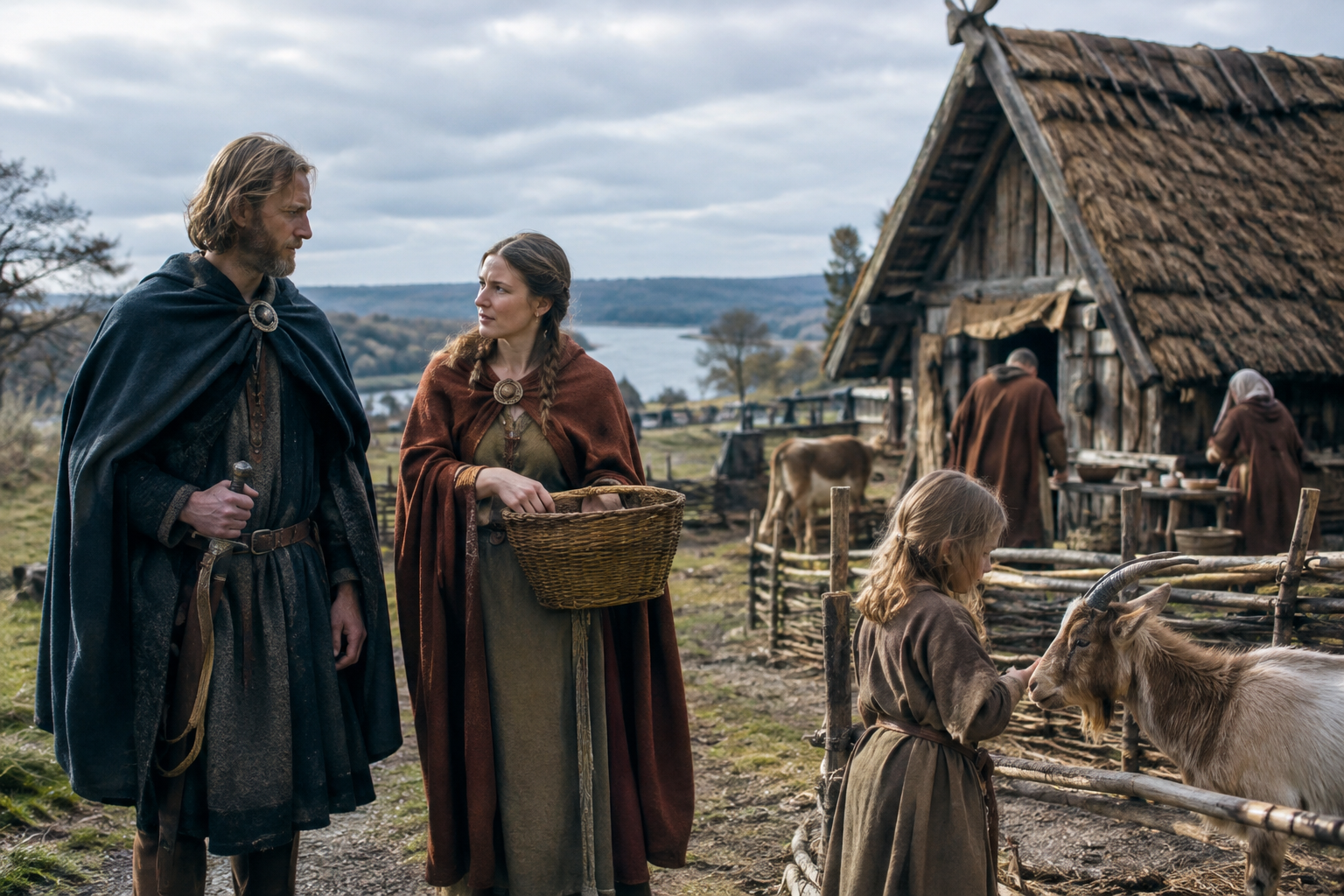
In early medieval Bavaria, one man from Altheim in present-day Germany has become an unexpectedly useful guide to a very specific paternal line. The individual known as Alh_247, dated to around AD 600, belongs to the Merovingian-period world: a landscape of villages, church foundations, local elites, old Roman frontiers, and new political identities taking shape after the Western Empire.
For people exploring the Y-DNA haplogroup R1b1a1b1a1a1c1a2b2, Alh_247 matters because he anchors this branch in a real archaeological setting. That is important. Y-DNA tracks one direct paternal line only, not a person's whole ancestry, but when a lineage appears in a securely dated burial it stops being an abstract string of letters and becomes part of lived history.
Altheim sits in Bavaria, a region that by the sixth and seventh centuries was tied into the Merovingian sphere while also preserving strong local traditions. This was not a blank post-Roman landscape. It was a zone shaped by generations of movement, intermarriage, military service, and political reorganization across former Roman and non-Roman territories.
Within that world, Alh_247 gives us a snapshot of one paternal line present in southern Germany around AD 600. We should be careful not to overstate the point: one burial does not define a people, a tribe, or a dynasty. But it does show that the lineage classified here as R1b1a1b1a1a1c1a2b2, or a reported association close to that branch, was part of the male population in Merovingian Bavaria.
That setting is especially interesting because Bavarian cemeteries of this period often reveal communities that were anything but isolated. Ancient DNA studies of early medieval Europe repeatedly show that local burial grounds could include people with different ancestry profiles, family histories, and wider connections. A sample like Alh_247 belongs in that broader story of post-Roman mixing rather than in a simple tale of a single "tribe" marching from one homeland to another.
Germanic languages and genomes
The haplogroup name here is very narrow. R1b1a1b1a1a1c1a2b2 sits deep within the wider R1b family, one of the major Y-chromosome groupings in western Eurasia. The broader parent branch has a long and complicated prehistoric history stretching back far earlier than the Merovingian age, but that does not mean every tiny downstream branch shared the same route, date, or social history.
That is where many family-history stories go astray. A precise subclade can survive through very different cultures and languages over time. The paternal line carried by a man buried in Bavaria around AD 600 may have much deeper roots in earlier European population history, but the burial itself tells us about his immediate historical world: early medieval southern Germany, in a period when identities were being constantly remade.
Because the evidence here is sparse, caution is part of the story. We have a valuable ancient anchor, not a complete map. Alh_247 is best treated as a documented bearer associated with this branch in a Merovingian context, rather than as the founding ancestor of everyone living with that haplogroup today.
The centuries around AD 600 are some of the most revealing in European archaeogenetics because written labels and biological history do not always line up neatly. The old habit was to imagine sharply bounded peoples moving intact across the map: Franks here, Bavarians there, Romans somewhere else. Ancient DNA has made that picture much messier, and much more interesting.
In practice, communities in the old frontier belt often combined local continuity with incoming ancestry from several directions. Men carrying western European Y-chromosome lineages could appear in cemeteries whose material culture reflected shifting political loyalties, Christianization, and links into wider Merovingian networks. That makes a Bavarian sample like Alh_247 useful not because he proves a grand migration by himself, but because he shows this paternal branch in the middle of a historically dynamic region.
A reader with this haplogroup today might therefore think less in terms of a single legendary ancestor and more in terms of layered European history: late Roman borderlands, early medieval settlement, and the formation of new regional societies. That is often how Y-DNA becomes archaeologically meaningful - not through mythic simplicity, but through repeated appearance in real human communities.
An ancient DNA study of this broad early medieval landscape, published in Nature, helps frame exactly that kind of question: how populations on the Roman and post-Roman frontier blended, persisted, and changed over time. Even without treating one sample as the whole story, the regional pattern gives Alh_247 historical weight.
Southern Germany in the Merovingian period stood close to one of Europe's great historical fault lines: the former Roman frontier. Long before Alh_247 was buried, this zone had seen Roman soldiers, provincial farmers, traders, migrants, and neighboring groups move through and settle across it. When imperial administration weakened in the west, people did not simply vanish and get replaced wholesale. Many stayed, adapted, married across communities, and became part of new political formations.
That wider background matters for interpreting paternal lines. A Y-haplogroup can persist through enormous cultural change. The same direct male line may pass from men living under Roman institutions to descendants buried in cemeteries identified archaeologically as early medieval Bavarian or Merovingian-period. The labels change; the paternal line can continue.
This is one reason short, tidy ethnic claims are usually misleading. R1b1a1b1a1a1c1a2b2 in an early medieval Bavarian grave does not automatically mean "Frankish," "Bavarian," or "Germanic" in any strict biological sense. It means that one man in that society carried that direct paternal branch. The history comes from the combination of lineage, archaeology, date, and place.
Ancient DNA in post-Roman Britain
It is tempting to dismiss a lone ancient sample as too little evidence. Yet archaeology often works like this. One securely placed individual can establish that a lineage was present in a region at a certain time, and that alone can sharpen later interpretations. For descendants testing today, that is not trivial information.
Alh_247 tells us that this paternal branch was present in a community living in the early medieval Bavarian world, around the time when the Merovingian kingdoms dominated much of western and central Europe. He also reminds us that paternal ancestry is best understood through context. The branch did not live on its own. It existed inside a society built from family continuity, mobility, political change, and local adaptation.
That makes the sample historically richer than a bare haplogroup label. Instead of a timeless "European" abstraction, we are looking at a man from a known place and period - one thread in the remaking of central Europe after Rome.
Roman and early medieval Britain
The most distinctive thing we can say about R1b1a1b1a1a1c1a2b2 from the evidence here is modest but solid: this paternal line is attested in Merovingian-period Bavaria through the individual Alh_247 from Altheim, around AD 600. That places the lineage within the busy, mixed, post-Roman societies of early medieval central Europe. If this is your haplogroup, the best historical picture is not a single legendary origin story, but a paternal line that was already part of the human landscape of early medieval Bavaria.
Comments