Haplogroup R1b1a1b1a1a1

– 6 min read


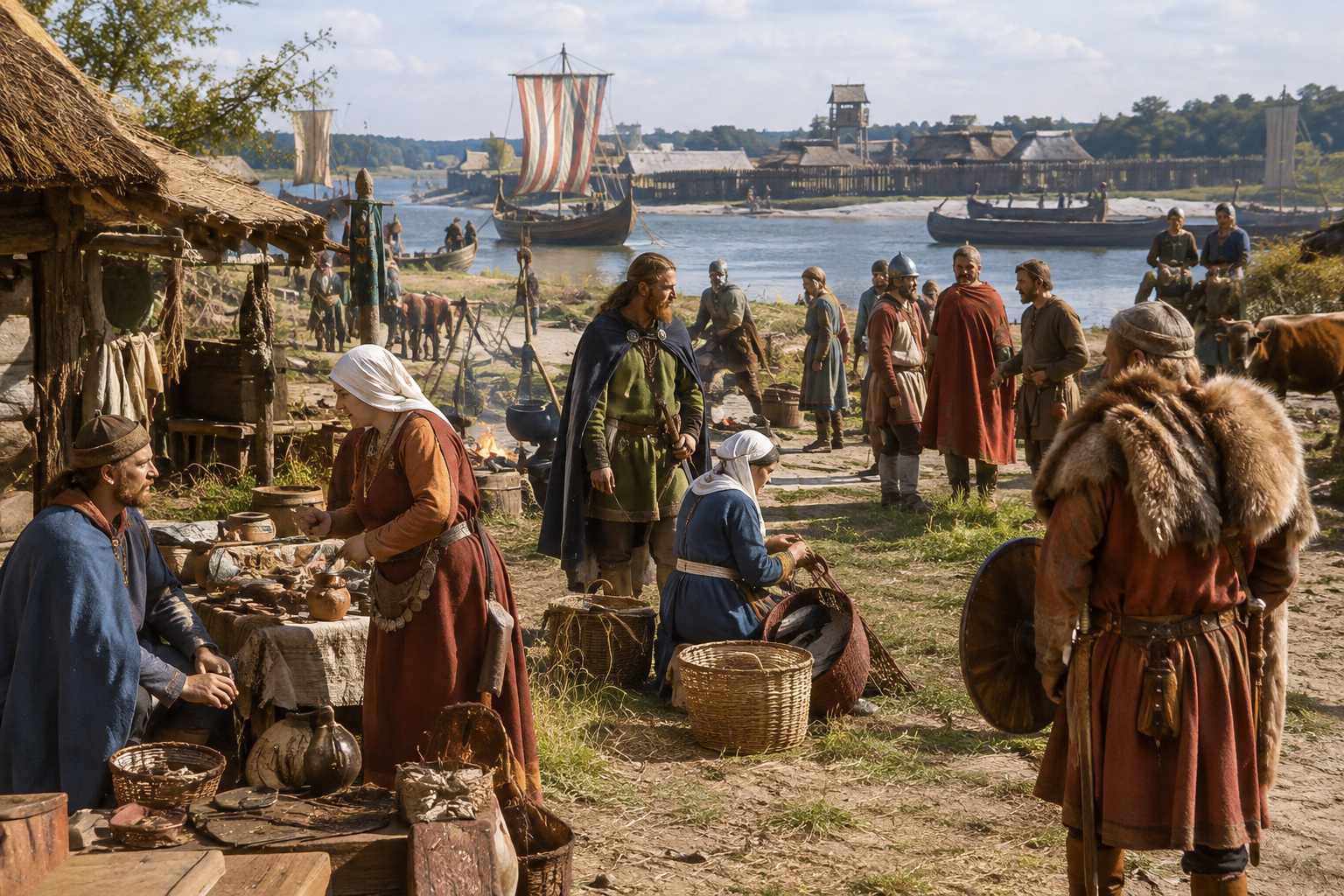
At Edix Hill in Cambridgeshire, an early Anglo-Saxon cemetery used in the sixth century AD, one man identified as EDI064c carried the Y-DNA haplogroup R1b1a1b1a1a1. That looks, at first glance, like a very technical footnote. In fact it is rather a useful historical clue, because this same paternal branch turns up again and again in burials linked to the North Sea world, to post-Roman Germany, to Anglo-Saxon England, and further back into Bronze Age central and northwestern Europe.
The interest here is not that one haplogroup can explain a people. It cannot. Y-DNA traces only one direct paternal line among thousands of ancestors. But when the same branch appears in cemeteries from West Heslerton, Buckland near Dover, Oakington, Lower Saxony, Sigtuna, Sint-Truiden, and even much earlier sites such as Leubingen and Mienakker, it starts to show a durable male-line presence in the very regions that fed the migrations and political reshaping of early medieval northwestern Europe.
EDI064c from Edix Hill, dated here to about AD 545, is a good place to begin because the site sits squarely within the formative centuries of early medieval England. This was the period when communities with roots around the North Sea were settling, mixing, and establishing new local identities in Britain. A paternal line like R1b1a1b1a1a1 appearing here is therefore not an isolated curiosity but part of that larger demographic story.
Edix Hill is not alone. The same branch is also reported in several other early Anglo-Saxon or Saxon-associated burials: I11583 from West Heslerton in North Yorkshire around AD 500, I20652 and I11584 from the same broader cemetery landscape around AD 550, BUK012, BUK060, BUK064, BUK070, and BUK007 from Buckland near Dover around AD 400, and OAI006 and OAI013 from Oakington around AD 470. That is already a striking cluster. It suggests that this paternal lineage was present among multiple communities involved in the settlement of post-Roman England, not just in a single graveyard or one short-lived family line.
An ancient DNA study on the early English population has helped frame exactly this kind of evidence, showing that migration into Britain after Rome was real, substantial, and regionally variable rather than mythical or uniform https://www.nature.com/articles/nature25778. R1b1a1b1a1a1 does not stand for "Anglo-Saxon" by itself, but its repeated appearance in these cemeteries fits neatly into that wider archaeological and genetic picture.
If the English material were all we had, one might be tempted to treat this as a local insular pattern. But the distribution is broader and more historically revealing than that. In Lower Saxony and neighboring regions, the haplogroup appears in HID003 and HID004 from Hiddestorf around AD 400, BRC006x from Bruecken in Saxony-Anhalt around AD 500, RTW012 from Rathewitz around AD 500, and three burials from Dunum, DUN006, DUN009, and DUN011, around AD 840.
That matters because these are precisely the kinds of regions tied to the continental side of the North Sea exchange zone. This was a world of river routes, marshland edges, coastal contacts, military service, marriage migration, and shifting political loyalties. Paternal continuity across these sites does not prove one tribe, one kingdom, or one language. What it does show is that the branch belonged comfortably within the male-line landscape of Germanic-speaking northern Europe over many centuries.
There are Scandinavian appearances as well. CGG106724 from Sjælland in Denmark, dated around AD 175 and associated in the record with the Danii tribe, places the lineage in the Danish world before the Viking Age. Later still, urm160x from Viking Age Sigtuna in Sweden, dated around AD 935, and SWG001 from post-Viking Hedeby around AD 1140, show that the branch remained part of northern European urban and trading societies well into the Christian Middle Ages.
Seen together, these samples make R1b1a1b1a1a1 look less like a line tied to one dramatic migration and more like a durable paternal thread in the societies around the North Sea basin.
The really important twist is that this branch does not first appear in the historical period. Much earlier examples are listed from the Late Neolithic and Bronze Age. I12902 from Mienakker in the Netherlands, dated around 2682 BC and described as Vlaardingen/Corded Ware, places it in a world of late prehistoric communities living in the Rhine-Meuse region. RISE98 from L Beddinge in Sweden, around 2079 BC and associated with the Battle Axe horizon, extends the picture into southern Scandinavia.
Then there is LEU007 from Leubingen in Thuringia, dated around 1950 BC and linked to the Unetice cultural sphere. Leubingen is one of those names that looms large in Bronze Age archaeology because central Germany in this period was no backwater. It was part of a zone of hierarchy, metal circulation, and monumental burial traditions. The appearance of this Y-line there suggests that branches ancestral to later northwestern European male lines were already well established in central Europe during the Early Bronze Age.
Research on the Lower Rhine-Meuse region has repeatedly shown how dynamic this prehistoric corridor was, with long-term changes in ancestry and population structure rather than simple replacement by a single people https://www.science.org/doi/10.1126/science.aec2634. That is a useful backdrop for interpreting a lineage like R1b1a1b1a1a1: old in Europe, mobile within Europe, and visible in several later historical populations without belonging exclusively to any one of them.
Another cluster sits far from the North Sea, in the middle Danube and adjoining frontier zones. Here we find I15527 from the Imperial Roman cemetery at Viminacium in Serbia around AD 100, OSIJ003 from Roman-period Mursa in Croatia around AD 260, GYS029 from Late Antique Arrabona in Hungary around AD 425, and several sixth-century burials from Pannonia and Savaria: SZL050, SZL051, and SZL076. There is also I18184 from Holt-Tisza-part in Hungary around AD 650.
This is not evidence for a single migration arrow pointing neatly from central Europe into the Balkans or back again. Roman frontiers were magnets for movement. Soldiers, settlers, traders, federate groups, and local populations all interacted in the Danube provinces. The recurrence of R1b1a1b1a1a1 here shows that the branch was not confined to the northwest; it also formed part of the mixed male-line environment of the Roman and post-Roman Carpathian Basin.
Especially interesting are the Longobard-period and migration-era Hungarian samples. They sit in a historical landscape where Roman provincial traditions, incoming Germanic groups, and later steppe-linked elites could all overlap in the same region. That complexity is exactly why a haplogroup should be handled carefully: the Y-line is real, but the cultural label attached to a grave does not automatically define the man's whole ancestry or identity.
A few outliers help round out the story. TAQ013 from Etruscan Tarquinii around 400 BC and R11121 from Imperial Roman Isola Sacra around AD 200 place the branch in Italy in very different settings. CGG101214 from Hallstatt in Austria around 550 BC and Hung160 from Kesznyeten-Szeruskert in Hungary around 150 BC show it in Iron Age central Europe. None of these samples on their own can define the branch, but together they underline a broad west-central European distribution before and during classical antiquity.
By the medieval period, the lineage is also present in the Low Countries. At Sint-Truiden in Belgium it appears in ST2969 around AD 795 and later in ST0323, ST0786, and ST0024 between roughly AD 900 and 1090, while WPK005 from Wulpen in Flanders dates to AD 1162. That is a reminder that the branch continued through ordinary medieval town and churchyard populations as well as earlier migration-period cemeteries.
The Belgian evidence is useful precisely because it is not glamorous. It shows continuity into settled medieval life: parish communities, market centers, and regions integrated into the political world of Flanders and the Meuse basin.
If you belong to R1b1a1b1a1a1, the ancient evidence points most strongly toward a paternal line with deep roots in western and central Europe and a particularly visible footprint in the North Sea and adjacent continental worlds. The branch appears in Bronze Age central and northwestern Europe, in Iron Age and Roman contexts, and then repeatedly in Anglo-Saxon, Saxon, Scandinavian, and medieval Low Countries burials. That does not make every modern bearer "Anglo-Saxon" or "Viking." It does suggest that one important chapter of this lineage's documented history lies in the long, connected zone stretching from the Rhine-Meuse and northern Germany to England and southern Scandinavia.

Comments