Haplogroup R1b1a1a1b1
– 5 min read


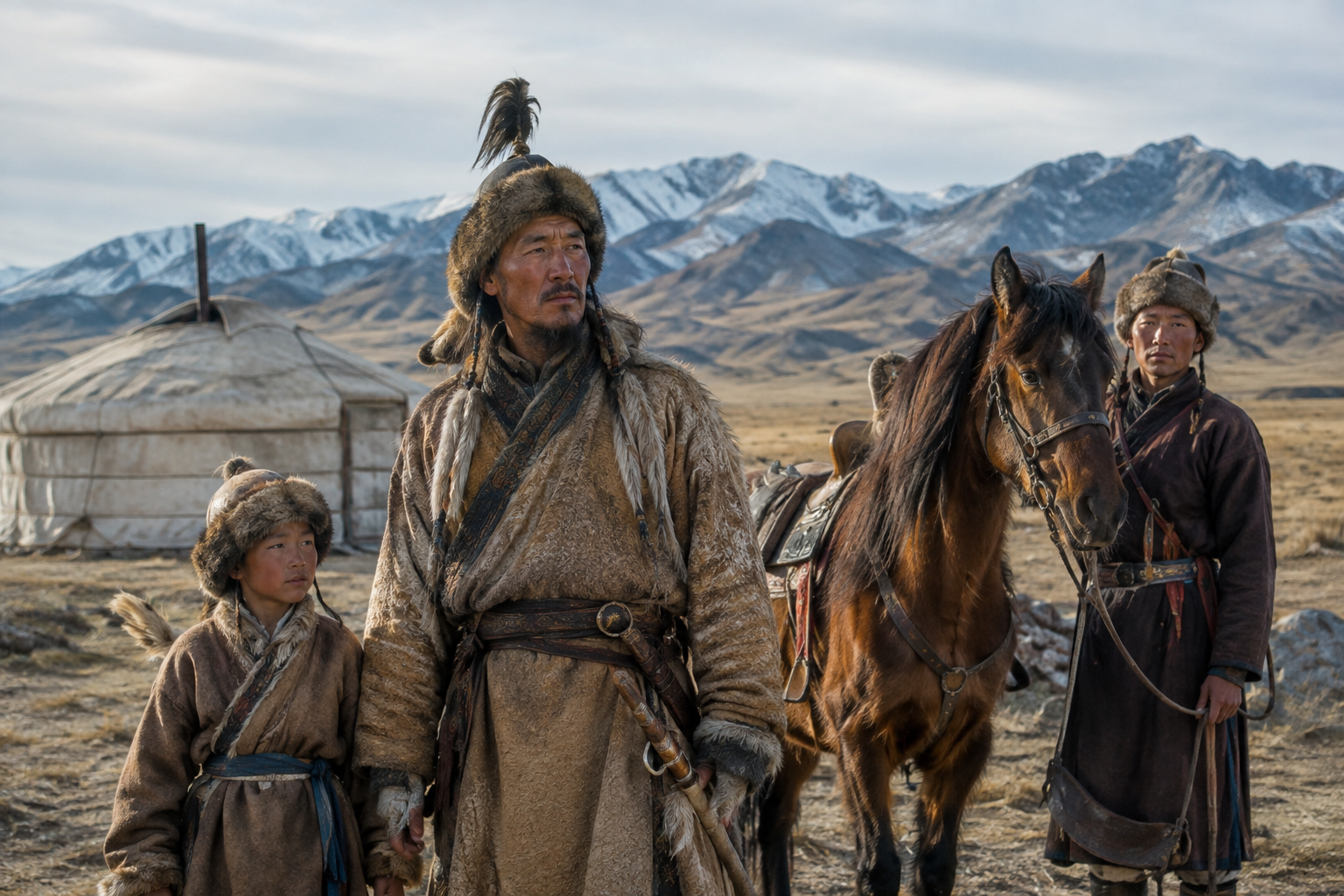
At Tavan Tolgoi in Mongolia, one late medieval burial has an oddly large reach. The individual known as TAV005, dated to about AD 1300 and described as Late Medieval Xiongnu Tavan Tolgoi, carries the Y-DNA haplogroup R1b1a1a1b1. That is immediately striking because this is a paternal lineage usually discussed in the broad story of western Eurasia, yet here it appears in a steppe context tied to Mongolia's long, entangled history of mobility, conquest, and elite exchange.
That does not make TAV005 a simple "European in Mongolia," nor does it let us collapse genetics into ethnicity. Y-DNA traces one direct paternal line only. But one well-placed paternal line can still be historically revealing, and in this case it points us toward a familiar truth of steppe archaeology: the eastern steppe was never sealed off. It was a contact zone, and sometimes a frontier where lineages from very distant worlds met, endured, and were buried under local skies.
The first thing worth saying is that the label attached to TAV005 deserves care. "Late Medieval Xiongnu Tavan Tolgoi" combines a site name with a historical reference that reaches much farther back in time than AD 1300. The Xiongnu were an ancient Inner Asian confederation centered many centuries earlier, whereas this burial is late medieval. In archaeology, such naming can reflect site traditions, regional usage, or database shorthand rather than a literal claim that the buried man belonged to the Xiongnu polity itself.
That matters because the most interesting question is not whether one label can do all the work. It cannot. The interesting question is why a man buried in late medieval Mongolia carried a paternal lineage assigned here as R1b1a1a1b1. Even a single sample like this can help show that Mongolia in the era after the great imperial expansions remained genetically and socially connected to wider Eurasian networks.
R1b is one of the major Y-chromosome branches found across western Eurasia, and many of its sub-branches became prominent in later prehistoric and historic populations from Europe to parts of Central Asia. But the exact label R1b1a1a1b1 is narrower than the parent clade, and good historical method requires restraint. We should not simply paste the whole prehistory of R1b onto TAV005 as if every branch behaved identically in every age.
What we can say more safely is that this paternal line fits a larger pattern in which steppe populations often contain lineages with broad west-east connections. By the late medieval period, such connections could reflect many different processes: older Bronze and Iron Age movements across the steppe, imperial incorporation of diverse groups, military service, marriage alliances, trade-linked mobility, or local descent from lineages that had arrived generations earlier.
In other words, a Y-haplogroup is not a passport stamp. It is better read as one thread in a long male-line history. TAV005 is important precisely because he shows how far such threads could travel, and how thoroughly they could become part of the eastern steppe's human landscape.
By about AD 1300, Mongolia stood in the aftermath of enormous political change. The Mongol imperial world had tied together regions from East Asia to Eastern Europe and the Near East. Armies moved, tribute moved, craftspeople moved, and families moved. In such a world, the appearance of a western-associated paternal branch in Mongolia is not an anomaly to be dismissed; it is the sort of evidence one might expect from a continent-spanning imperial ecology.
That still leaves open the deeper question: was this line a recent arrival in the late medieval period, or part of an older steppe inheritance? The eastern steppe had seen repeated pulses of interaction long before the Mongol Empire. Western steppe-related ancestry and lineages had reached deep into Inner Asia at various times, and later populations often carried highly mixed genetic profiles formed over centuries rather than in one dramatic migration.
A classic ancient DNA study of Eurasian population history, published in Nature, helped establish just how interconnected Bronze Age and later steppe worlds could be. Even without forcing that paper to speak for this exact burial, it offers the larger framework in which a lineage like R1b1a1a1b1 in Mongolia becomes historically intelligible rather than surprising.
Archaeology has been telling us for years that the steppe is bad at staying neatly divided. Material culture travels. Horses and herds make distance workable. Political confederations gather people who did not start in the same place. Ancient DNA has sharpened that picture by showing, again and again, that Inner Asia hosted populations with varied ancestry profiles and shifting paternal lineages.
TAV005 belongs naturally in that picture. A late medieval man from Tavan Tolgoi with haplogroup R1b1a1a1b1 does not stand for all Mongolians, all steppe peoples, or all men buried at the site. What he does offer is direct evidence that one paternal line with deeper west Eurasian associations was present in a Mongolian burial context at this date.
That is exactly the kind of finding that stops us from telling overly tidy stories. It reminds us that the steppe was not merely a highway across Eurasia; it was also a place where lineages could settle, persist, and be folded into new political and cultural settings.
For someone researching haplogroup R1b1a1a1b1 today, TAV005 is valuable not because he provides a complete origin story, but because he widens the map. He shows that this branch, or a reported association with it, appears in late medieval Mongolia and therefore belongs in a Eurasian rather than narrowly regional conversation. The paternal past of R1b branches is often discussed through western Europe or the Pontic-Caspian steppe; TAV005 insists that eastern steppe history also belongs in view.
That is especially useful in genealogical thinking, where people can be tempted to treat a haplogroup as culturally exclusive. Ancient DNA keeps spoiling that habit. A lineage may have one deep history, but the men who carried it could end up in very different worlds: pastoral confederations, trading corridors, frontier garrisons, imperial retinues, or settled communities far from where modern expectations would place them.
The most responsible way to read haplogroup R1b1a1a1b1 here is also the most interesting. TAV005 from Tavan Tolgoi does not give us a neat ethnic label or a one-line migration route. He gives us something better: a documented late medieval man in Mongolia whose direct paternal line links him to the wider traffic of Eurasian history. In a region shaped by confederations, long-distance alliances, and imperial movement, that is not a footnote. It is the point.
If this is your haplogroup, the ancient evidence suggests a paternal story that can reach well beyond modern national borders. Not a single origin myth, but a steppe-sized history of movement, persistence, and unexpected placement.
Comments