Haplogroup I1a2a2a3
– 5 min read


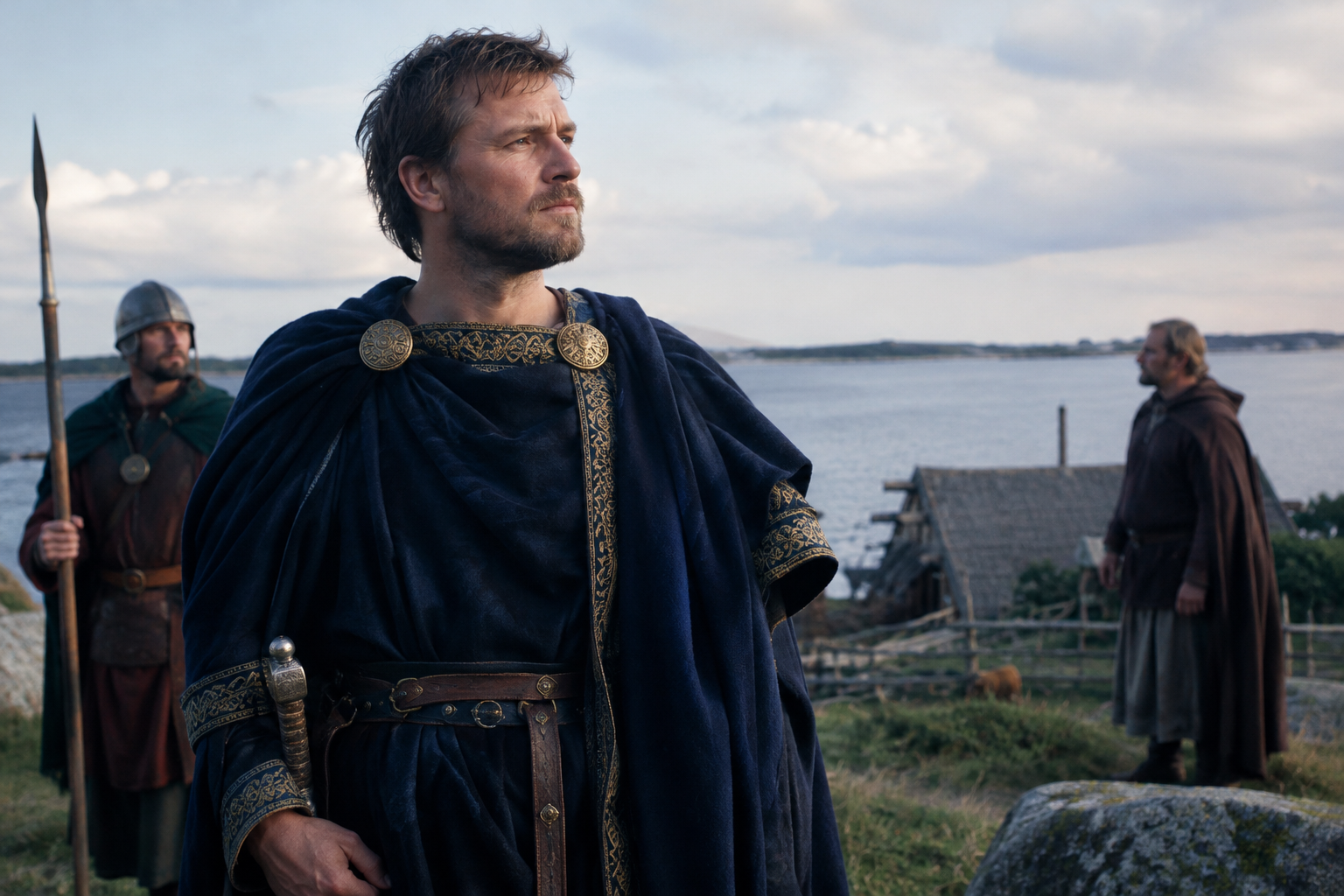
At Brøndsager in Denmark, one Late Roman Age burial has become an unexpectedly useful signpost for the paternal history of northern Europe. The individual known as VK521, dated here to around AD 290, is described as a noble from Torsiinre near Brøndsager. That alone would be interesting enough. But for men researching the Y-DNA haplogroup I1a2a2a3, the real importance is that this burial places a line associated with that branch in a firmly Scandinavian setting during the last centuries of Roman power.
That matters because I1 is one of the best-known northern European Y-chromosome lineages, yet every smaller branch has its own, narrower history. Y-DNA follows one direct paternal line only: father to son to son. It does not describe a person's whole ancestry, culture, or language. Even so, when a sub-branch like I1a2a2a3 appears in an ancient burial from eastern Denmark, it gives us something far better than legend: a man, a place, and a date.
The Brøndsager area belongs to a Denmark that was outside the Roman Empire yet deeply entangled with it. By the third century AD, southern Scandinavia was not an isolated fringe. Goods, styles, and probably people moved across the Baltic and along the North Sea coast, while local elites developed their own forms of authority. A burial identified as noble suggests social rank within that world, though it does not license us to invent a biography for VK521.
What makes the sample so valuable is its timing. Around AD 290, Europe was living through the later Roman imperial period, but Scandinavia was following its own political and social rhythms. A paternal lineage associated with I1a2a2a3 in this context sits comfortably within a broader pattern often seen in ancient DNA: many branches of I1 appear repeatedly in Germanic-speaking northern Europe, especially in southern Scandinavia and adjacent regions, long before the Viking Age gave those regions their most famous historical profile.
A genetic study connected with ancient Scandinavian populations and wider northern European patterns is available at https://www.biorxiv.org/content/10.1101/703405v1. Even where one specific terminal assignment must be treated cautiously, the broad archaeological picture is clear enough: lineages within the I1 world were already well established in Denmark during late antiquity.
The temptation with a long haplogroup label is to treat it like a ready-made ethnic badge. That is precisely what it is not. I1a2a2a3 is a fine-grained branch nested within the wider I1 paternal tree. The wider tree is strongly associated with northern Europe, especially Scandinavia, but that does not mean every branch had the same distribution, date, or historical role.
So the safest historical reading is a modest one. This branch, or a line reported as belonging to it, appears in a high-status Danish context in the Late Roman Age. That anchors the lineage in a region central to later Germanic-speaking history, without claiming that every bearer was a warrior, a chieftain, or part of a single tribe. Ancient DNA is at its best when it narrows the map rather than writes a saga.
For many readers, Scandinavian paternal history begins with longships. Archaeology is less theatrical and much more revealing. Southern Scandinavia had already spent centuries developing elite networks, regional identities, and cross-sea connections before the first Viking raids recorded in western chronicles. A lineage found in Denmark around AD 290 belongs to that deeper pre-Viking world.
That world helps explain why I1 branches matter so much in later northern European history. The men carrying such lineages were living in societies that would eventually feed into the migrations, trading systems, and state formation of the early medieval north. But it would be wrong to leap straight from one Danish burial to a single migration narrative. The real lesson is continuity of presence: a paternal line connected with I1a2a2a3 was already there in a meaningful social setting centuries before the Viking Age.
Status labels in archaeology should always be handled carefully. Still, when a burial is described as noble, it tells us that the individual was not just any anonymous male sample pulled from the landscape. He belonged to a stratum of society visible enough in death to attract later attention and modern classification. In practical terms, that makes VK521 a useful reminder that lineages associated with I1a2a2a3 were not confined to some invisible rural margin.
That does not mean the haplogroup itself was aristocratic. Haplogroups are inherited biological lines, not titles. Yet a high-status context can show how a paternal lineage sat inside real historical structures: family, inheritance, landholding, alliance, and rank. In late Roman Denmark, those structures were becoming increasingly important as local elites consolidated power.
Eastern Denmark was part of a maritime zone, not a sealed peninsula. The Baltic linked communities as much as it separated them, and southern Scandinavia maintained contacts with the North Sea coast, the lower Elbe region, and lands farther south. That broader setting makes it unsurprising that lineages rooted in Scandinavia would later appear in areas touched by migration-period and early medieval movements.
But here we must keep categories straight. A Y-chromosome branch is not the same thing as language spread, cultural style, or political expansion. The presence of I1a2a2a3 in a Danish burial does not, on its own, prove a specific migration route into Britain, Germany, or elsewhere. What it does provide is a plausible northern anchor for paternal ancestry that later family lines may still preserve.
One sample can never stand for a whole people. Even so, ancient DNA works cumulatively. A burial like VK521 becomes more informative when set beside the growing body of evidence from Scandinavia and the Germanic-speaking north showing recurrent I1-associated paternal lines across later prehistory and early history. The value of this Danish case lies in its combination of region, date, and status.
It also helps that Denmark has become one of the most important laboratories for ancient population history. Work on the country's deeper prehistory has shown just how much change and continuity can coexist in the same landscape over millennia. By the Late Roman Age, communities there were heirs to very long local histories, even as they engaged with a changing European world.
For someone exploring the haplogroup I1a2a2a3, the most distinctive point here is simple and solid. A line associated with this branch appears in Late Roman Age Denmark, in the person of VK521 from Brøndsager, around AD 290, and in a socially prominent setting. That does not turn every modern match into a descendant of one noble house or one ancient chieftain. But it does place this paternal line within the old Scandinavian heartland, in a period when local elites were already shaping the northern world that later history would call Germanic and, eventually, Viking.
Comments