Haplogroup Q1b1a3a1a
– 5 min read


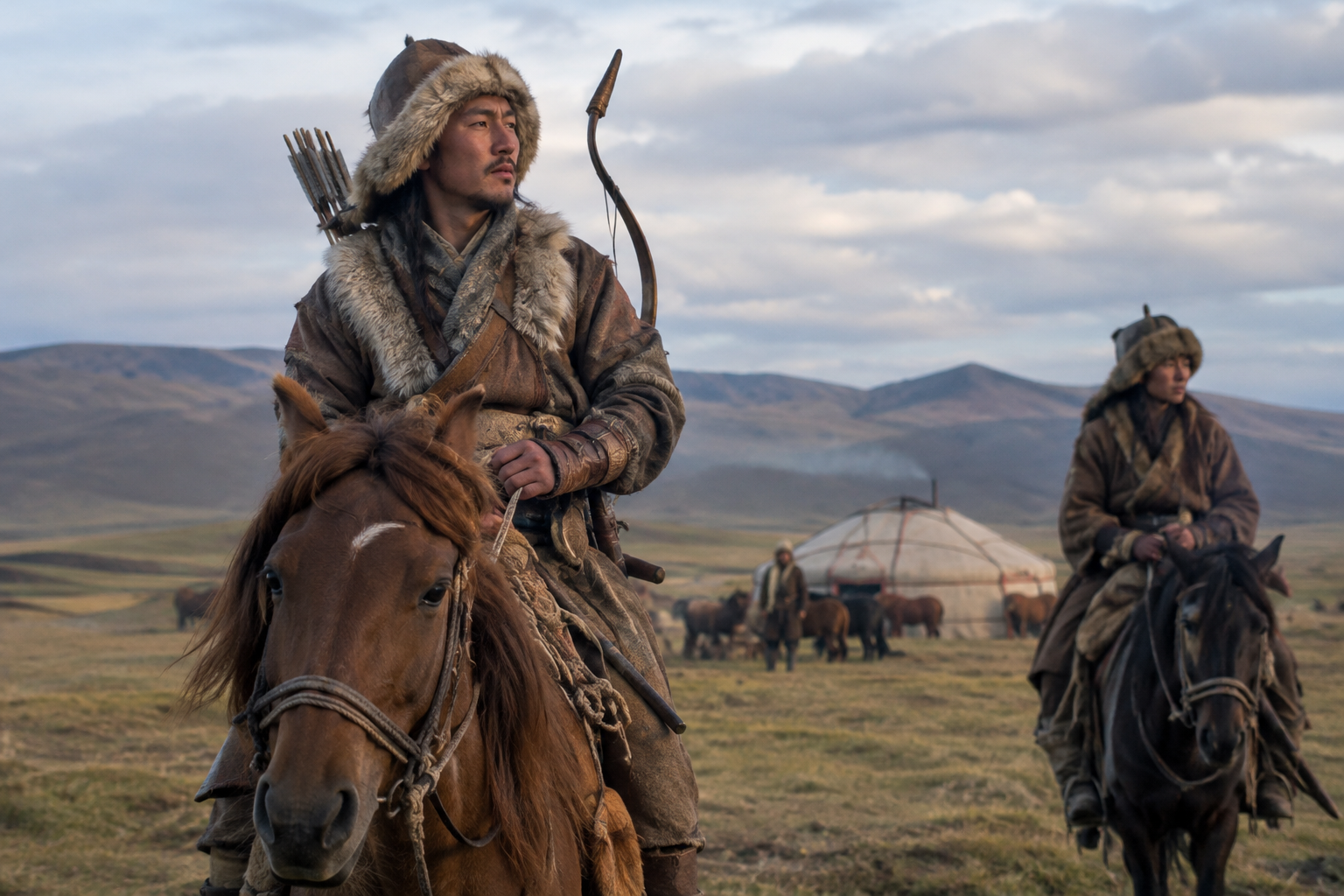
One of the clearest ancient signposts for the Y-DNA haplogroup Q1b1a3a1a in this material comes from a man labelled DEL001, dated to around AD 25 in Late Xiongnu Mongolia. That is already enough to make him interesting. He belongs to a world that sat between imperial China, the eastern steppe, and the great mobile confederations that shaped Inner Asian history, and his paternal line places him inside a branch of haplogroup Q that is especially relevant to the deep history of northern and eastern Eurasia.
It is worth saying at once what that means, and what it does not. Y-DNA tracks one direct paternal line only: father to son to son across generations. It is not the same thing as a person's whole ancestry, language, or political identity. But when a lineage such as Q1b1a3a1a turns up in a securely dated archaeological context like Late Xiongnu Mongolia, it gives us a precise little peg on which to hang a much larger historical question: how were paternal lines distributed across the eastern steppe at the moment when old Bronze and Iron Age populations were being drawn into powerful new confederations?
The Xiongnu loom large in Eurasian history, often as seen through hostile or anxious outside observers. Chinese texts describe them as formidable steppe rivals; later historians have long debated how far Xiongnu political traditions fed into other Inner Asian empires. Ancient DNA has changed that discussion by showing that the Xiongnu were not a biologically uniform people but a confederated population with striking diversity.
Within that setting, DEL001 matters because he anchors Q1b1a3a1a in Mongolia during the late Xiongnu period, around the early first century AD. This is not simply a curiosity of classification. It shows that one branch of haplogroup Q was present among populations participating in the political and social world of the eastern steppe at a time of major imperial competition and mobility.
A widely cited ancient DNA study on the genetic history of the Mongolian steppe helped establish just how varied steppe populations were across time, including the Xiongnu horizon; the broader research framework can be followed through this supporting research link. The important point for readers is not that one haplogroup "defines" the Xiongnu. Quite the reverse: DEL001 is valuable because he sits inside a mosaic, reminding us that steppe empires were built from many lineages rather than one tidy paternal bloc.
Haplogroup Q is an old and widespread paternal lineage with deep roots in northern Eurasia and an especially important place in the peopling histories of Siberia and the Americas. But that broad statement applies to the parent haplogroup Q, not automatically to every later sub-branch. The article haplogroup here is the much narrower Q1b1a3a1a, and caution matters. A modern tester with this lineage should not assume that every ancient Q-bearing man was part of the same recent paternal history.
What we can say more carefully is that a branch this specific belongs in an eastern Eurasian and Inner Asian story more than a medieval western European one. The Late Xiongnu sample suggests that this paternal line, or a very close ancestral branch, circulated in populations of Mongolia during the early centuries around the turn of the era. That is historically meaningful because Mongolia in this period was not a cul-de-sac. It was a crossroads of herders, traders, political clients, war bands, and families moving within expanding steppe networks.
That matters for family historians. If your paternal line is Q1b1a3a1a, the value of an ancient match like DEL001 is not that it names your ancestor, still less that it ties you to a famous ruler. Its real value is that it places your lineage within a documented archaeological world: the eastern steppe, the Late Xiongnu period, and the turbulent centuries in which Inner Asian populations were being reorganised on a grand scale.
There is a temptation, whenever a steppe sample carries a striking lineage, to leap straight to dynasties and conquering tribes. Archaeology is much less obliging than that. The Late Xiongnu were politically coherent at times, but genetically they appear heterogeneous. That is exactly what one might expect from a confederation drawing in different groups across a large landscape.
So DEL001 should be read as evidence of presence, not of monopoly. He shows that Q1b1a3a1a was part of the paternal repertoire of the late Xiongnu-era population in Mongolia. He does not prove that all Xiongnu men belonged to this branch, nor that this branch marked a ruling house, nor that every later Q-lineage in Central or East Asia descends through a neat historical chain from Xiongnu elites.
This is where ancient DNA is at its most useful and, frankly, most refreshing. It punctures the old habit of imagining whole peoples as genetically uniform. The steppe was full of mixture, recruitment, alliance, and replacement. A single Y-line can survive inside that churn for centuries, but it survives as one thread among many.
To understand why this single sample is still worth attention, it helps to set Mongolia in its longer regional frame. The eastern steppe had already seen millennia of population movement before the Late Xiongnu period: Bronze Age pastoral expansions, contacts with farming zones to the south, and later Iron Age political consolidation. By the first century AD, the region was tied into exchange systems stretching from northern China to the Altai and beyond.
In such a setting, paternal lineages could spread in several ways. Some lines expanded with successful local families. Others moved through incorporation of outside groups. Still others persisted quietly within communities for generations before appearing in the skeletal record by chance. That is why archaeological context is so important. DEL001 is not just a label in a tree. He is evidence that this branch was living in Mongolia in a specific historical horizon, among people enmeshed in one of Eurasia's most consequential steppe confederations.
Readers interested in how ancient paternal histories in East Asia are being reconstructed more generally may also find it useful to look at broader discussions of ancient Y-chromosome patterns and movement across the region, because these studies increasingly show that no single branch maps neatly onto one language family or one empire.
At first glance, one ancient individual may seem a thin basis for an article. In fact, ancient DNA often works like that. History is built not only from grand cemeteries and royal tombs, but from the patient accumulation of securely dated people in recognisable places. DEL001 gives Q1b1a3a1a a firm archaeological foothold in Late Xiongnu Mongolia, and that is more valuable than a hundred airy internet claims about legendary ancestors.
It also gives the lineage a setting that matches what many researchers now see in Inner Asia: repeated population mixing, shifting political identities, and local continuities folded into wider imperial structures. Haplogroups travel through households and male lines, but they do so inside societies that are constantly changing. The man behind DEL001 lived in precisely that kind of world.
For someone researching a present-day paternal line, Q1b1a3a1a currently points most clearly toward a northern or eastern Eurasian background rather than a specifically western one, and the appearance of DEL001 in Late Xiongnu Mongolia shows that this branch was present in the eastern steppe by around the early first century AD. That does not make every bearer "Xiongnu", but it does place the lineage inside a real and important archaeological landscape: the mobile, mixed, politically inventive world of ancient Mongolia.
That is often the most useful thing ancient DNA can do. It does not hand you a legendary pedigree. It gives you a documented horizon in which your paternal line was already alive, moving through history with ordinary men whose bones, at rare moments, still let us hear their names in the language of genetics.
Comments