Haplogroup I1a2a1a1d1a1b2a1a
– 5 min read


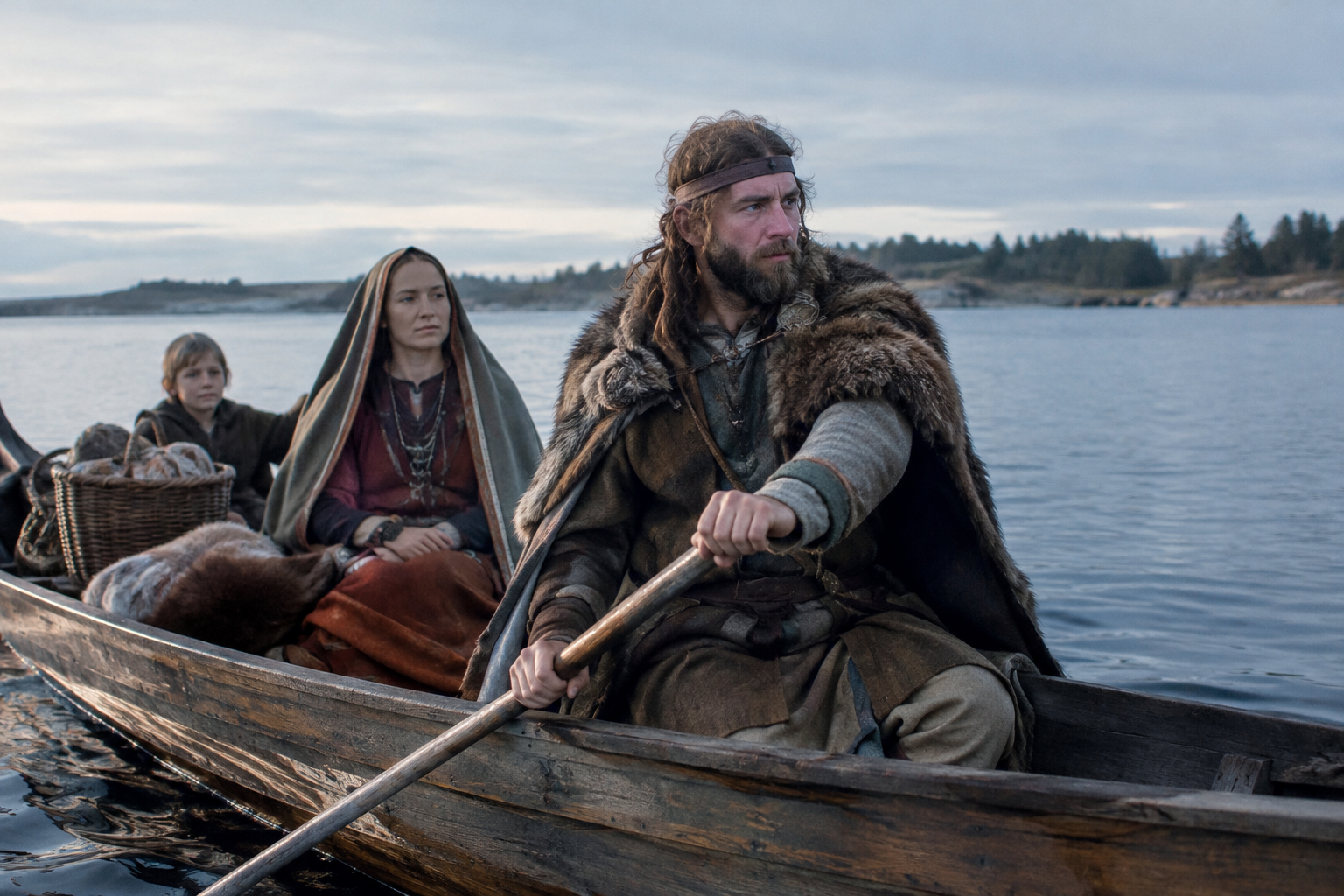
In around AD 725, a man identified as VK552 was laid to rest at Salme II on Saaremaa, the large Estonian island that sits like a gatekeeper in the eastern Baltic. He belongs to the remarkable Salme ship-burial horizon, one of the most arresting finds of the Vendel Age: armed men buried in a maritime setting far from the Scandinavian heartlands usually associated with such elite warrior customs. For anyone tracing the Y-DNA haplogroup I1a2a1a1d1a1b2a1a, this is where the story becomes properly historical rather than merely abstract.
That long string of letters and numbers marks a very specific paternal branch nested inside the broader haplogroup I1, a lineage strongly associated with northern Europe. Y-DNA follows one direct male line only, so it does not define a person's whole ancestry, language, or identity. But when a branch appears in an excavated individual from a site as vivid as Salme, it gives us something much better than generalisation: a real man, in a real place, in a world of Baltic seaways, raiding, retinues, and long-distance contacts.
The Salme discoveries are important because they sit at the meeting point of archaeology, history, and mobility. Saaremaa was not some remote backwater. In the 7th and 8th centuries AD, the eastern Baltic was tied into the same maritime networks that linked Sweden, Finland, the Gulf of Riga, and beyond. A burial at Salme II therefore speaks not only to where a man died or was buried, but to the traffic of people, conflict, and alliance moving across the sea.
VK552, dated here to about AD 725, is associated with that world. The haplogroup assignment connects him to the article's branch, I1a2a1a1d1a1b2a1a, but it is worth being careful: the wider historical importance lies first in the site and period, and only then in the fine-grained terminal label. Very precise subclades are useful for paternal matching, yet the broader setting tells us why this lineage matters archaeologically.
An ancient DNA study investigating these northern European populations helped place such individuals into a bigger genetic picture of early medieval mobility and Scandinavian-linked expansion across the North and Baltic seas. The relevant research trail for this sample is linked through this ancient DNA study, which has often been discussed in connection with the spread of Germanic-speaking groups and their varied local interactions.
The broader haplogroup I1 turns up again and again in discussions of Iron Age and early medieval Scandinavia. That does not mean every I1 branch has the same history, nor that every man carrying it was a "Viking" in the later popular sense. What it does mean is that when a sub-branch like I1a2a1a1d1a1b2a1a appears at Salme II, it fits plausibly into a northern European paternal landscape already visible in early medieval burials and later Viking Age movement.
The chronology matters here. Salme belongs to the Vendel Age, just before the conventional Viking Age begins in AD 793. That makes VK552 especially useful. He stands in that slightly earlier world from which Viking Age raiding and sea-borne warrior culture emerged. If your paternal line falls into this narrow branch, Salme offers evidence that at least one bearer of a related line was present in this formative Scandinavian-Baltic military milieu.
And this is exactly the sort of correction archaeology likes to make to tidy historical storytelling. Rather than imagining a single great migration or one neat ethnic block, sites like Salme show a mobile northern world full of contacts, rivalries, and local complications. A haplogroup can point to continuity in paternal descent, but the burial context shows that the men who carried such lineages were participants in a connected, contested seascape.
One of the most useful things about Salme is its location. Saaremaa lies between Scandinavia and the eastern Baltic mainland, in a region that later sagas and chronicles would remember as strategically important and often violent. The men buried there were not simply "from Estonia" or "from Sweden" in any simple modern national sense. The site instead belongs to a zone where Scandinavian-style martial culture met Baltic geography.
That matters for interpreting I1a2a1a1d1a1b2a1a. A lineage found at Salme should not be lazily mapped onto a modern border. Early medieval paternal lines moved with crews, households, traders, mercenaries, and raiders. A man buried on Saaremaa may have been local to a wider Baltic-Scandinavian circuit rather than to a single political homeland.
Recent MyTrueAncestry readers who want more on this regional picture may find it useful to compare evidence from nearby northern waters and Baltic-facing societies.
Salme is also valuable because it sits before the full documentary glare of later medieval kingdoms. We are not yet dealing with fixed dynasties, heraldry, or well-recorded noble houses. Instead, we see the harder archaeological evidence of mobile armed groups and maritime status. That makes the genetic result more interesting, not less. It anchors this branch in a time when power travelled by ship and reputation was built across sea-lanes.
Broader Scandinavian genetic studies have repeatedly shown that the north was never isolated. Even where paternal lines look regionally persistent, the people carrying them often lived in mixed and changing communities. In that sense, VK552 is a good reminder that a direct paternal branch can endure while the surrounding ancestry, alliances, and identities shift around it across generations.
For descendants researching this haplogroup today, that is the historically responsible point. A branch such as I1a2a1a1d1a1b2a1a may connect you to a paternal line present in the Scandinavian-Baltic sphere in the early 8th century, but it does not by itself certify one famous tribe, one royal house, or one national story. What it does offer is a firmer foothold in the real human geography of the northern seas.
A single ancient match is never the whole argument, but some single ancient matches are far more evocative than others. VK552 is one of them because Salme II is not an anonymous cemetery find. It comes from a site that has become central to discussions of pre-Viking and early Viking maritime society in the Baltic. In practical terms, that means this haplogroup is not floating in the air; it is attached to a documented early medieval context of movement, warfare, and northern sea connections.
There is also a useful chronological lesson here. If a branch linked to I1a2a1a1d1a1b2a1a appears in AD 725 on Saaremaa, then this paternal line was already part of the eastern Baltic's Scandinavian-facing world before the classic Viking Age raids of western Europe entered the history books. That does not tell us where the branch first arose, nor does it reduce it to one people. But it does place it firmly in the northern European orbit from which later Viking Age expansions developed.
The clearest insight from I1a2a1a1d1a1b2a1a is not a grand claim of dynasty, but something more solid: this paternal branch is linked, through VK552, to the seaborne warrior world of Vendel Age Saaremaa around AD 725. That places it in a northern Baltic setting shaped by Scandinavian connections, mobility, and conflict before the Viking Age became a textbook label. For someone exploring this haplogroup today, Salme offers a rare gift from ancient DNA: not myth, but a documented foothold in one of early medieval Europe's most dynamic maritime frontiers.





Comments