Haplogroup I1a1b1a1c1
– 5 min read


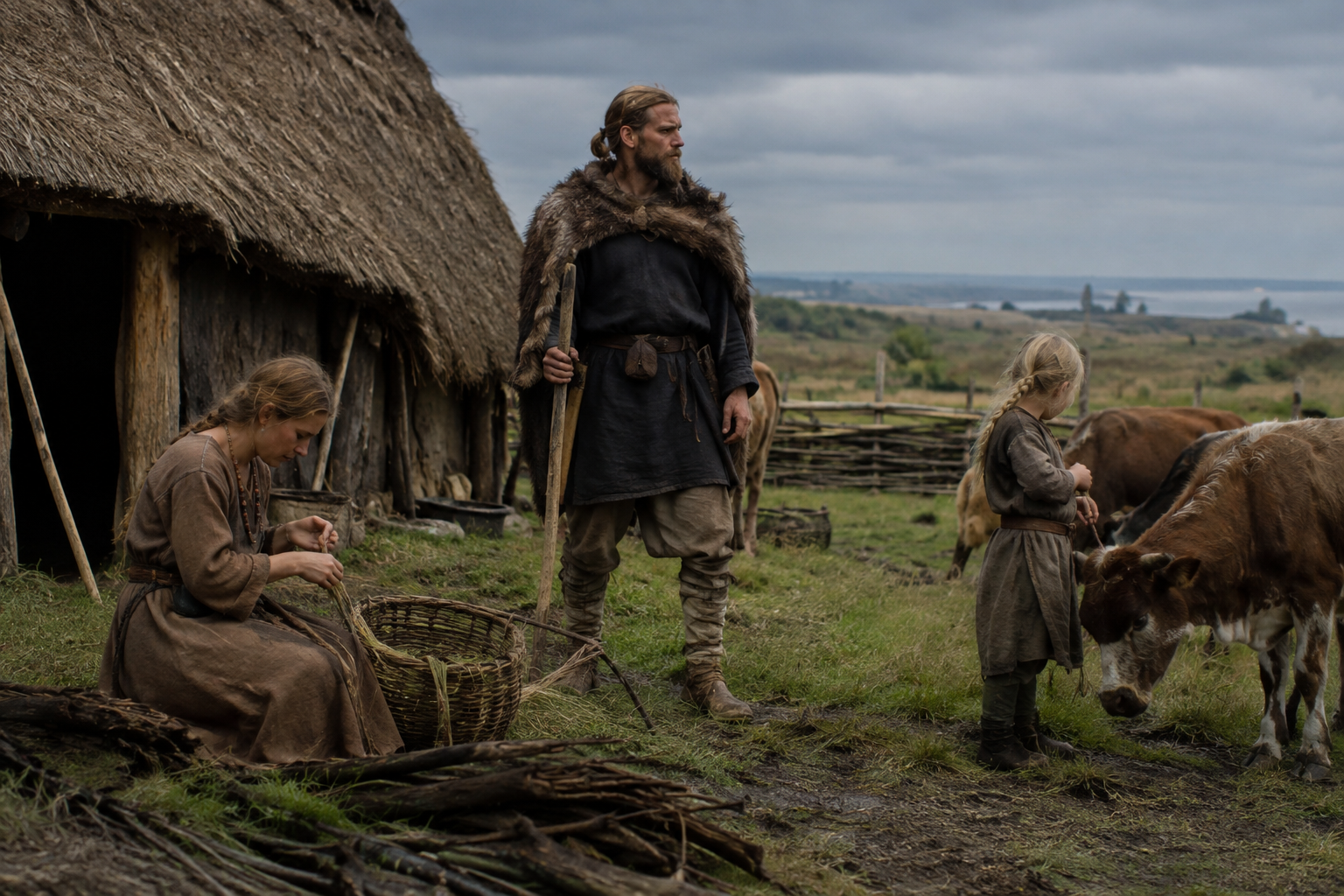
At Tollemosegard in Denmark, one excavated individual offers a small but telling glimpse into the paternal history of early medieval Scandinavia. The sample identified as VK70, dated to around AD 700, is associated here with the Y-DNA haplogroup I1a1b1a1c1 - a very specific branch within the wider I1 lineage that is strongly tied to northern Europe and especially to Scandinavia in both modern and ancient genetic studies.
That date matters. Around AD 700, Denmark stood on the threshold of the Viking Age, but it was not yet the world of the great raiding fleets familiar from later chronicles. It was a landscape of regional power, shifting identities, and long-established local communities. A paternal lineage like I1a1b1a1c1 in this setting is not a grand historical slogan; it is a clue anchored in one real man from a real Danish site, living in a period when Scandinavian populations were already shaping the genetic background of the North Sea world.
The most solid starting point for this haplogroup is therefore not a mythic founder, but VK70 from Late Iron Age Denmark. Even with limited contextual detail, the sample's location and date place him in a society that sat between the older Iron Age order and the better documented Viking centuries to come. That is exactly the kind of moment ancient DNA handles well: not the telling of sagas, but the reconstruction of continuity, population structure, and movement beneath them.
In practical terms, Y-DNA follows one direct paternal line only - father to son across generations. It does not describe a person's whole ancestry, culture, or language on its own. But when a branch like I1a1b1a1c1 appears in a Danish individual of around AD 700, it fits a wider pattern in which I1 lineages are deeply embedded in the demographic history of southern Scandinavia.
A broader ancient DNA study of Scandinavian populations, available at https://www.biorxiv.org/content/10.1101/703405v1, helped frame exactly this kind of question: how the people of the Nordic Iron Age and Viking Age were related to one another, and how their ancestry connected to later movements around the Baltic and North Sea.
Germanic languages and genomics
The wider haplogroup I1 is one of the best-known paternal lineages in Scandinavia today, and it appears repeatedly in ancient northern European material from later prehistoric and early medieval contexts. The branch named here, I1a1b1a1c1, is much narrower. That distinction is important. We can discuss the broad Scandinavian character of I1 with some confidence, but we should be more careful with the exact historical range of this precise subclade unless a study specifically resolves it to that level.
So what can be said responsibly? First, the Tollemosegard result places this paternal line in Denmark by the late Iron Age. Second, it shows that lineages ancestral to or associated with this branch were present before the classic Viking expansion of the ninth to eleventh centuries. In other words, if your own paternal line falls under I1a1b1a1c1, the most secure historical picture is not of a single dramatic migration, but of a lineage rooted in the older population history of Scandinavia.
That matters because public imagination often jumps straight from "Scandinavian" to "Viking raider." Archaeology is usually less theatrical and more interesting. By AD 700, Danish communities were already part of a mature northern world of farms, exchange networks, elite sites, craft production, and maritime communication. A Y-line found there belongs to that full social landscape, not just to the later age of ships in the chronicles.
The centuries around VK70's lifetime were formative ones in Danish history. Political centralization was uneven, but southern Scandinavia was increasingly connected through trade, warfare, and elite competition. Material culture from this period shows both regional variation and broader links across the Danish islands, Jutland, and southern Sweden. A paternal lineage surviving in this setting may reflect long local continuity just as much as mobility.
This is one of the useful correctives offered by archaeogenetics. Ancient DNA does not merely track newcomers; it also reveals who stayed. In Denmark, that question reaches much further back than the Iron Age, into the deep population shifts of the Mesolithic, Neolithic, and Bronze Age. By the first millennium AD, the inhabitants of the region already represented the outcome of many earlier transformations, cultural as well as genetic.
That longer Danish background is worth keeping in view. It stops us from turning one late Iron Age Y-chromosome into a simplistic ethnic badge. The man behind VK70 was not a walking haplogroup. He was a person living in a community with its own local history, shaped by generations of ancestry from many lines, maternal and paternal alike.
Even so, the timing of VK70 is suggestive. Around AD 700, Scandinavian maritime links were becoming ever more important. The North Sea and Baltic were not barriers but roads. Over the next few centuries, people from Denmark and neighboring regions would travel, settle, trade, and fight across Britain, Ireland, the Frankish coast, the Baltic east, and the North Atlantic islands.
For lineages within I1, this later expansion helps explain why Scandinavian-associated paternal branches can appear widely across northern Europe in later periods. But the Tollemosegard sample is useful precisely because it predates the famous outward surge. It gives us a firmer homeland context: this branch is not merely "Viking abroad," but part of the population substrate within Scandinavia itself.
That broader historical pattern also helps connect genetic findings to language history. The spread and consolidation of Germanic-speaking populations around the North and Baltic Seas cannot be reduced to one haplogroup, of course, but paternal lineages like I1 are frequently part of that northern European story.
North Sea migrations to Britain
There is a temptation, with ancient DNA, to assume that one sample is too little to say anything useful. But archaeology often advances through exactly such modest anchors. A securely dated individual from a known region can fix a lineage in time and place more effectively than pages of speculation.
Here, VK70 does three important things. It places an I1-associated paternal line in Denmark around AD 700. It links the branch to a pre-Viking or threshold-Viking Scandinavian context rather than a later romanticized diaspora alone. And it reminds us that the population history of the north was already well established before the Viking Age became visible in written sources.
As more Scandinavian burials are genetically resolved at finer levels, branches such as I1a1b1a1c1 will become easier to map in detail. For now, this is a cautious but meaningful historical placement: a paternal line tied to the old societies of Denmark at a pivotal moment in northern Europe's history.
The clearest lesson of haplogroup I1a1b1a1c1 here is not grandeur but placement. Its presence in VK70 at Tollemosegard shows this paternal branch in Denmark at about AD 700, in the living world that immediately preceded the better known Viking centuries. For anyone researching this line today, that is a valuable sort of connection: not a fantasy pedigree, but a historically grounded northern context in which this paternal ancestry was already at home.





Comments