Haplogroup R1a1a1b1a3a1a7
– 5 min read


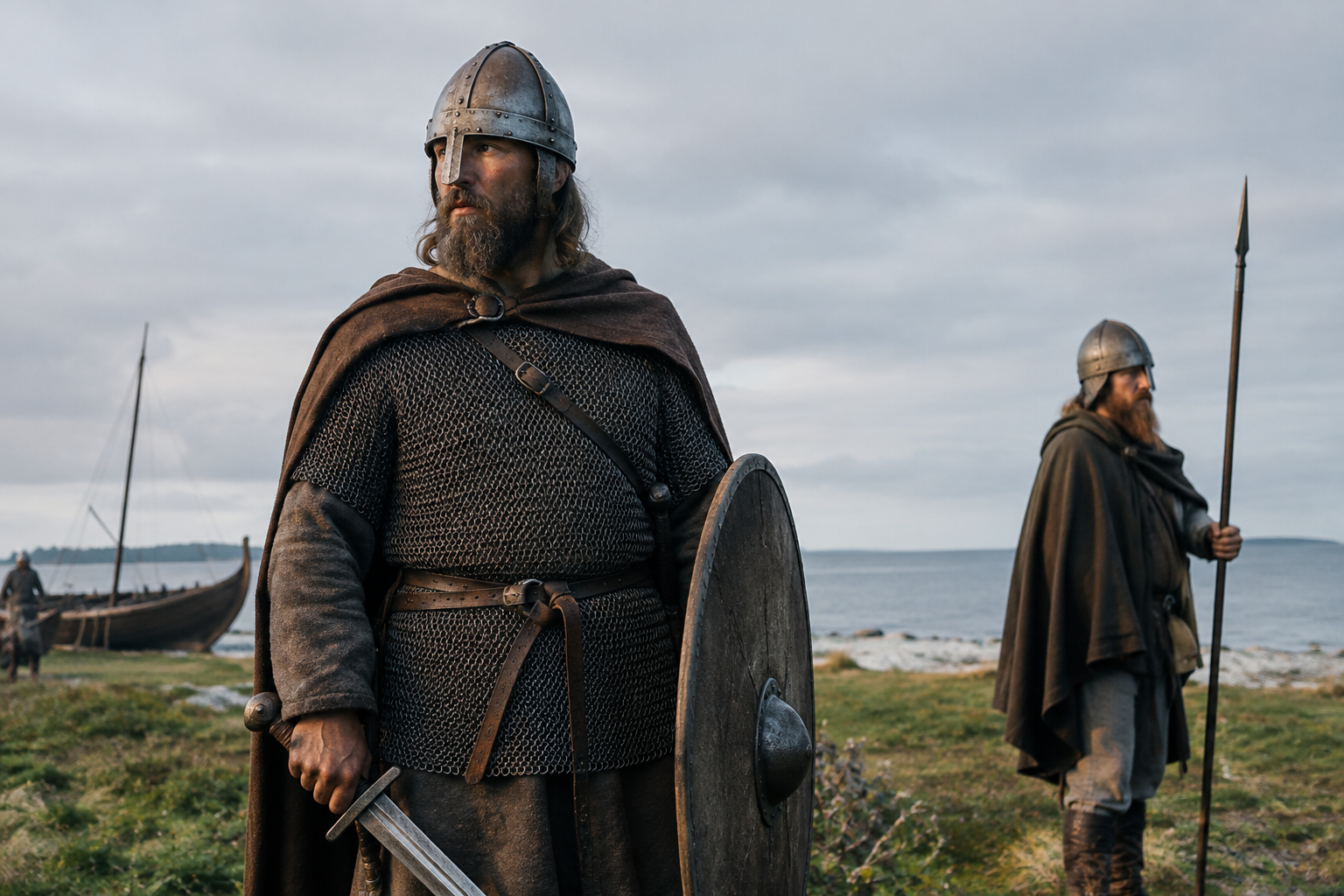
In around AD 725, a man now known to researchers as VK493 was buried at Salme on the island of Saaremaa in Estonia. He belongs to the remarkable Salme II boat burial, one of the most discussed warrior graves from the eastern Baltic, because it captures a moment when Scandinavia and the Baltic world were bound together by movement, violence, and seaborne ambition. In this case, the paternal line reported for the article is R1a1a1b1a3a1a7, a very specific branch nested within the broader and much older R1a family.
That matters because Y-DNA follows one direct paternal line only: father to son across generations. It does not describe a person's whole ancestry, still less his language or identity on its own. But at Salme, where archaeology and ancient DNA meet in unusually vivid fashion, even one paternal line can help place an individual inside the human realities of the Vendel Age and the world that fed into the Viking Age.
The Salme finds are important not because they offer a neat legend, but because they are stubbornly archaeological. These were real dead from a real episode on Saaremaa, dated to the late 7th or early 8th century, and VK493 belongs to that horizon at about AD 725. The site has become central to discussions of pre-Viking and early Viking mobility across the Baltic, especially contacts linking eastern Sweden and the islands and coasts beyond.
For this article's branch, the key point is modest but significant: a man associated with Salme II is reported with R1a1a1b1a3a1a7. That does not mean the whole burial group shared the same direct paternal ancestry, nor that one haplogroup can explain the expedition. What it does show is that this narrow R1a branch had reached, or was present within, a Scandinavian-Baltic warrior context by the Vendel Age.
An ancient DNA study examining these burials and the broader Scandinavian world is linked here in research on ancient genomics and early northern European population history. Even without squeezing more from the paper than the evidence allows, the Salme context is enough to make VK493 a compelling anchor for this haplogroup.
Early Medieval Baltic Connections
The unwieldy name R1a1a1b1a3a1a7 tells you something at once: this is not the broad, headline-grabbing level of R1a often discussed in popular genetics. It is a downstream branch, one twig on a very large paternal tree. That distinction is crucial. The history of R1a as a whole stretches across enormous parts of Eurasia and many periods, but that wide history cannot simply be poured into this narrower subclade as though they were the same thing.
Still, the Salme evidence gives this branch a useful historical setting. By the 8th century, the Baltic was not a fringe. It was a corridor. People, goods, styles, and fighting groups moved between eastern Scandinavia, the islands of the Baltic, and the mainland shores around them. A lineage like R1a1a1b1a3a1a7 appearing in this environment fits a world of regional entanglement rather than isolation.
That is especially worth stressing because genetic lineages are often mistaken for ethnic badges. They are not. A man carrying this branch could belong to a community shaped by local ancestry, foreign contacts, marriage networks, fosterage, raiding, trade, or all of them together. Salme is interesting precisely because it resists tidy labels.
Saaremaa lies in a strategic position in the eastern Baltic. To modern eyes it can look peripheral on a map; to early medieval sailors it was anything but. Islands like this were staging posts, meeting points, and sometimes killing grounds in a maritime world that was already dense with connections before the classic Viking Age raids known from western Europe.
That setting helps explain why a lineage such as R1a1a1b1a3a1a7 at Salme matters more than a single technical assignment in a database. It places one paternal line in a frontier zone where Scandinavian expansion, Baltic interaction, and local political competition overlapped. In other words, this is not just a random old skeleton with a long genetic label. It is one thread from a place where history was happening at sea level, quite literally, between coasts.
The broader linguistic and demographic background to this northern world is explored in MyTrueAncestry's piece on the spread of Germanic languages using ancient genomics, which helps frame the larger setting without pretending that language and Y-DNA are the same thing.
Germanic Languages and Genomics
One of the most attractive things about Salme is that it sits on the threshold of an era. The classic Viking Age is often dated from the late 8th century, but the people buried at Salme belong to the world that made that later expansion possible. They show organized seaborne movement, martial retinues, and Baltic-range contacts already in operation.
So when VK493 is associated with R1a1a1b1a3a1a7, the branch enters history not in abstraction but in motion. We are not looking at a lineage pinned to a static homeland in some timeless way. We are seeing it in a man caught up in the traffic of the northern seas during the Vendel Age, when eastern Sweden and the Baltic islands were deeply entangled.
This is also where caution improves the story rather than flattening it. We do not need to claim that this branch was uniquely Scandinavian, uniquely Baltic, or the signature of a ruling house. The evidence is more interesting than that. It shows a paternal line present in a maritime contact zone during a formative period in northern European history.
If you carry R1a1a1b1a3a1a7 today, Salme does not prove descent from a named warrior, a famous expedition, or any noble line. Ancient DNA simply does not work like that. What it can do is offer a historically grounded glimpse of one place where this paternal branch, or an assignment associated with it, appears in the archaeological record: Saaremaa, around AD 725, in a burial tied to the martial and maritime world of the Vendel Age.
For family historians, that is already valuable. It links an otherwise opaque string of letters and numbers to a real coastline, a real burial assemblage, and a real period of Baltic movement before the Viking Age fully announced itself in written history. That is often the most honest and most rewarding kind of connection: not fantasy ancestry, but a firmer sense of the worlds in which your paternal line once moved.
For more on this northern setting, the MyTrueAncestry community also has a useful article on medieval Finland and archaeogenetics, another reminder that the Baltic was a network of overlapping histories rather than a set of isolated shores.
The clearest supported insight for R1a1a1b1a3a1a7 is that this paternal line appears in an early 8th-century Baltic warrior context at Salme II through sample VK493. That does not reduce the branch to one people or one destination. But it does place it, solidly and memorably, in the seaborne world of the Vendel Age, where Scandinavia and the eastern Baltic were already shaping the history that would soon be called Viking.





Comments