Haplogroup R1b1a1b1a1a2c1a3a2a1d
– 5 min read


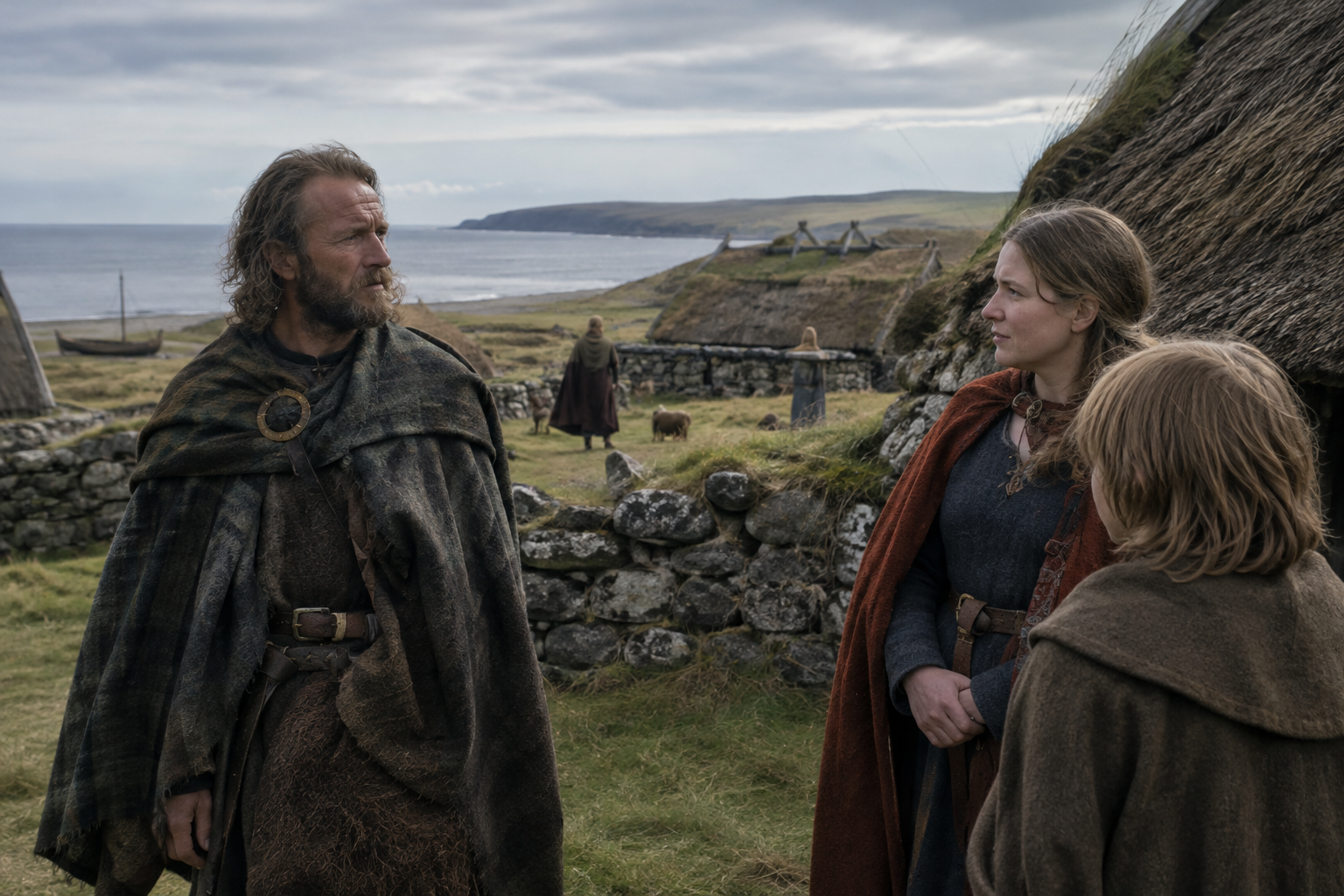
At Buckquoy on the Mainland of Orkney, one excavated individual offers a small but unusually vivid window into the Viking Age North Atlantic. The man labeled VK202, dated to around AD 940, is associated here with the Y-DNA haplogroup R1b1a1b1a1a2c1a3a2a1d, a very specific branch within the much broader R1b family that is common in western Europe today.
That matters because Orkney in the 10th century was not some quiet peripheral corner. It was a busy island world shaped by seafaring, Norse settlement, older Pictish and local populations, and constant movement across the North Sea. A single Y-chromosome line cannot tell us a person's whole ancestry or identity, but it can anchor one direct paternal line in a real place, at a real moment, when northern Britain was being remade.
Buckquoy is one of those Orcadian sites that archaeologists keep returning to because it sits right at the intersection of continuity and change. The wider area has long been important for understanding how Norse settlers interacted with existing communities in the Northern Isles. By the 9th and 10th centuries, Orkney was tied into Scandinavian political and trading networks, yet it was never simply a colonial blank slate. People there lived among older landscapes, reused older places, and created something regionally distinctive.
In that setting, VK202 is useful precisely because he is not presented as a saga hero or a dynastic founder, but as an ordinary excavated person from a well-known island environment. The haplogroup assignment to R1b1a1b1a1a2c1a3a2a1d places his paternal line inside a branch structure that ultimately belongs to western Eurasia's immense R1b complex, but the historically important point is narrower: this direct male line was present in Viking-Age Orkney, in a society where Scandinavian cultural power and local biological continuity were interacting in complicated ways.
A genetic study of ancient populations from Britain and surrounding regions, available as research on bioRxiv, has helped frame exactly these sorts of questions: how much continuity there was, how much migration occurred, and how local communities changed across the early medieval centuries. Even without pressing beyond what is securely stated for VK202, Buckquoy fits that wider archaeological conversation beautifully.
The full label R1b1a1b1a1a2c1a3a2a1d is extremely fine-grained. In practical terms, that means we are dealing not with the whole history of R1b, but with one twig on a very large paternal tree. It would be a mistake to take the enormous prehistoric spread of parent R1b branches and simply paste that whole story onto this exact subclade.
Still, one broad historical observation is safe. Branches within R1b are deeply embedded in the population history of Atlantic Europe and Britain, including regions that later experienced Roman rule, post-Roman change, and Viking-era migration. When such a lineage appears in Orkney around AD 940, it reminds us that Viking Age populations were not genetically uniform "Norse types." They were communities formed through movement, intermarriage, and the absorption of earlier local lineages into new political and cultural worlds.
That is one of the reasons ancient DNA has been so useful in the study of language spread and identity formation. Archaeology can show us settlements, burials, and artifacts; genetics can show patterns of relatedness and ancestry; but neither works well if we force modern ethnic boxes onto early medieval people. VK202's Y-DNA traces one paternal line, not a complete nationality.
Germanic languages and genomics
There is an old temptation in popular history to imagine Viking settlement as a simple replacement story: Scandinavians arrive, locals vanish, and a new people appears. Orkney has never really behaved so neatly. The islands preserve strong evidence for Scandinavian political and cultural transformation, yet the underlying population history was almost certainly more entangled.
That is what makes a sample like VK202 historically interesting. A man buried in 10th-century Orkney could participate fully in a Norse-speaking or Norse-dominated world while carrying a paternal line that, at a broader level, sits very comfortably within the long genetic history of the British Isles and Atlantic Europe. That is not a contradiction. It is exactly what we should expect in a maritime zone where families, identities, and loyalties were being remade over generations.
The Northern Isles were connected not just to Norway, but to Caithness, the Hebrides, Ireland, the Irish Sea, and the Scottish mainland. Ships, marriage alliances, fosterage, raiding, trade, and landholding all moved people around. Archaeologically, the islands belong to the Viking Age North Atlantic; genetically, they were part of a much messier human landscape.
One sample cannot stand in for all of Orkney, and sensible ancient-DNA work is always careful about that. Yet individual burials matter because they keep the story honest. Instead of speaking in abstractions about "Vikings" or "islanders," we can point to one excavated person, one site, one date, and one paternal lineage documented in that setting.
VK202 therefore has a value beyond the haplogroup label itself. He helps locate this lineage in a place famous for hybridization: culturally Scandinavian, geographically Scottish, and historically shaped by older Pictish and insular roots. The most interesting lesson is not that one branch was "Viking" in some pure sense, but that Viking Age society in Orkney included men whose paternal ancestry belonged to lineages widespread in the western edge of Europe.
That same pattern appears again and again in early medieval ancient DNA: identities move faster than chromosomes, and political worlds can change more quickly than populations disappear. If you are interested in how post-Roman and Viking-age Britain absorbed newcomers while retaining deeper local ancestry, this is one of the clearest themes emerging from the science.
Roman and early medieval Britain
For someone researching this haplogroup today, the Buckquoy evidence suggests a paternal line present in the north of Britain during the height of the Viking Age, in a zone where Scandinavian settlement met older insular populations. That is a historically meaningful context even if it does not provide a neat origin story for the branch itself.
In other words, the most responsible interpretation is also the most interesting one. This lineage appears in an island community that sat on the front line of one of medieval Europe's great transformations, yet the genetic signal points away from simplistic ideas of replacement. A paternal branch like R1b1a1b1a1a2c1a3a2a1d could belong to people living through Norse expansion without needing to represent an exclusively Scandinavian male descent.
The significance of R1b1a1b1a1a2c1a3a2a1d here lies in scale. It is a very narrow paternal marker, but it appears in a very big historical setting: 10th-century Orkney, where migration, language, power, and local continuity met in daily life. VK202 does not give us a royal pedigree or a grand tribal label. He gives us something better: a securely ancient reminder that the Viking world was peopled by individuals whose family histories were already layered long before they were buried in Norse-era island ground.





Comments