Haplogroup I2a1a2b1a1a1a1
– 5 min read


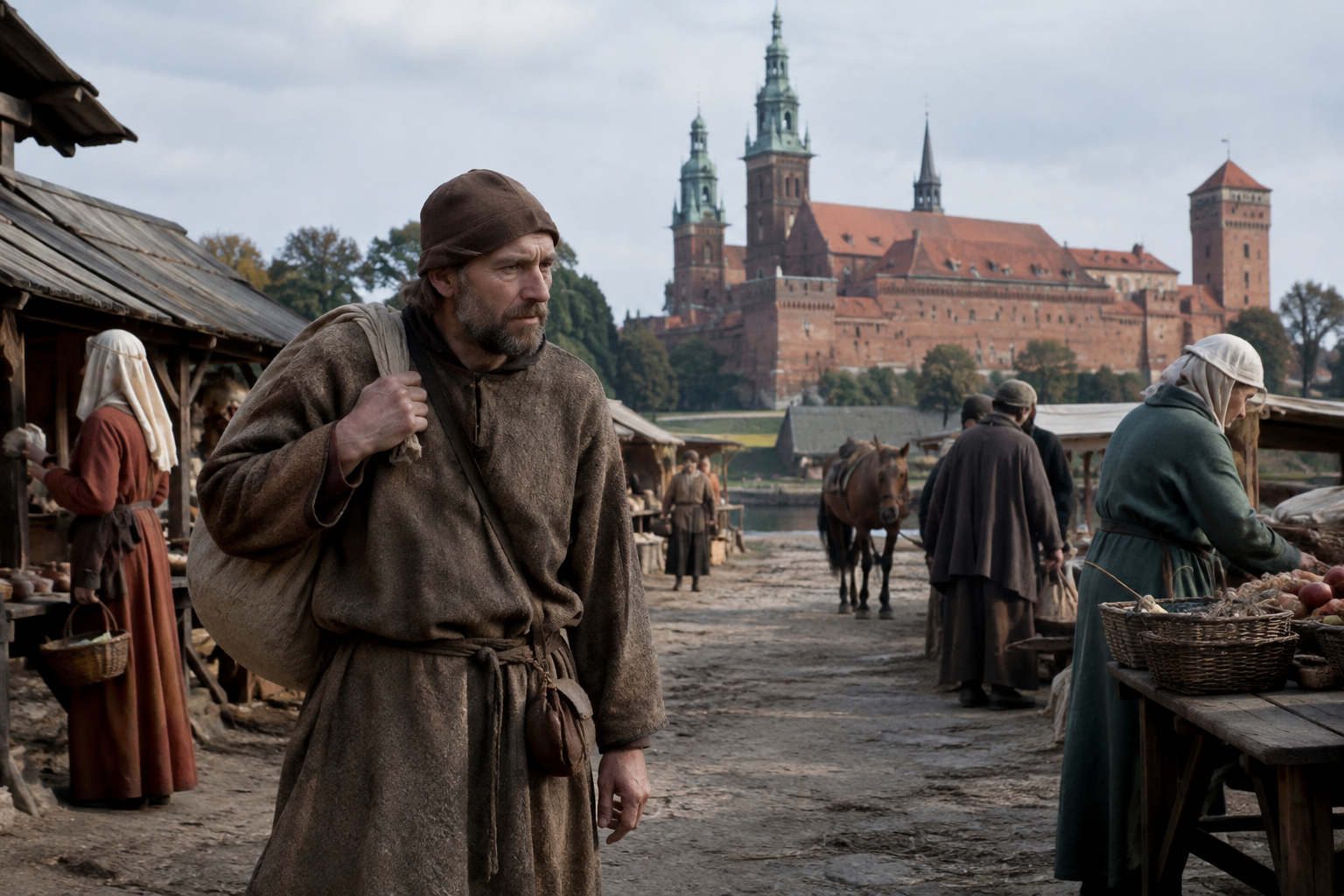
In around AD 1150, one man living in Krakow left behind a very small but intriguing clue to the deep history of paternal ancestry. He appears in the ancient DNA record simply as VK210, a medieval commoner from Poland. There is nothing grand about the label, and that is precisely why he matters. Ancient DNA so often comes to us wrapped in elite burials, famous dynasties, or dramatic migration stories. Here, by contrast, we meet an ordinary urban or peri-urban inhabitant of one of medieval Central Europe's most important centers, carrying the Y-DNA haplogroup I2a1a2b1a1a1a1.
That long string of letters and numbers marks a very specific paternal branch, far narrower than the wider I2 family from which it descends. Y-DNA follows one direct male line only: father to son to son across the centuries. It does not summarize a person's whole ancestry, language, or identity. But when a lineage like I2a1a2b1a1a1a1 turns up in a documented medieval individual from Krakow, it gives us a fixed point: a real man, in a real place, in the High Middle Ages, whose paternal line had already been part of Europe's much older demographic story.
Krakow in the 12th century was no backwater. It was one of the principal political and ecclesiastical centers of Piast Poland, a place shaped by trade, church institutions, craft production, and regional movement. A "commoner" from Krakow therefore stands in an especially useful historical setting. He was not living at the margins of European history, but at a crossroads where local continuity and wider connections met.
That matters because haplogroup discussions can easily drift into abstraction. VK210 reminds us that paternal lineages were not just moving across maps in prehistory; they were embodied in medieval townspeople, laborers, artisans, and households. A branch like I2a1a2b1a1a1a1 was part of the living social fabric of a Christian Polish city by the 1100s, not merely a prehistoric residue.
A genetic study associated with medieval Central and Eastern European burials, available at https://www.biorxiv.org/content/10.1101/703405v1, helps place such individuals into the broader archaeogenetic conversation about population structure, continuity, and movement in the region. Even when one sample cannot carry a whole historical argument on its own, it can anchor larger questions securely in time and place.
The important thing here is scale. I2a1a2b1a1a1a1 is not the same thing as the entire I2 haplogroup, and it should not be treated as though it carries the full ancient range or history of every I2 branch. The broader I2 family is one of Europe's old paternal lineages, with deep roots in the continent's prehistoric population history. But each descending branch has its own later story, and those stories may differ sharply by region and period.
For this article, the strongest direct evidence is medieval and Polish. That means we should be careful. We can say that this specific paternal line is documented in Krakow around AD 1150 through VK210. We can also say that its wider ancestry belongs to a Y-chromosome family long established in Europe. What we should not do is pretend that one medieval Krakow sample proves an unbroken, neatly mapped route from some single prehistoric tribe to one modern surname or nationality. History is not so tidy, and genetics rarely is either.
Still, the lineage is historically suggestive. In Central and Southeastern Europe, branches of I2 are often part of discussions about long-term local male ancestry, survival through major cultural transitions, and later incorporation into medieval Slavic-speaking populations. VK210 fits comfortably within that sort of historical landscape, even if the precise path of his own paternal ancestors remains beyond recovery.
There is a temptation, especially in public history, to look upward: dynasties, castles, heraldry, glittering tombs. Yet ancient DNA has repeatedly shown that ordinary burials can be more revealing than princely ones when the question is population history. VK210 is valuable precisely because he was not singled out by exceptional status. He offers a glimpse of the everyday male lineages present in medieval Krakow rather than the carefully preserved image of political power.
And medieval cities were complicated places. They gathered people from surrounding villages, from regional trade routes, from ecclesiastical networks, and sometimes from much farther afield. So VK210's presence does two things at once. It may reflect local continuity in southern Poland, and it also belongs to a setting where mobility was normal. That combination makes Krakow an excellent place to think about how old paternal lines persisted within changing medieval societies.
Origins of Medieval Townspeople
It is very easy to take a haplogroup found in medieval Poland and label it "Slavic," full stop. That is understandable, but too simple. By AD 1150, Krakow was certainly part of a medieval Polish world shaped by Slavic language, Piast rule, Latin Christianity, and regional state formation. But Y-DNA lineages are older than those medieval identities. A paternal branch can pass through many cultural worlds before it appears in the historical record under a familiar name.
That is one reason ancient genomics has been so useful for historians of language and migration. It forces us to distinguish between genetic descent, speech communities, and political identity. Readers interested in how language spread and genetic ancestry sometimes overlap, but do not always match neatly, may want to compare this case with broader work on early Europe and language history.
For VK210, the safest conclusion is also the most interesting one: by the 12th century, this precise paternal branch was part of the population living in Krakow. That does not make it exclusively Polish, exclusively Slavic, or exclusively anything else. It makes it historically real in a medieval Polish setting.
One sample can never stand in for an entire city, much less a nation. But single individuals matter enormously in archaeogenetics because they give chronology to lineages that might otherwise be discussed only in modern DNA projects. Without ancient individuals, a haplogroup can seem to float free of history. With even one securely dated burial, it becomes attached to a specific human life.
VK210 also belongs to a growing pattern in European ancient DNA: medieval populations often contain paternal lines with much deeper roots in the continent than the political labels of the age might suggest. The medieval world was full of new kingdoms, new church structures, and shifting frontiers, but many male lines within it were far older than those institutions. If you are interested in how such older substrata survived into later societies, there is useful context in wider discussions of Balkan and eastern European population history.
The most distinctive thing we can say about I2a1a2b1a1a1a1 from the present evidence is modest, but solid. It is attested in a medieval commoner from Krakow, sample VK210, around AD 1150. That places this paternal branch within the lived history of High Medieval Poland and suggests that men carrying it were part of the ordinary population of an important Central European center.
For someone researching this haplogroup today, that is a useful kind of anchor. It does not promise descent from a famous house or a single heroic migration. Instead, it points toward something more historically grounded: a paternal line at home in medieval Europe, preserved not in legend but in the bones of a working city and the patient work of ancient DNA.





Comments