Haplogroup R1a1a1b1a3a2b
– 4 min read


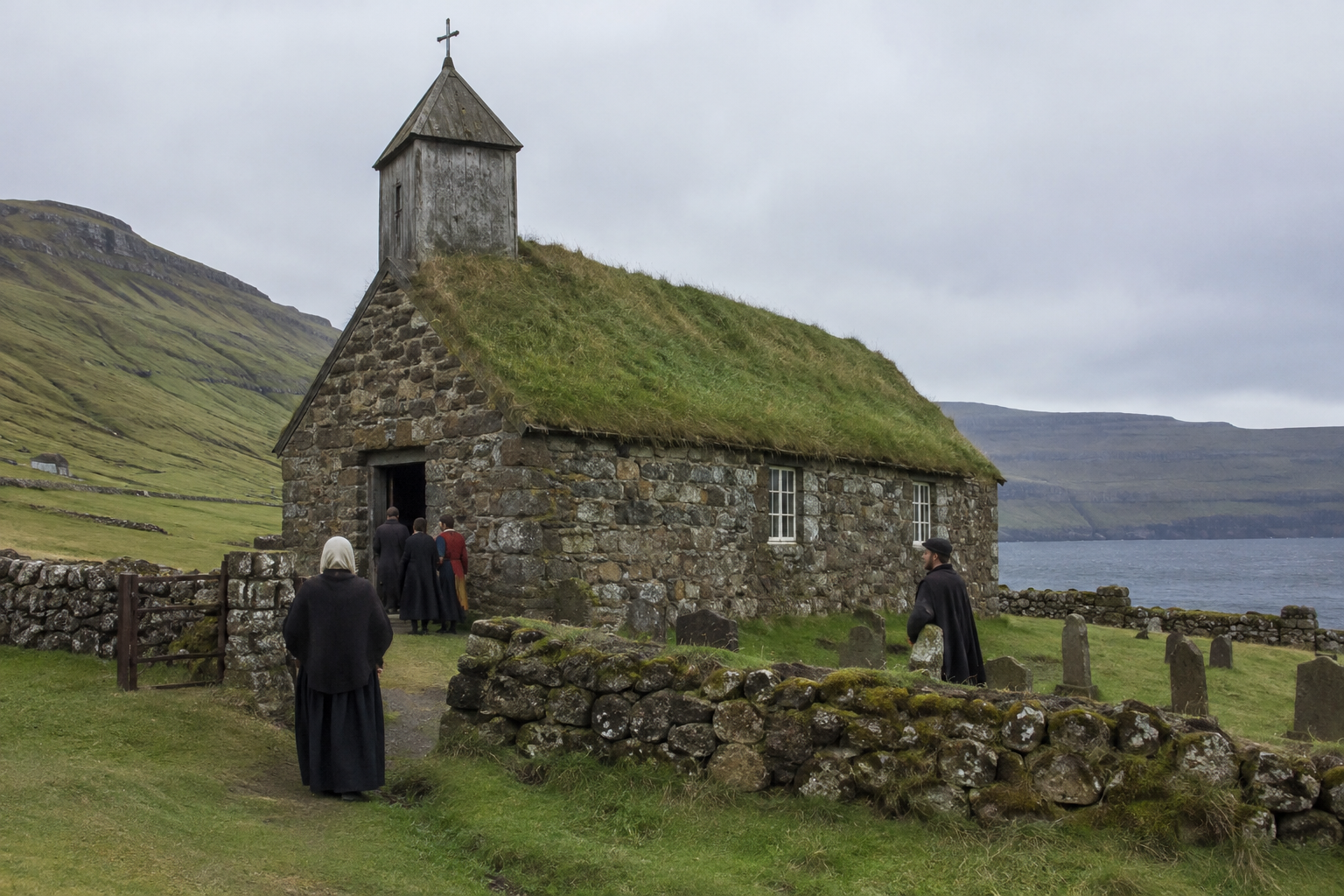
At Sandoy Church in the Faroe Islands, one ancient male sample stands out precisely because it is so late, so local, and yet so revealing. The individual identified as VK45, dated to around AD 1600, belongs to the Y-DNA haplogroup R1a1a1b1a3a2b. That may look like a forbidding string of letters and numbers, but in historical terms it opens a very practical question: what does a paternal lineage more often discussed in the wider North and East European world look like when it turns up in a small North Atlantic island community?
The answer is not a fairy-tale saga about one heroic founder. It is more interesting than that. A Y-chromosome records only one direct paternal line, not a person's whole ancestry, but when we find a branch like R1a1a1b1a3a2b in the Faroes, it reminds us that island populations were never sealed jars. Even communities that seem remote on the map were made by movement: Scandinavian settlement, contact across the North Atlantic, marriages, churchyard burials, and centuries of ordinary lives.
VK45 comes from Sandoy Church, one of the Faroese settings where ancient DNA has begun to illuminate the population history of the islands. The date, around AD 1600, matters. This is not the first generation of Viking settlement, nor the heroic age of the sagas, but a Christian, post-medieval community in which old lineages had already been filtered through many centuries of drift, kinship, and demographic bottlenecks.
That makes the sample historically useful. In a place like the Faroes, a single male lineage does not stand for the whole population, but it can show how particular paternal branches persisted into the early modern period. A genetic study of Faroese material, circulated at this research preprint, helped bring such individuals into view as part of the islands' longer population story.
Faroese ancestry and selection
R1a1a1b1a3a2b is a very specific sub-branch within the broader haplogroup R1a, one of the best-known Y-chromosome lineages across parts of Eurasia. But this is where caution is essential. The large parent branch has a deep and complicated history stretching across many regions and periods; that does not mean every narrow descendant branch followed the same path in the same way.
So for VK45, the sensible historical claim is modest but meaningful. We are looking at a Faroese man of around AD 1600 whose paternal line belonged to a precise subclade within R1a. That does not make him a proxy for all Faroese men, all Scandinavians, or all earlier Viking settlers. What it does show is that this paternal branch had reached, and survived within, the North Atlantic island world by the early modern period.
People often imagine the Faroe Islands as marginal. Archaeology and genetics tend to suggest something subtler: they were peripheral only if one thinks from the viewpoint of a continental capital. From the perspective of seafaring communities, the Faroes sat on a network linking Norway, the British Isles, Iceland, and beyond.
That matters for understanding a lineage like R1a1a1b1a3a2b. The islands were settled and sustained by repeated human contact, not by one event. Paternal lines could arrive with settlers, persist through local descent, or be reshaped by later migration and marriage. A church burial around AD 1600 belongs to that long afterlife of settlement, when lineages had already been naturalized into Faroese society.
In that sense, VK45 is a corrective to simplistic Viking-age storytelling. The important history is not only who first landed, but which lines endured through famine, disease, marriage patterns, and the hard arithmetic of small populations. Early modern churchyards are full of that quieter sort of evidence.
North Atlantic settlers and sagas
There is a temptation, whenever R1a appears in a northern context, to leap straight to language, ethnicity, or conquest. Better to slow down. In medieval and post-medieval Scandinavia and the North Atlantic, paternal lineages were shaped by exactly the same untidy processes that shape any population: founder effects, local survival, social mobility, and sheer chance.
The Sandoy Church sample is valuable because it belongs to a period when the Faroes were deeply Christian and long integrated into Scandinavian and North Atlantic systems. That places R1a1a1b1a3a2b not in a mythic prehistoric haze but in a documented historical society. The lineage was part of lived Faroese history, not merely of some distant ancestral source population.
This is one reason ancient DNA is so useful when paired with archaeology. It lets us move away from broad modern averages and see lineages in particular times and places. The same island that today is discussed through population genetics was once a collection of households, parishes, and burial grounds, each preserving fragments of paternal history in human remains.
Church burials can seem less glamorous than warrior graves or princely tombs, but they are often better windows into real population history. A site like Sandoy Church speaks to continuity: generations living in one place, burying their dead within a Christian landscape, and transmitting both culture and genes through ordinary family life.
For a haplogroup article, that is especially important. R1a1a1b1a3a2b here is not attached to a named dynasty or a grand political house. Instead, it appears in the much more common human setting from which most modern paternal lines actually descend: a local man in a local community, in a burial ground shaped by religion, kinship, and settlement history.
That also connects this find to wider discussions of how Germanic-speaking and Scandinavian populations formed and spread. Not because one sample can answer that question by itself, but because each securely placed male lineage helps anchor the larger map. Broader genomic work on northern Europe and language history has made exactly that point in other contexts.
Germanic languages and genomes
If your paternal line falls under R1a1a1b1a3a2b, VK45 offers a grounded historical image rather than a grandiose claim. By around AD 1600, this branch was present in the Faroe Islands, embedded in a settled North Atlantic Christian community. That suggests a paternal history compatible with the long maritime world of Scandinavia and its island networks, though not exclusive to them.
The real value of the sample is its specificity. It shows that this branch was not merely part of some abstract northern genetic background, but part of the lived population history of Sandoy. For descendants exploring their Y-DNA today, that is often the most useful kind of ancient connection: not a legend, but a place, a date, and a man whose paternal line endured on the edge of the North Atlantic.
Comments