Haplogroup R1a1f

– 5 min read


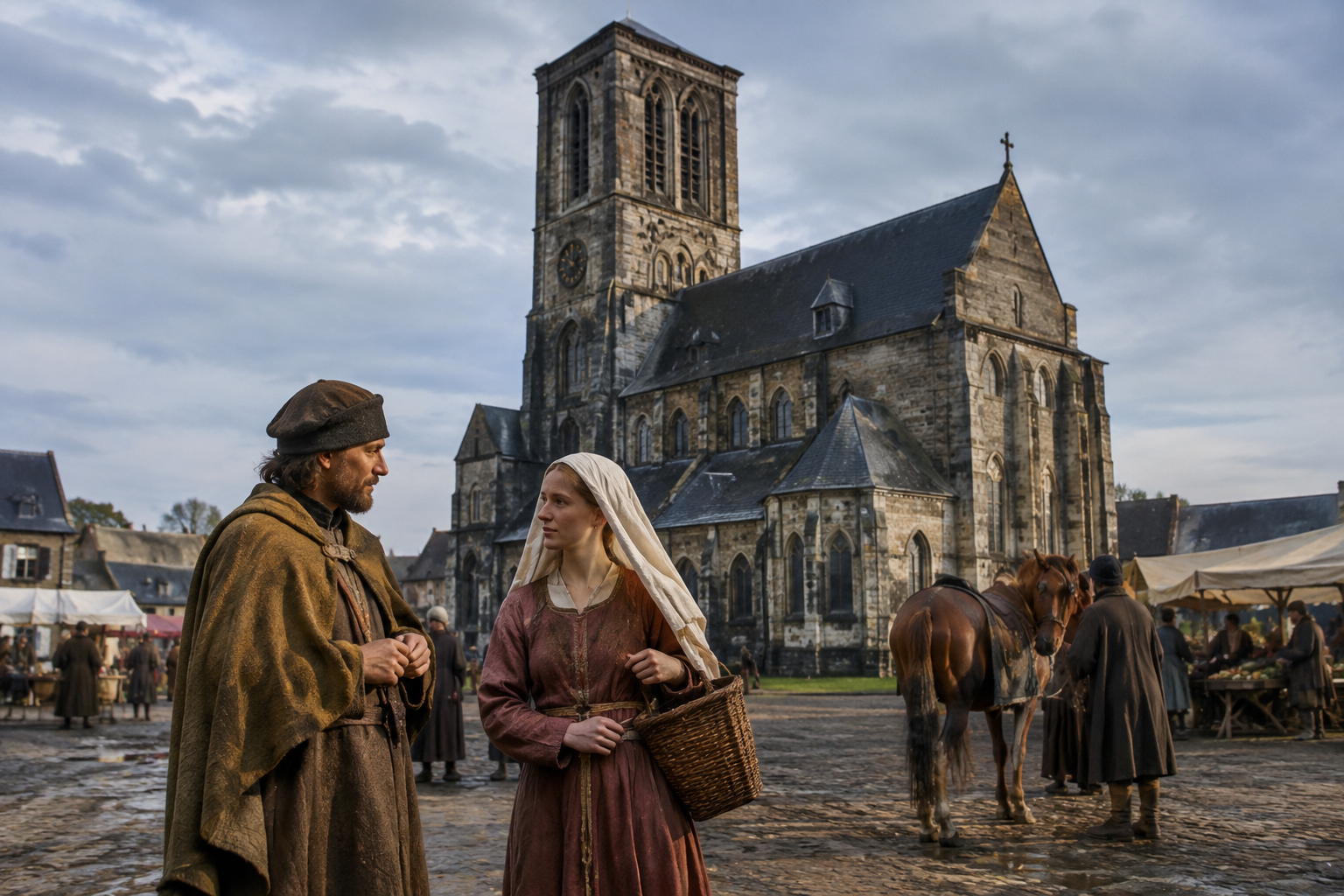
At Sint-Truiden in medieval Belgium, one burial stands out precisely because it does not fit the local pattern. The individual labeled ST0027, buried around AD 900 at the Onze-Lieve-Vrouwekerk, was identified in the site material as an outsider. That alone would make him interesting. But for anyone tracing a paternal line, the further association with the Y-DNA haplogroup R1a1f makes him especially revealing: here is a lineage turning up not in a steppe barrow or a grand princely tomb, but in an urban churchyard in the Low Countries.
That is a useful reminder of what Y-DNA can and cannot do. It follows one direct paternal line only, not a person's whole ancestry, language, or legal identity. Yet when a lineage like R1a1f appears in a clearly medieval town context, it helps us ask a better historical question: how did particular male lines move through the crowded, mobile, thoroughly mixed societies of early medieval Europe?
Sint-Truiden was no remote village. In the early Middle Ages it was an important religious and economic center in the region of present-day Belgium, tied into the monastic networks, markets, and political structures of Lotharingia. A burial from this setting already belongs to a world of roads, exchange, ecclesiastical authority, and population movement.
ST0027's label as an outsider matters because it points away from the old habit of assuming that medieval cemeteries represent neatly bounded local communities. They often do not. Towns and churches drew in pilgrims, laborers, traders, servants, clergy, dependants, and people whose origins lay somewhere else entirely. In that context, a paternal lineage associated with R1a1f is best read not as an ethnic badge, but as one strand within a mobile medieval population.
A recent ancient DNA study of medieval Sint-Truiden examined exactly these questions of urbanization and population structure, showing how genetics can illuminate whether people buried together were in fact drawn from the same local background or from more varied origins. The broader research context can be explored here: https://genomebiology.biomedcentral.com/articles/10.1186/s13059-025-03580-z.
R1a1f is a named branch within the wider R1a paternal family, one of the better-known Y-chromosome groupings across Eurasia. But this is where precision matters. The deep history of broad R1a cannot simply be pasted onto every smaller branch beneath it, and certainly not onto one medieval man in Belgium. Without secure, sample-specific downstream resolution and comparative context, it would be careless to turn ST0027 into proof of any single migration tale.
Still, the appearance of an R1a-related paternal line in a medieval Low Countries burial is entirely historically plausible. By AD 900, western and central Europe had long been shaped by Roman frontiers, post-Roman population shifts, Frankish expansion, ecclesiastical travel, and commercial movement along the Rhine-Meuse corridor. The interesting point is not that one lineage "belongs" there in some timeless way, but that medieval towns were the places where many older and wider family histories met.
That also helps explain why Y-DNA findings can feel both very specific and frustratingly incomplete. They can identify a direct male-line signature, but they do not by themselves tell us whether ST0027 spoke a Germanic language, grew up locally, came from the eastern Frankish world, or arrived through some other route. Those questions need archaeological context, isotopes, kinship data, and comparison with other graves.
If you place Sint-Truiden on the map of early medieval Europe, the site becomes even more suggestive. The Low Countries sat within one of the great connective zones of the continent, linked to the Rhine basin, northern France, the North Sea world, and inland routes toward the German lands. People moved through this region constantly, sometimes over generations, sometimes within a single lifetime.
That is why an "outsider" burial in a church context deserves attention. Such a label implies that the burial population could be studied not simply as locals versus foreigners in the modern sense, but as a community formed by different scales of belonging. A man carrying a paternal lineage reported as R1a1f could have been locally born into a family with older non-local roots, or newly arrived, or descended from migrants several generations back. Medieval identities were rarely as tidy as later nationalist histories would like.
This wider frontier and riverine world has shown again and again, in both Roman and post-Roman studies, that borderlands were blending zones. Not every cemetery tells the same story, of course, but the general historical pattern is clear enough: the Low Countries were a place where lineages circulated, settled, and were absorbed into new communities.
Because R1a branches are often discussed alongside the history of Indo-European or Germanic-speaking populations, there is a temptation to leap straight from haplogroup to language. That is much too simple. Languages spread through power, prestige, settlement, intermarriage, institutions, and sometimes conquest; paternal lines are only one narrow biological channel.
Even so, medieval Belgium belongs to a region where Germanic-speaking political and cultural formations mattered enormously, especially under Frankish rule and its aftermath. A paternal lineage such as R1a1f in this setting is therefore compatible with the long, entangled history of communities shaped by those transformations. Compatible, though not conclusive. The value lies in combining genetics with the historical map, not replacing history with a haplogroup label.
This is where ancient DNA has improved the conversation. Instead of trying to match whole peoples to single genes, researchers can now examine cemeteries, towns, frontier communities, and family clusters at much finer resolution. The result is almost always a messier, and more convincing, picture than the old textbook tribes marching across a map.
It is easy to dismiss a lone medieval sample as too slight to matter. But individual burials are often where the real texture of history begins. ST0027 is not important because he can be made into a hero, founder, or dynast. He is important because he anchors R1a1f in a documented place and period: a medieval ecclesiastical center in the Low Countries, around AD 900, in a population where not everyone shared the same background.
That sort of evidence is especially valuable for descendants testing today. Many people discover a Y-DNA branch and immediately want a single homeland, a single tribe, a single historical people. Medieval evidence like Sint-Truiden suggests something more realistic and, in truth, more interesting. A paternal line may have travelled through multiple cultural worlds before it appears in the written and archaeological record at one particular churchyard.
For R1a1f, the strongest point here is not grandeur but placement. This branch is represented in ST0027, an outsider burial from Sint-Truiden around AD 900, inside a town-shaped world of movement, institutions, and mixed origins. For someone researching this paternal line, that is a meaningful clue: not proof of one ethnic identity, but evidence that this lineage was part of the human traffic of early medieval northwestern Europe.

Comments