Haplogroup R1a1a1b2e
– 5 min read


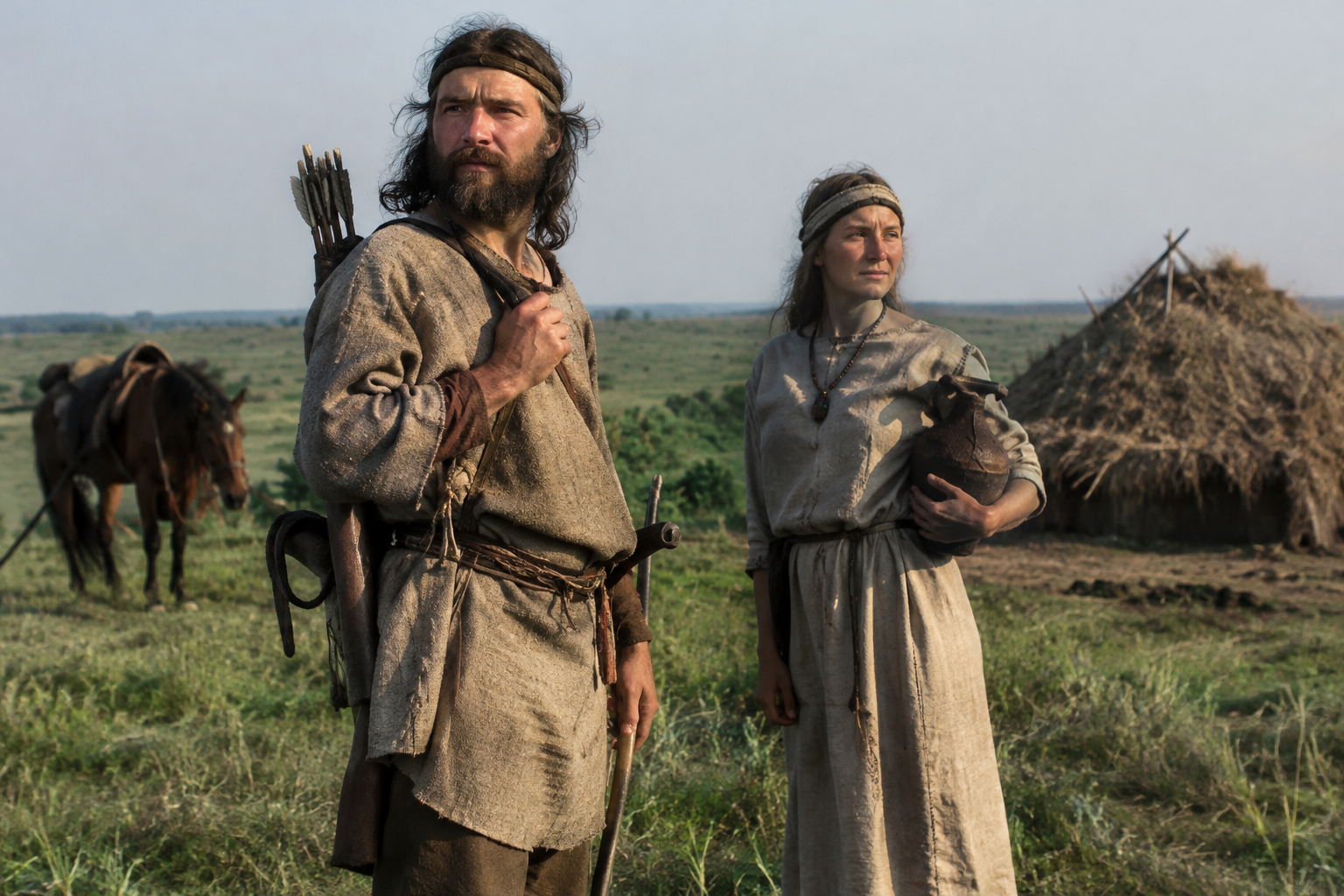
One of the clearer ancient signposts for the paternal branch R1a1a1b2e is a man known as I0232, dated to around 1550 BC and associated with the Srubnaya horizon of the Trans-Volga forest-steppe. That may sound forbiddingly technical, but the setting is historically vivid enough: this was the Bronze Age world east of the Volga, where pastoral communities moved across open grasslands and wooded river zones, burying their dead in a landscape that would later become central to debates about steppe societies, mobility, and the spread of languages.
I0232 matters because he places this lineage in a real archaeological context rather than in modern surname projects or broad maps of present-day DNA. In other words, we are not dealing here with a vague idea of "steppe ancestry," but with a paternal line tied to an identifiable Bronze Age population. As always, Y-DNA tracks just one direct male line out of thousands in a person's family tree, yet that single line can still tell a sharply focused historical story.
The Srubnaya culture, usually dated to the later Bronze Age, occupied a wide zone across the Pontic-Caspian and Volga-Ural steppes. Archaeologists know it above all through its burial traditions and pastoral economy. Genetically, Srubnaya groups have become important because they sit within the long history of steppe populations that followed earlier horizons such as Yamnaya and Poltavka, but were not simply identical to them.
That is where I0232 becomes especially useful. A sample from the Trans-Volga forest-steppes links the haplogroup discussed here to a frontier zone between open steppe and northern woodland. This is not a trivial geographical detail. Borderlands like this were often places where communities mixed herding, seasonal movement, and regional exchange, and where paternal lineages could spread without implying that every aspect of culture or identity moved in lockstep with them.
A major ancient DNA study of Bronze Age steppe populations helped establish just how consequential Srubnaya-related groups were in the wider Eurasian picture, showing that these communities belonged to a changing and interconnected steppe world rather than an isolated pocket of prehistory: research published on these ancient populations remains one of the key reference points for placing such samples in context.
The broader haplogroup R1a is one of the best-known Y-chromosome branches in Eurasian population history, especially in discussions of Bronze Age and later eastern European and central Eurasian populations. But that broad fame can be misleading. The branch in this article is not "all R1a"; it is the much narrower R1a1a1b2e, and we should be careful not to smuggle in the whole history of the parent clade as if it automatically belonged to this exact sub-branch.
What the ancient evidence supports, more modestly and more usefully, is that a lineage associated with this branch appears in the Srubnaya-related world east of the Volga in the mid-2nd millennium BC. That places it within a historical landscape of late Bronze Age steppe populations whose descendants and relatives likely contributed, in different proportions, to later groups spread across eastern Europe and inner Eurasia.
It also reminds us that paternal continuity and cultural continuity are not the same thing. A Y-chromosome can persist through major changes in language, political allegiance, and way of life. The man buried as I0232 was part of a Bronze Age archaeological culture, not a modern nation and not a ready-made ethnic label from later historical texts.
There is a tendency to imagine regions beyond the great rivers as remote edges of history. The Trans-Volga zone was nothing of the sort. In the Bronze Age it formed part of an enormous corridor linking the western steppe, the Volga-Ural region, and lands farther east. Populations here were positioned to take part in movements of herders, marriage networks, technologies, and probably speech communities as well.
That makes I0232 more than a dot on a genetic map. He comes from a region where ecological zones overlapped and where social connections likely ran in several directions at once. If your paternal line belongs to R1a1a1b2e, this ancient placement suggests a deep ancestry rooted in one of Eurasia's most historically dynamic corridors, rather than in a neatly bounded homeland.
This point sits well with wider discussions on steppe and post-steppe mobility. The Bronze Age was full of continuity, but it was also full of reshuffling: groups expanding, contracting, mixing, and reforming across generations. A paternal line found in a Srubnaya-associated burial may therefore signal participation in that wider web of movement without giving us a simple one-arrow migration story.
It is tempting to leap straight from Srubnaya graves to later peoples of the Iron Age and medieval world. The temptation should be resisted, at least in its simplest form. Still, there is a historically sensible reason the Srubnaya evidence attracts attention: later populations of the wider steppe and forest-steppe often emerged in regions shaped by these Bronze Age predecessors.
That does not mean that one can draw an unbroken ethnic line from I0232 to Scythians, Sarmatians, Slavs, or any later community. It does mean that the paternal landscape from which those later populations emerged had already been structured, in part, by Bronze Age lineages such as those found in Srubnaya-associated burials. Ancient DNA keeps forcing historians to be more concrete about this. Population history is rarely about replacement alone; quite often it is about old lines surviving inside new social worlds.
For readers interested in how steppe and eastern European histories continued to recombine over long periods, MyTrueAncestry has explored that broader problem in articles on frontier populations and mixed communities. Those later cases do not prove anything specific about R1a1a1b2e, but they do show how fluid the historical settings could become.
With this haplogroup, the evidence we have been given is concentrated rather than sprawling: one ancient individual, one date, one archaeological setting, and one very important region. That may seem slight, but in fact it is exactly how much of archaeogenetics works. A single securely placed sample can anchor a lineage in time and space far better than pages of speculation.
For R1a1a1b2e, the secure takeaway is a Bronze Age presence in the Srubnaya-associated Trans-Volga forest-steppe. The larger interpretation is that this paternal line belonged to the world of late Bronze Age steppe societies that helped shape the demographic history of Eurasia. What we do not have, at least from this evidence alone, is a warrant to attach the lineage to a specific later tribe, language, or ruling house.
Southern Urals and the Magyars
The most distinctive thing about R1a1a1b2e in the evidence here is not a royal legend or a sweeping claim of conquest. It is the quieter, stronger fact that this paternal branch appears in a documented Bronze Age man, I0232, from the Srubnaya world of the Trans-Volga forest-steppe around 1550 BC. For anyone researching this lineage today, that is a meaningful clue: your direct paternal line may reach back into the mobile, pastoral, and historically influential societies of the late Eurasian steppe Bronze Age.
Comments