Haplogroup R1a1a1b2a2b1

– 5 min read


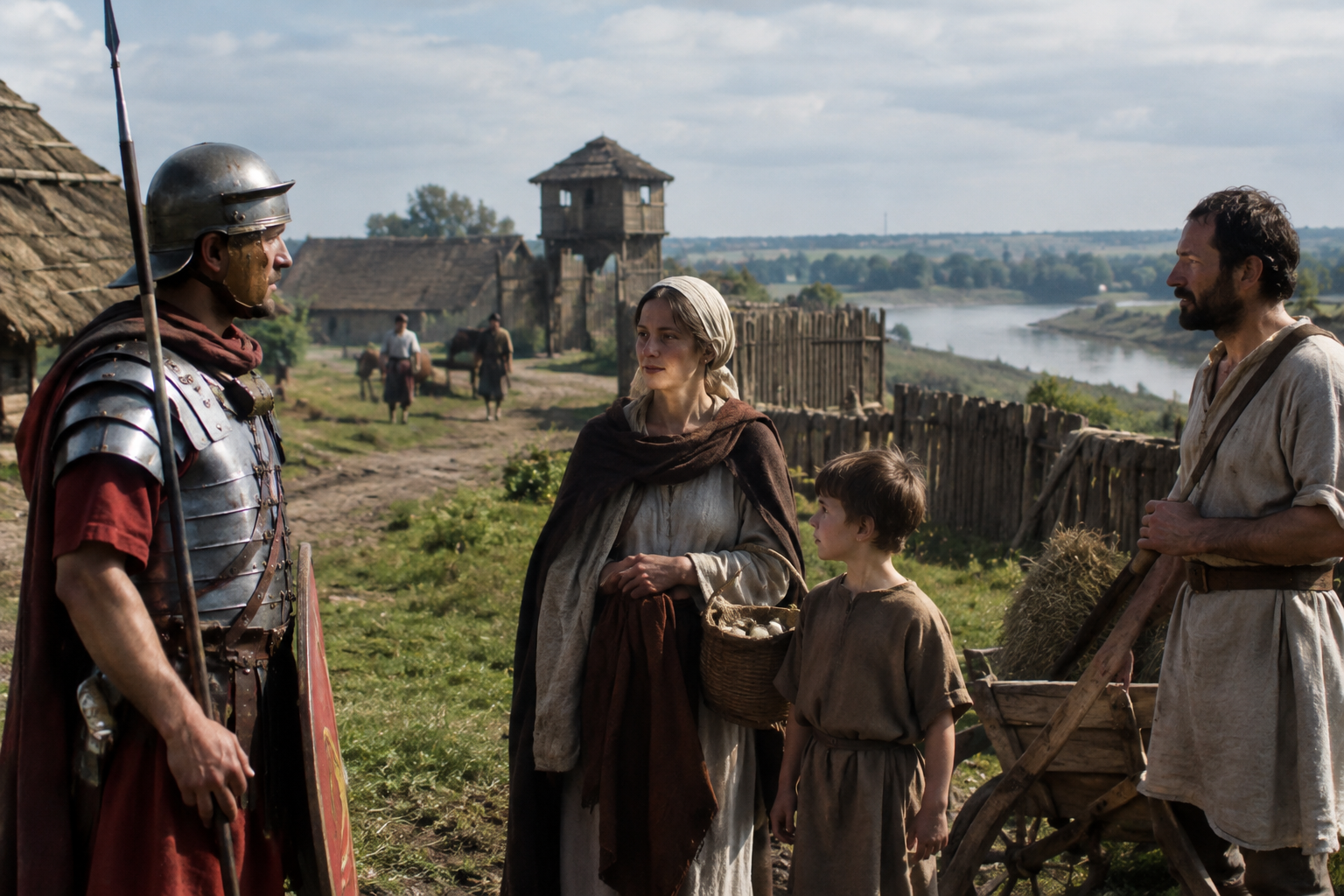
At Rakoczifalva-Szolnok in Late Roman Hungary, one man from around AD 250 has become a useful fixed point for thinking about the Y-DNA branch R1a1a1b2a2b1. He appears in the ancient DNA record as RKF241, from a world that was neither simply "Roman" nor simply "barbarian", but something much more interesting: the busy, unstable, mixed frontier society of the Carpathian Basin.
That setting matters. A Y-chromosome lineage traces one direct paternal line only, not a person's whole ancestry, language, or identity. But when a branch such as R1a1a1b2a2b1 turns up in a documented Late Roman burial from central Hungary, it places that paternal line inside one of the great contact zones of ancient Europe, where imperial rule, migration, military movement, and local continuity all met.
Rakoczifalva lies on the Great Hungarian Plain, a landscape that in the Roman period sat close to the imperial edge and beyond it. By the third century AD, this was a region shaped by trade, war, recruitment, resettlement, and the constant movement of people through the Danube world. RKF241 belongs to that historical moment.
What makes the sample notable is not that it lets us attach a grand label to one man, but that it anchors a paternal lineage in a place where identities were layered. In the Carpathian Basin during Late Antiquity, communities could include locals with deep regional roots, incomers from other provinces, and people tied in one way or another to groups beyond the formal Roman frontier. The archaeology of the period often resists neat ethnic boxes, and the genetics does too.
A major ancient DNA study of the Roman world and its neighboring regions helped establish just how varied these frontier populations could be, especially in and around the imperial borderlands of Central and Eastern Europe. That broader research context is important for understanding why a sample like RKF241 deserves attention even when the surviving details are sparse: research on ancient genomes from the Roman and post-Roman world has repeatedly shown that frontier cemeteries were places where biological ancestry and historical identity did not line up in any simple way.
The immediate difficulty with a highly specific haplogroup label is that the deeper the branch name, the easier it is to overstate what it means. R1a is a very broad Y-DNA family with a long and complicated history across Eurasia. R1a1a1b2a2b1 is a much narrower twig on that large tree, and it should not automatically inherit every migration story ever told about R1a as a whole.
What can safely be said is more modest and more useful. This branch belongs within a paternal lineage family that has been important in many parts of eastern and central Europe over long stretches of time. Finding it in Late Roman Hungary fits a pattern familiar from the wider region: the Carpathian Basin was one of those places where lineages associated with steppe-linked and eastern European histories could appear within communities living in direct contact with the Roman imperial system.
That does not turn RKF241 into a spokesperson for an entire people. It does, however, remind us that paternal ancestry in Roman-period Hungary could reflect connections extending well beyond one province or one political order.
If you imagine ancient Hungary as a sealed box, the evidence quickly becomes frustrating. If you imagine it as a corridor, the evidence starts to make historical sense. For millennia, the Carpathian Basin linked the Balkans, the steppe, Central Europe, and the Danube frontier. Empires tried to govern it, armies crossed it, and communities within it were repeatedly reshaped without ever becoming entirely new.
That is why a single Late Roman Y-line matters here. R1a-derived paternal lines have often appeared in discussions of mobility across the European plain and the steppe-facing zones beyond it. In a frontier cemetery context, such a lineage may speak less to one dramatic migration event than to the long habit of this region absorbing men, families, and military-age populations from different directions.
The same historical lesson appears again and again in ancient DNA from border societies: people do not stay inside the categories that later historians prefer. Late Roman cemeteries in the middle Danube zone are especially good at disturbing tidy narratives. They show that imperial frontiers were not just defensive lines; they were social engines producing new communities.
By about AD 250, the Roman Empire was under strain, and the middle Danube was one of the places where that strain was felt sharply. Political instability, military pressure, and shifting alliances altered how people lived on both sides of the frontier. A burial from this period in Hungary belongs to a landscape already being transformed, decades before the better-known Migration Period upheavals of the fourth and fifth centuries.
That timing gives RKF241 extra interest. He does not come from the age of the Huns or the early medieval Hungarian conquest, but from an earlier phase when the late imperial world was still functioning, though imperfectly. His paternal lineage therefore sits in a historical middle ground: old enough to predate those later medieval formations, yet late enough to belong to a society already marked by intensified movement and frontier mixing.
For readers researching their own paternal line, this is often the most revealing point. A match to an ancient individual does not mean descent from that person, still less from a named tribe. It means that your direct paternal line belonged to the same wider male-line branch found in a documented human life at a particular place and time. In this case, that time and place are highly suggestive: Late Roman Hungary, one of Europe's great crossroads.
People understandably want a single historical label for a haplogroup-bearing ancient sample. Was he Roman? Was he linked to a Germanic-speaking group? Was he part of some wider eastern European or steppe-derived ancestry stream? With the evidence presently at hand, the most responsible answer is that Late Roman Hungary forces these categories into contact rather than allowing one to cancel the others.
The middle Danube zone saw the spread of languages, the movement of military personnel, and the formation of mixed communities long before medieval kingdoms put firmer names on the map. A paternal lineage like R1a1a1b2a2b1 could pass through those worlds without belonging exclusively to any one of them. That is not evasive; it is exactly what archaeogenetics has been teaching us about frontier societies.
This broader problem of language spread, mobility, and mixed communities is explored well in MyTrueAncestry's discussion of Germanic-language expansion through ancient genomics. It is useful here because it shows how genetics can illuminate movement without reducing every lineage to a single ethnic badge.
There is a temptation to dismiss single ancient samples as too small to matter. But archaeology is full of cases where one well-placed individual sharpens the whole picture. RKF241 does that because he joins a historically rich setting to a very specific paternal branch. Even without a long list of associated finds, the combination of date, place, and lineage is already meaningful.
It also fits a wider pattern seen in studies of Roman and post-Roman population history: the Carpathian Basin did not simply receive one new population after another in neat sequence. Instead, it accumulated people. Some lineages endured locally, some arrived through mobility and marriage, some were tied to military structures, and many were folded into communities that were culturally mixed from the start.
Readers interested in that wider Roman provincial picture may also want to compare this Hungarian case with work from other imperial settings, including Iberia and the frontier zones further west, where ancient DNA has likewise complicated old assumptions about who belonged where.
The strongest insight from haplogroup R1a1a1b2a2b1 in this case is not a tale of royal descent or a single tribe on the move. It is the more historically interesting fact that this direct paternal line is attested in RKF241, a man from around AD 250 at Rakoczifalva-Szolnok in Late Roman Hungary, a region where Europe's major population streams met in daily life. For anyone carrying this branch today, that is a reminder that paternal ancestry can connect not just to one homeland, but to a frontier world shaped by contact, service, mobility, and survival.
Comments