Haplogroup R1a1a1b2a2a3c2
– 5 min read


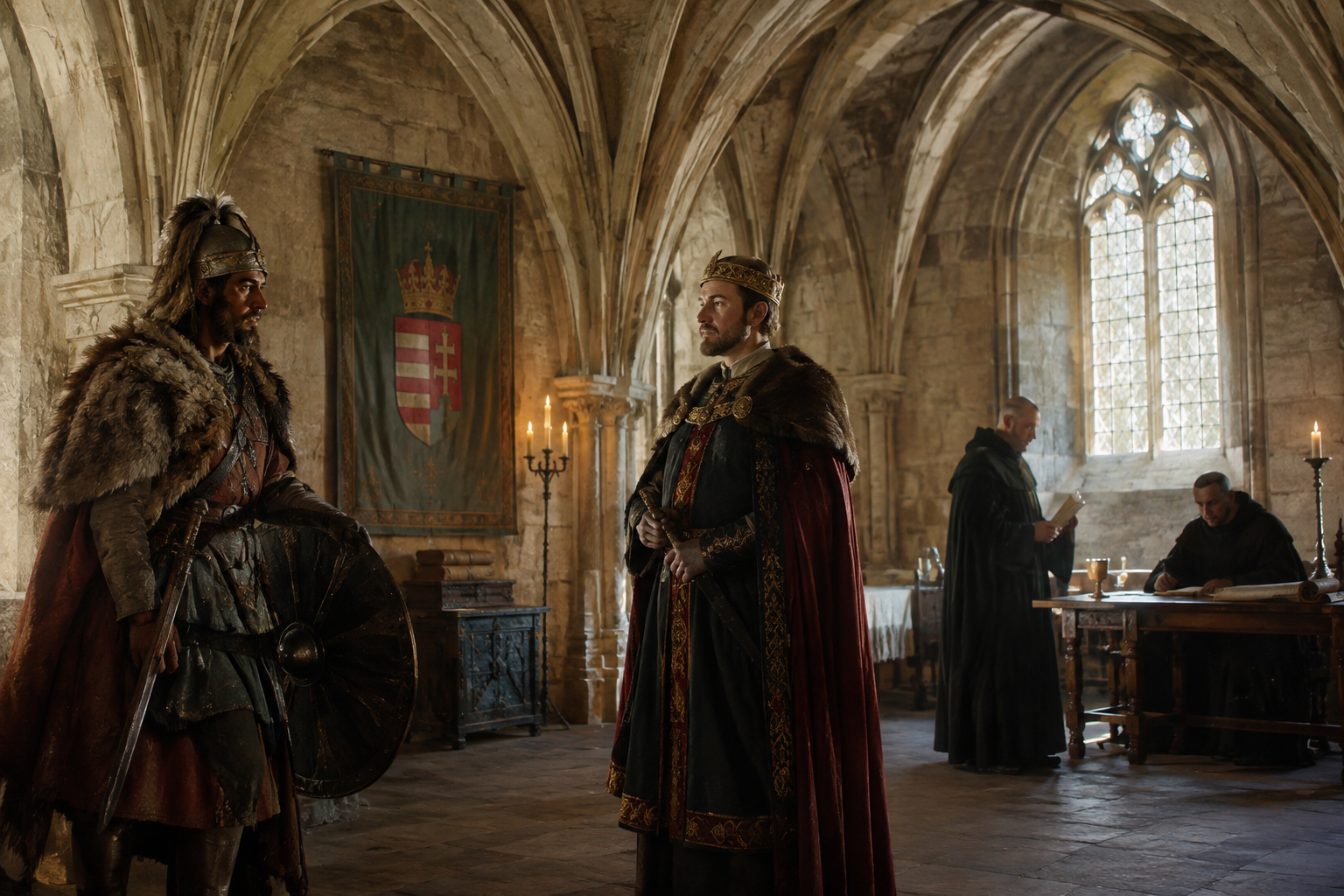
One of the more arresting appearances of haplogroup R1a1a1b2a2a3c2 in the ancient record comes from medieval Hungary, in a burial identified as HUAS82 from the Gothic Vault of the Royal House of Aba, dated to about 1405 AD. That is already enough to make an archaeologist pause. Here is a paternal line turning up not in a vague population average, but in a named elite setting, in a kingdom whose medieval history was built out of older steppe, Carpathian, and European strands.
The same branch is also reported in a much earlier individual, HUN001, an elite Hun warrior from Hungary dated to around 376 AD. Put those two finds side by side and the immediate temptation is to tell a grand tale of direct dynastic survival from the Huns to medieval nobility. Tempting, yes; responsible, no. What the evidence does support is something subtler and, in its way, more interesting: this paternal line appears in two high-status contexts in the Carpathian Basin nearly a millennium apart, across two very different political worlds.
The deeper parent haplogroup R1a is widely associated with many ancient and modern populations across Eurasia, but that broad background is not the same thing as the much narrower branch discussed here. R1a1a1b2a2a3c2 marks one direct paternal line only. It does not describe a whole people, a language, or a complete ancestry profile. Still, when such a lineage appears in archaeological contexts that are both prominent and historically charged, it can help illuminate how male lines moved through power structures over time.
The Carpathian Basin is exactly the sort of place where that matters. Roman frontiers, post-Roman military confederations, Hunnic expansion, Avar rule, the Hungarian Conquest, and the later medieval kingdom all passed through the same broad landscape. Ancient DNA studies of the region have repeatedly shown that this was not a sealed ethnic container but a zone of mixture, continuity, replacement, and reorganization. A recent study on medieval Hungarian elites points in that direction clearly, showing how conquest-period and later elite groups could preserve noticeable steppe-linked ancestry while also belonging to a thoroughly Central European medieval world.
The earlier of the two samples, HUN001, is described as an elite Hun warrior from Hungary, dated to about 376 AD. Even without embroidered storytelling about weapons or costume, that label places him in one of the most disruptive centuries in European history. The late 4th and 5th centuries saw the Huns emerge in and beyond the Carpathian Basin as a military and political force that transformed the late Roman world.
What ancient DNA has done, helpfully, is dismantle the old habit of imagining the Huns as a single biologically uniform people. Research on the broader Hunnic and post-Hunnic world shows a very mixed picture: some individuals carry strong eastern steppe connections, others look more western Eurasian, and many reflect the blending typical of mobile confederations. That means a Y-chromosome result such as R1a1a1b2a2a3c2 is historically useful not because it identifies "the Hun lineage," but because it reminds us that Hunnic elites could incorporate multiple paternal backgrounds.
An ancient DNA study of the period, published in Science Advances, helped establish just how varied the genetic profiles connected with the Hunnic horizon could be in the Carpathian Basin. HUN001 fits that broader lesson well. The Huns were not a neatly bounded tribe in genetic terms; they were a political formation built through movement, alliance, and absorption.
The later sample, HUAS82, comes from a very different setting: the Hungarian nobility, specifically the Gothic Vault of the Royal House of Aba, in a Benedictine monastery context dated to about 1405 AD. Here the same paternal branch appears not in the age of imperial collapse and mounted confederations, but in a Christian, dynastic, and institutionally medieval kingdom.
That shift in setting matters. A monastery vault is part of a world of landed power, patronage, burial memory, and family identity. By the early 15th century, Hungary was not a frontier receiving the first shock of steppe arrivals. It was a mature medieval realm with written lineages, aristocratic competition, and noble houses anxious about legitimacy. Finding this haplogroup in such a burial shows that the branch was present within later elite society, whatever its earlier route into the region may have been.
It is worth keeping the levels of certainty separate. The presence of R1a1a1b2a2a3c2 in HUAS82 does not prove a direct genealogical bridge from any specific Hunnic individual, still less from HUN001 himself. But it does place this paternal line among the lineages carried by people of high standing in medieval Hungary. That is an important historical fact on its own terms.
Research on medieval Hungarian elite burials, including work available at this preprint study, has been especially valuable because it moves beyond legend and asks who these buried elites were genetically, how much continuity they show with earlier groups, and how strongly steppe-associated ancestry remained visible in the kingdom's upper strata.
Ancient DNA often becomes most interesting when the same narrow line appears in contexts that are clearly not identical. HUN001 belongs to the turbulent centuries of migration-era power politics. HUAS82 belongs to a medieval noble and monastic setting. The value of the pair is not that they magically fill every century in between, but that they anchor this haplogroup in two elite environments within the same larger region.
That invites a careful historical reading. The Carpathian Basin repeatedly absorbed incoming groups while also preserving local populations and reshaping social rank. A paternal lineage present in one era's elite could survive, disappear, or re-enter through later movements. So when a branch like R1a1a1b2a2a3c2 turns up in both a Hun-period individual and a medieval noble context, the safest conclusion is that this was one of the lineages circulating within the long-lived exchange zone of the basin, sometimes reaching the top of society.
This is also a useful reminder that elite status does not equal ethnic purity. The late antique "Hun warrior" and the medieval noble in the Aba vault belonged to different political languages, different institutions, and different cultural worlds. Y-DNA links only their direct paternal line, not their entire historical identity.
For someone who carries R1a1a1b2a2a3c2 today, the present evidence gives a focused but intriguing picture. This branch is linked here to at least two ancient men in Hungary: one from the Hun-period elite around 376 AD, and one from a medieval noble burial around 1405 AD. That does not pin your paternal ancestry to a single tribe or dynasty, but it does place your line within a historically important corridor where steppe-linked and European lineages met, mixed, and sometimes rose to prominence.
In other words, this is a haplogroup with evidence of presence in the high-status worlds of both late antique and medieval Hungary. That is not a fairy-tale pedigree. It is something better: a small, hard-won piece of real history.





Comments