Haplogroup R1a1a1b2a2a3b

– 6 min read


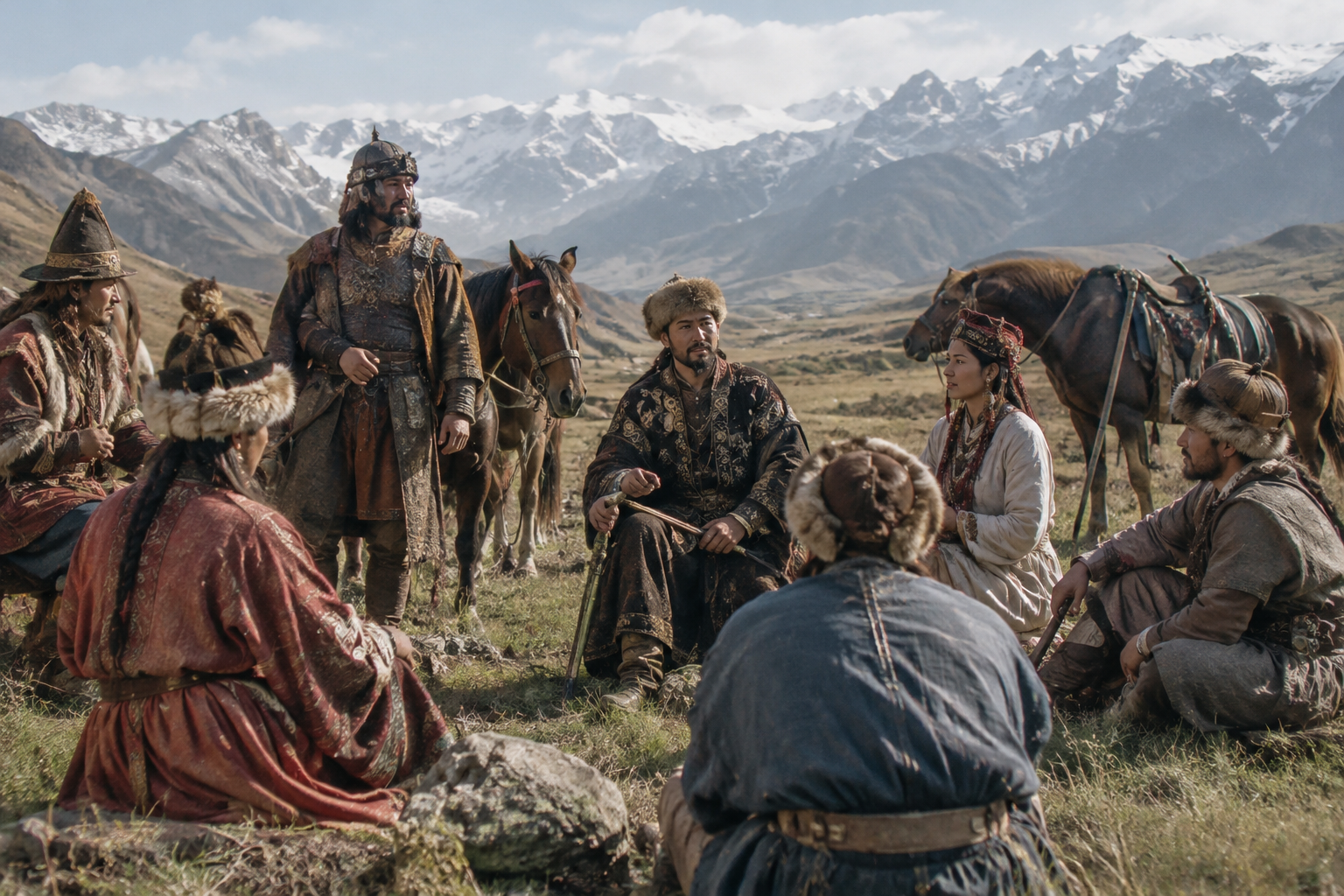
Some Y-DNA lineages announce themselves in the grand capitals of medieval Europe. Others appear first in kurgans, mountain valleys, and steppe cemeteries, among horse-riding societies who left few written records but a great deal of archaeological drama. Haplogroup R1a1a1b2a2a3b belongs to that second category. Its story, at least from the evidence supplied here, is not one of neat dynastic paperwork but of movement across the Eurasian steppe: Saka and Scythian burials in the Tian Shan, Iron Age graves in Kazakhstan, a Sarmatian individual on the Black Sea, and a Hunnic-period burial in Kyrgyzstan.
That makes this lineage historically interesting for a simple reason. It gives us a paternal thread running through some of the most mobile and politically influential regions of ancient Eurasia. Y-DNA traces one direct male line only - father to father to father - so it is never the whole story of a person's ancestry. But precisely because it follows that narrow line, it can illuminate patterns of continuity, migration, and male-mediated expansion that written history often misses.
R1a is one of the major Y-chromosome families of Eurasia, with a deep and complicated history stretching across Europe and Asia. The branch discussed here, R1a1a1b2a2a3b, is a much narrower twig on that large paternal tree. That distinction matters. We should not lazily pour the entire history of broad R1a into this specific subclade as if they were the same thing. Still, the ancient samples linked with this branch strongly place it in an eastern steppe and Inner Asian setting during the Iron Age and the centuries around the turn of the era.
In broad terms, the evidence here points toward a world of steppe confederations, mounted elites, exchange routes, and shifting frontiers between Central Asia and the Black Sea. Rather than tying this haplogroup to one single "people," it is safer to say that it appears in populations associated with Saka, Scythian, Sarmatian, Wusun, and Hunnic-period contexts. That alone is revealing. It suggests that this paternal line participated in the connected but changing societies of the steppe belt, where identities were political and cultural as much as biological.
Readers interested in the bigger archaeological background to steppe genetics may enjoy this broader overview of mobile societies and ancient genomes.
The supplied ancient DNA samples form a striking cluster. Several come from Iron Age Kazakhstan: AKB001 from Qaraghandy, dated to 600 BC; ESZ001 from Iron Age Eleke Sazy Tasmola, also 600 BC; and KSH004 from Karashoky I Tasmolinskaya, again 600 BC. These are not random dots on a map. They sit in a region central to the archaeology of early nomadic steppe societies, where burial mounds, horse equipment, weapons, and prestige goods speak of a mobile aristocratic culture.
Then there is I0577, from Iron Age Arzhan Russia Year:650 BC. Arzhan has long occupied a near-mythic place in steppe archaeology because of its elite burials and its importance for understanding early Scythian horizons. A paternal line appearing there and in Kazakhstan suggests not a single tribe marching in lockstep, but a wider zone of related male lineages circulating among influential steppe communities.
The Tian Shan samples make that picture even sharper. CSP003 and CSP004, both listed as Saka Scythian Tian Shan Year:700 BC, place this lineage in one of the great mountain corridors of Inner Asia. The Tian Shan was never merely a barrier. It was a funnel, a frontier, and a meeting ground. To find related paternal ancestry there is to glimpse the kind of movement that linked mountain pasture, steppe plain, and trade route long before the Silk Road acquired its famous name.
That same corridor continues into later centuries with DA101x, a Hunnic Period Kyrgyzstan Tian Shan Uch Kurbu Year:238 AD individual, and CHN001, listed as Wusun Uyuk-Sagly Chandman Mountain Year:25 AD. These are historically different worlds, yet geographically overlapping ones. The value of ancient DNA is precisely that it lets us ask whether some paternal lines persisted through political change even when the names of the ruling groups changed.
For a closer look at one of those Iron Age Central Asian settings, this related article is especially relevant.
The sample DA139, identified as Sarmatian Black Sea Year:50 AD, is particularly useful because it extends the story westward. The Sarmatians were not simply "the same" as the earlier Scythians, but they emerged from related steppe traditions and occupied an overlapping political landscape from the Don to the Black Sea. A paternal branch found both in Central Asian contexts and in a Sarmatian individual on the Black Sea hints at the long-distance networks that tied the Eurasian steppe together.
Another sample, BDY003 from Korgantas Early Hun Iron Age Bidayk mound 1 Year:250 BC, sits at an intriguing chronological hinge. This was a period when steppe societies were re-forming, expanding, and entangling with powers to the south and west. One can imagine - carefully, and without claiming too much - that lineages like this moved not in a single migration but through generations of alliance, marriage exchange, elite recruitment, and shifting confederations.
That is one of the hardest things for modern readers to grasp. Ancient populations were not static ethnic blocks. The same paternal line could be present in different archaeological cultures because those cultures themselves were fluid. A man buried as "Saka" in one century and another buried in a "Sarmatian" context later on may share a branch of Y-DNA without belonging to the same immediate family, language group, or political community.
If you want to follow that western steppe connection further, the Black Sea and northern Pontic zone are essential reading.
What, then, does R1a1a1b2a2a3b reveal? First, it shows that a specific paternal lineage associated with the wider R1a family appears in a chain of ancient contexts stretching from Iron Age Kazakhstan and the Tian Shan to the Black Sea and into the Hunnic period. That is valuable evidence for distribution and persistence. It helps map male-line presence across a region famous for mobility.
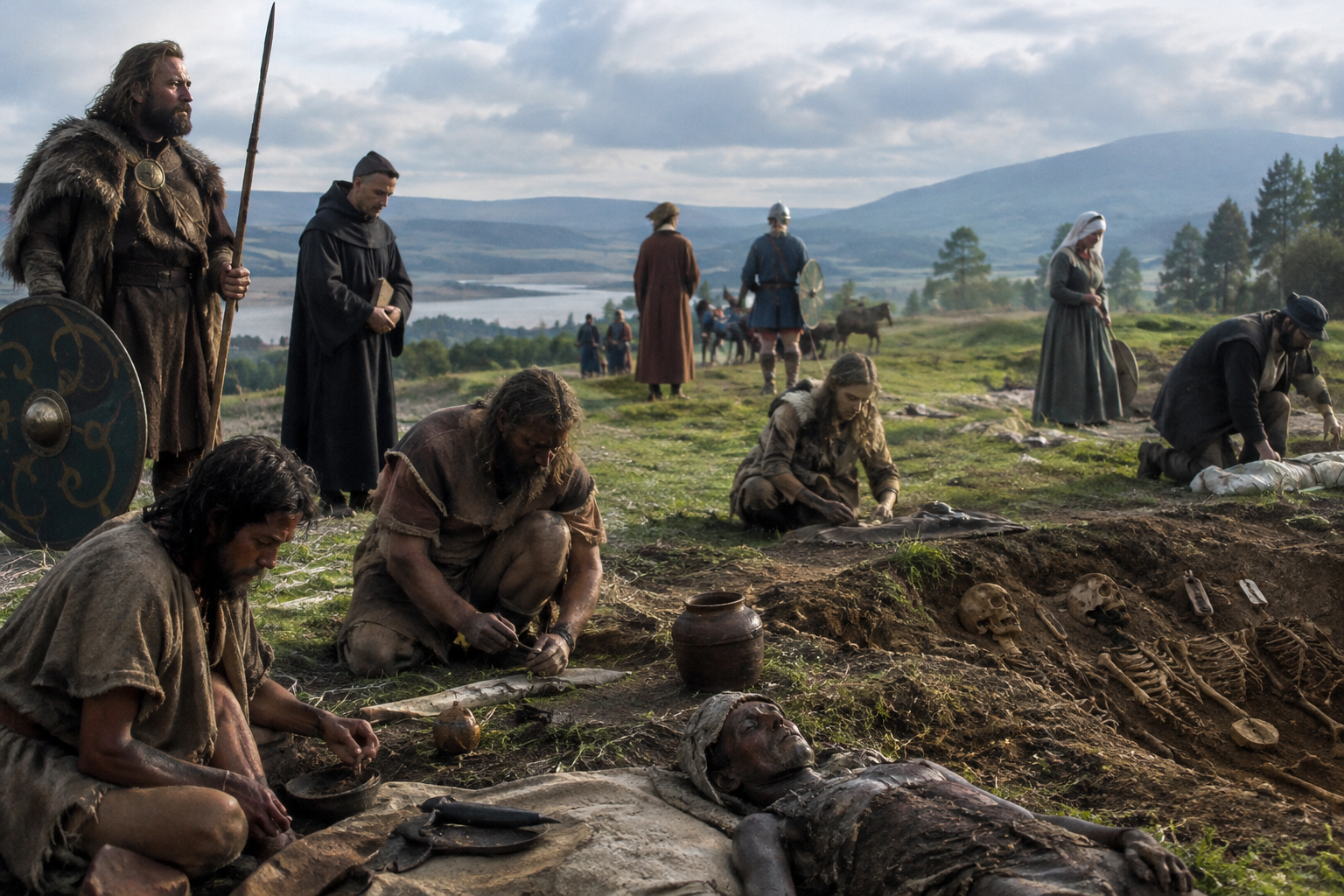
Second, it reminds us that genetics and archaeology answer different questions. Archaeology tells us about burial practice, material culture, landscape, and social display. Genetics tells us about biological relationship at various scales. Put them together, and a cemetery becomes more than a collection of objects: it becomes a record of how real communities formed, moved, and endured.
But there are limits. Sharing this haplogroup with an ancient individual does not prove direct descent from that person. Nor does it make someone automatically Scythian, Sarmatian, Wusun, or Hun. It means that along one paternal line, there is a connection somewhere back in deep time. That is exciting enough without embroidery.
In many haplogroup features, this is the point where we would turn to supplied noble houses, ancestral seats, and castles, and ask how a medieval lineage may sit against the older genetic landscape. Here, though, the input provides no actual noble family or castle data alongside the haplogroup. That is worth saying plainly. The absence matters because it stops us from doing the easy but misleading thing: inventing a bridge from an Iron Age kurgan to a medieval lordly pedigree.
Still, the broader historical lesson is a good one. Medieval genealogies begin late and unevenly; ancient DNA begins earlier but more fragmentarily. The two records illuminate different stretches of the past. Where they overlap, they can be powerful. Where they do not, restraint is the honest option. For this branch, the supplied evidence is strongest in the steppe burials themselves rather than in later castles or named dynasties.
If you are curious how ancient DNA can sometimes intersect with elite and dynastic history when the evidence is available, this article offers a good example.
Read About Scythian Elite Lineages
There is something rather wonderful about a haplogroup like R1a1a1b2a2a3b. It does not sit tidily inside modern national borders. It belongs to a historical zone of horse cultures, burial mounds, mountain corridors, and political worlds that rose and vanished long before modern identities appeared. Through samples such as CSP003, CSP004, I0577, AKB001, ESZ001, KSH004, BDY003, CHN001, DA139, and DA101x, we can see that this paternal branch had a real place in that ancient landscape.
For anyone carrying this haplogroup today, that does not write a ready-made family saga. What it offers instead is something better: context. It places one direct paternal line within the long human history of the Eurasian steppe, among populations whose movements helped shape the ancient world from Central Asia to the Black Sea.
Upload your DNA to MyTrueAncestry to explore whether your own results show links to ancient individuals, archaeological cultures, and deep paternal histories like these. The matches will not prove descent from a specific Scythian rider or Hunnic-period burial, but they may give you a fascinating new angle on where one part of your ancestry story begins.
Comments