Haplogroup R1a1a1b2a2a1d1
– 5 min read


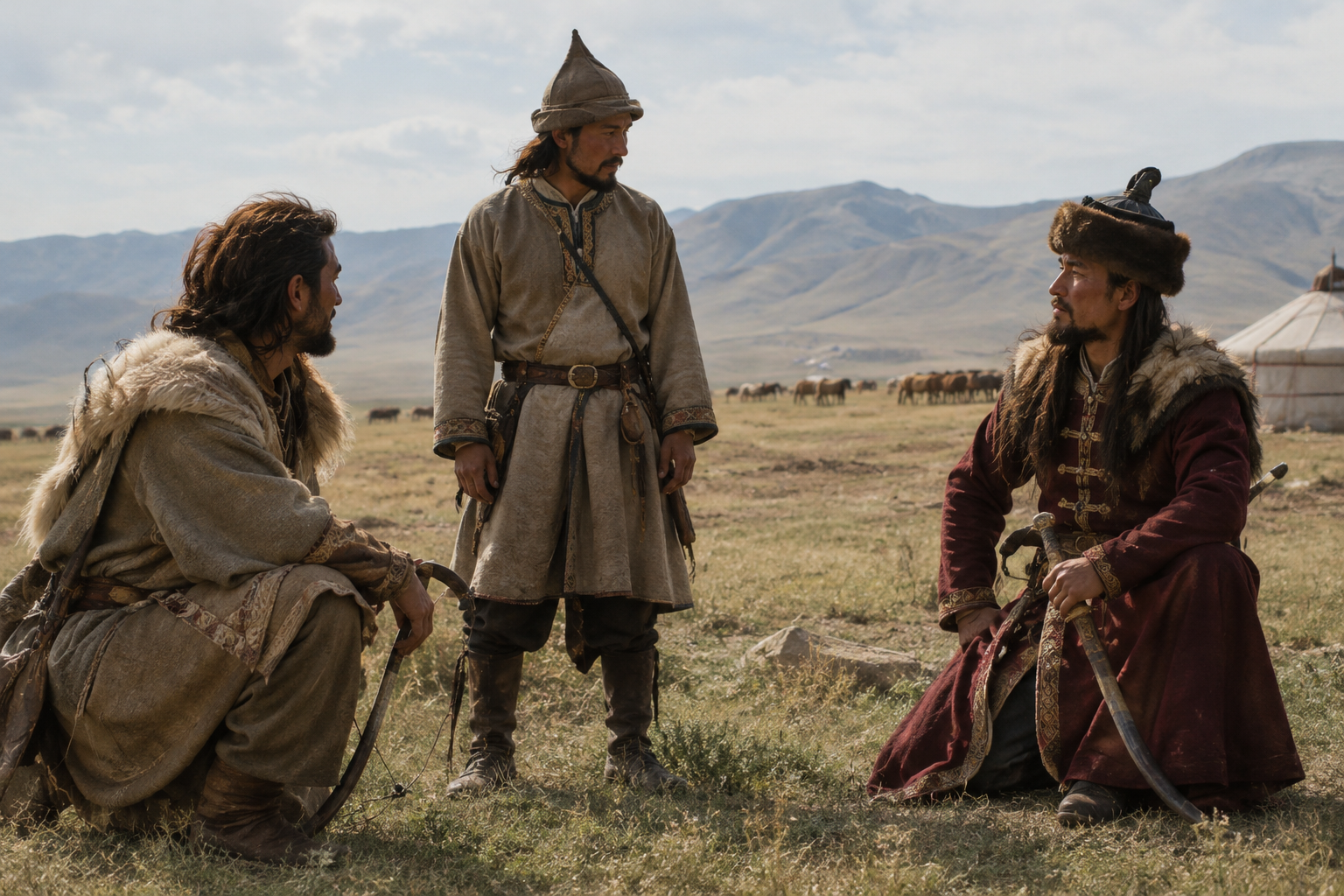
At Uguumur Uul in Mongolia, an individual from the Xiongnu period, dated here to around AD 50 and identified as UGU010, offers the most arresting starting point for this branch. The reason is not that one burial can explain an empire. It cannot. The interest lies in the fact that the paternal line associated with this article, R1a1a1b2a2a1d1, turns up in a setting tied to one of Inner Asia's great confederations, the Xiongnu, whose world connected the eastern steppe to far wider networks of movement, alliance, and conflict.
That matters because this haplogroup is not appearing here in isolation from history. Even with a small set of ancient matches, the pattern reaches across very different archaeological settings: a Bronze Age Andronovo context at Georgievsky Bugor, a Corded Ware horizon individual from the Trans-Volga forest-steppe, and then a later Xiongnu-period burial in Mongolia. Y-DNA traces one direct paternal line, not a person's whole ancestry, but even so, this is a notably steppe-facing sequence of appearances.
R1a1a1b2a2a1d1 is a very precise terminal-style label inside the much broader R1a family. That distinction is essential. The big parent haplogroup R1a has a vast history spread across Eurasia, but a narrow branch like this should not be given the whole biography of R1a by default. What the evidence here supports is more modest and more useful: this lineage is associated, in the ancient examples supplied, with populations moving through the steppe and steppe-edge worlds from the Bronze Age into the early historic period.
The sample set does not justify a claim of one uninterrupted dynasty, one tribe, or one ethnicity. Archaeological cultures, political confederations, and paternal lines are different things. But it does justify taking the steppe corridor seriously as the historical theatre in which this branch appears.
The oldest clearly named setting here is I11540, dated to about 1300 BC at Georgievsky Bugor and assigned to the Andronovo Culture. That places this paternal signal in the Middle to Late Bronze Age world of pastoralist societies stretching across large parts of the Eurasian steppe. Andronovo is archaeologically important because it sits in the long argument about how mobile herding communities linked the forest-steppe, the open steppe, and regions farther south and east.
One should be careful not to over-polish the picture. "Andronovo" is an archaeological label covering a broad and varied horizon, not a single people marching in lockstep across the map. Still, a branch associated with this context belongs in a historical landscape shaped by livestock economies, seasonal movement, and wide contacts across northern Eurasia.
A landmark ancient DNA study on steppe populations helped show just how consequential these Bronze Age movements were for later Eurasian population history, even if any one narrow subclade must be treated cautiously within that larger story: research on Inner Eurasian population structure and mobility remains central to understanding why steppe-linked paternal lines can appear across such distant regions.
The sample kzb007, dated to about 1725 BC and described as Trans-Volga Forest Steppes CWC, pulls the story a little farther west and into the wooded margins of the steppe. "CWC" here refers to the Corded Ware cultural horizon, a vast archaeological phenomenon whose regional expressions linked parts of northern and eastern Europe to the steppe frontier in complicated ways.
This is exactly the sort of case where archaeologists have to resist tidy narratives. A Corded Ware classification does not automatically mean the same ancestry profile everywhere, and it certainly does not mean every man in that world belonged to the same paternal branch. Yet the appearance of this lineage in the Trans-Volga forest-steppe is historically telling because that zone was one of the great contact belts of Eurasia: neither deep forest nor open grassland alone, but a region where populations, technologies, and kin groups met and mixed.
In other words, this branch is not showing up only in one imperial moment or one famous confederation. It is already visible in earlier Bronze Age settings tied to the interaction sphere between steppe pastoralists and neighboring communities. That gives the later Mongolian appearance more depth.
By the time we reach UGU010 at Uguumur Uul, around AD 50, the historical setting has changed dramatically. We are no longer in the Bronze Age world of Andronovo or Corded Ware, but in the era of the Xiongnu, the powerful confederation that dominated much of the eastern steppe and loomed large in Chinese historical writing. A paternal branch found in this context belongs to a world of mounted mobility, imperial negotiation, and multi-regional recruitment.
That last point is especially important. The Xiongnu were not a genetically uniform bloc, and ancient DNA has repeatedly shown that steppe polities could contain striking diversity. So the value of UGU010 is not that it somehow reveals "the" Xiongnu haplogroup. Rather, it demonstrates that this branch had reached, or remained present in, Mongolia within the political orbit of that confederation.
For that wider background, one useful point of orientation is an ancient DNA study of the Mongolian steppe, which helped establish just how dynamic population history in this region was across successive archaeological and historical periods. UGU010 fits best into that larger picture of mixture and mobility, not into a simple tale of one unbroken ethnic line.
Put these three appearances together and a coherent, if carefully limited, picture emerges. The branch is represented in a Bronze Age Corded Ware setting on the Trans-Volga forest-steppe, in an Andronovo-associated context at Georgievsky Bugor, and later in Xiongnu-period Mongolia. That does not prove direct descent from one named ancient man to another. It does suggest that the paternal ancestry behind R1a1a1b2a2a1d1 belonged to the long human traffic of the Eurasian steppe corridor.
This corridor was never just a road for conquest. It was an ecological zone with its own rhythms, where herding, exchange, marriage networks, raiding, diplomacy, and seasonal migration all played their part. Paternal lineages could travel with expanding populations, survive inside mixed communities, or reappear centuries later in quite different political formations.
That is why a branch like this can be historically interesting even from a handful of ancient samples. It links not one civilization to another in a neat chain, but several episodes in the making of Inner Eurasia.
Xiongnu and Hunnic connections
If your Y-DNA falls under R1a1a1b2a2a1d1, the ancient evidence here points most clearly toward a paternal history embedded in steppe and steppe-edge populations rather than in one narrowly local story. The strongest impression is of continuity of presence across very different moments: Bronze Age mobile societies in the Volga and Kazakh steppe worlds, and later the politically complex landscape of Xiongnu Mongolia.
That is a sober but valuable conclusion. Not a promise of descent from a famous ruler, and not a shortcut to ethnic certainty, but a real archaeological clue: this paternal branch has credible ancient appearances in the great connective zone of Eurasia, where some of the most consequential movements in ancient history took shape.
Comments