Haplogroup R1a1a1b2a2a1d

– 4 min read


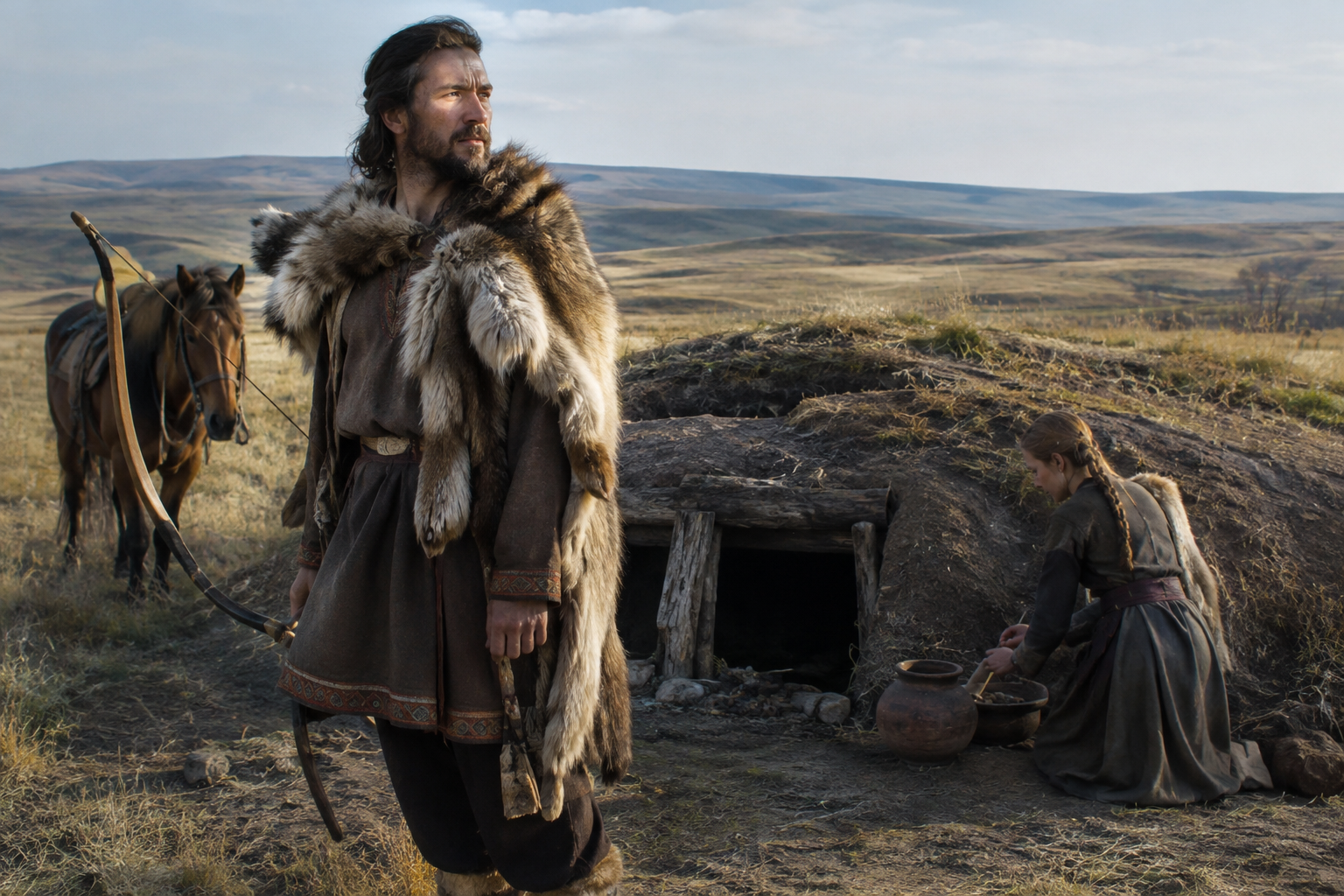
In the steppe country around Kharkiv, an Early Iron Age man known to researchers as I11980 was buried at Kupyevaha in what is now eastern Ukraine, around 675 BC. He belongs to the world often described as Scythian: mobile, connected, and deeply entangled with the great grassland corridor stretching across Eurasia. For anyone tracing the Y-DNA haplogroup R1a1a1b2a2a1d, that is where the evidence begins here: not with legend, but with one excavated individual from the north Pontic steppe.
That matters because a haplogroup this specific is a very narrow paternal branch, not a grand label for an entire people. Y-DNA follows one direct male line only. But when a branch like R1a1a1b2a2a1d appears in an Iron Age burial from the Ukrainian steppe, it immediately places that paternal line in one of the most historically important contact zones in ancient Eurasia.
Kupyevaha sits in a region that, by the 7th century BC, was part of the wider Scythian horizon of the northern Black Sea world. This was not an isolated backwater. It was a frontier and a bridge: between forest-steppe and open grassland, between local communities and long-distance networks, between the Black Sea zone and lands further east.
The sample I11980 gives us something unusually valuable for paternal history: a named ancient individual, a place, and a rough date anchored in archaeology. That does not allow us to reconstruct his language, status, or life story in detail, and it certainly does not make him the representative of all Scythians. But it does show that the paternal branch reported here, R1a1a1b2a2a1d, was present in the Early Iron Age north Pontic world.
This is exactly the sort of evidence that makes archaeogenetics useful. It takes a lineage out of the abstract and puts it into a cemetery, a landscape, and a historical moment. Research on ancient populations of the northern Black Sea region has increasingly shown just how mixed and dynamic these societies were, with biological ancestry, cultural identity, and historical labels not always lining up neatly.
The first temptation with a long Y-DNA label is to turn it into a ready-made migration story. That is usually where caution is needed. R1a as a broad paternal family has a long and complicated history across Eurasia, and many of its branches appear in different places and periods. The branch discussed here, R1a1a1b2a2a1d, is much narrower. The single ancient example supplied for this article shows it in an Early Iron Age Scythian-context burial at Kupyevaha; it does not, by itself, map the entire origin or spread of the branch.
Even so, the context is revealing. A steppe-associated Iron Age find points toward a paternal line moving within, or already established in, the networks that linked eastern Europe to the wider Eurasian steppe. In practical terms for family historians, that means this branch is best understood against the background of mobility, exchange, and regional interaction rather than as a marker of one fixed ethnicity.
That distinction is worth making because historical names like Scythian describe a cultural and archaeological world, not a single bloodline. One cemetery can contain several paternal lines; one paternal line can pass through very different cultures over centuries.
The Kharkiv region is especially interesting because it sits near the meeting point of ecological zones. To the south and east lies the open steppe, so central to mounted pastoral lifeways and long-distance movement. To the north and west are forest-steppe regions with their own settlement histories and local traditions. A burial from this zone belongs, therefore, to a genuinely mixed historical theatre.
That helps explain why ancient DNA from the broader Scythian world has proved so informative. Scythian-era populations were never a single homogeneous block. They were connected communities spread across immense distances, often sharing material culture and aspects of lifeway while still showing local genetic variation. An ancient DNA study of Scythian elites and related burials has helped sharpen that picture, showing how paternal descent could matter within particular communities without reducing the whole phenomenon to one lineage or one origin story. The Harvard Dataverse research collection associated with these materials can be found here.
So when we place I11980 into context, the point is not that he unlocks a single Scythian essence. Rather, he shows one branch of a wider R1a world embedded in the lived archaeology of the Early Iron Age north Pontic frontier.
Readers sometimes assume that a lone ancient sample is too little to say anything useful. In one sense, yes: one man cannot stand in for a continent. But in another sense, archaeology is often built from exactly this kind of disciplined small evidence. A burial with a secure archaeological setting can matter greatly when it pins a lineage to a time and place that are historically meaningful.
Here, the importance lies in the combination of date and region. Around the 7th century BC, the north Pontic zone was becoming central to the history recorded by Greek observers and visible in spectacular steppe archaeology. Communities in this world were participating in networks of warfare, herding, exchange, and prestige that tied the Black Sea to the deep interior of Eurasia. A paternal lineage present there was part of that wider human landscape, whatever later routes its descendants may have taken.
That is also why steppe finds often resonate far beyond Ukraine. Branches associated with Iron Age eastern Europe can later appear, in broader or sister forms, across central Europe, the Balkans, the Eurasian interior, and beyond. The steppe was less a border than a conveyor belt of contact.
For descendants or testers who match R1a1a1b2a2a1d today, the responsible historical takeaway is quite concrete. Your direct paternal line has at least one documented ancient foothold in the Early Iron Age steppe zone, in a burial from Kupyevaha near Kharkiv. That is a strong archaeological anchor.
What it does not mean is automatic descent from a named Scythian chief, or proof of a single uninterrupted ethnic identity across 2,700 years. Y-DNA is narrower and, in some ways, more interesting than that. It shows how one male line persisted through historical worlds that were constantly changing.
The distinctive value of R1a1a1b2a2a1d in this case is not sheer quantity of samples, but clarity of setting. Sample I11980 places this paternal branch in the Early Iron Age Scythian world of eastern Ukraine, a region that mattered enormously in the making of Eurasian history. If your paternal ancestry falls on this branch, the ancient evidence currently points not to courtly fantasy but to the real, mobile, hard-edged landscape of the north Pontic steppe.

Comments