Haplogroup R1a1a1b2a

– 6 min read


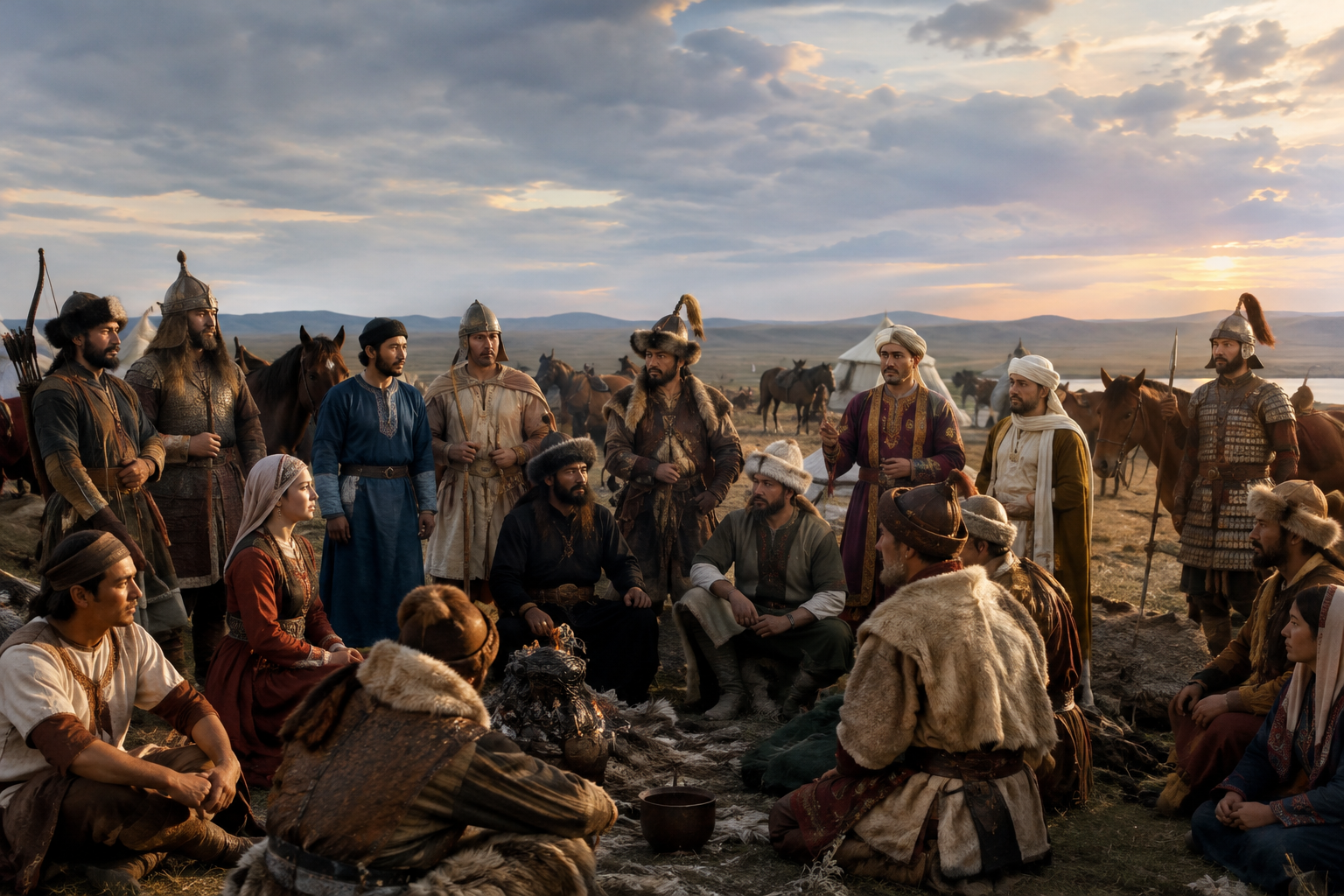
Some Y-DNA haplogroups behave in the historical record rather like recurring cameos. They appear in one age on the Eurasian steppe, turn up again in Iron Age burials, then reappear in the mobile worlds of Huns, Avars, and medieval frontier societies. R1a1a1b2a is one of those lineages. Not because it can be turned into a neat ethnic label - it cannot - but because the ancient DNA linked with this branch places it again and again in zones of movement, exchange, and political upheaval.
That is what makes it so interesting. Y-DNA traces a direct paternal line: father to son to son across time. It does not describe a person's whole ancestry, culture, language, or identity. But when a paternal lineage appears in burials from Bronze Age Samara, Iron Age Kazakhstan, Xiongnu Mongolia, Hun-period Hungary, and even medieval Portugal, it gives us an unusually vivid way to think about how male lines could travel across continents while becoming part of very different societies.
R1a belongs to one of the major Y-chromosome lineages of Eurasia, with a long and complicated history across eastern Europe, the steppe, Central Asia, and parts of South Asia. The specific branch here, R1a1a1b2a, is much narrower than the broad umbrella of R1a, so we must be careful: we cannot simply pour the whole history of R1a into this one subclade and call the matter settled.
What the supplied evidence does suggest is that this branch belongs in the world of steppe-connected populations. The earliest sample in this set, I0432, comes from Middle Bronze Age Poltavka Potapovka-1 Samara Russia, dated to 2745 BC. That places this paternal line, or something close to it, in the Volga-steppe sphere very early on. Another important clue comes from kzb003, listed as Trans-Volga Forest Steppes CWC and dated 1725 BC, suggesting that related paternal lines were also present in the forest-steppe world to the north and west.
Already, then, we are looking at a lineage with deep roots in the steppe and adjoining forest-steppe, precisely the zones that mattered so much for Bronze Age mobility.
Explore the Rise of Ancient DNA
By the Iron Age, the picture becomes broader and more dramatic. Several samples place this haplogroup in the eastern steppe and Central Asian sphere: DA5 from Tagar Iron Age Russia Khakassia Grishkin Log 1 dated 900 BC; BKT001 from Iron Age Bektauta Kazakhstan dated 650 BC; KYZ001 from Iron Age Saka Scythian Kyzylshilik Kazakhstan dated 660 BC; DA15 from the Eurasian Steppes Saka Scythian horizon dated 715 BC; and I12457 from Iron Age Katelai dated 900 BC.
These are not all one people in any simple sense. "Scythian" and "Saka" were labels applied across broad cultural worlds, often covering diverse communities linked by horse culture, archery, seasonal mobility, and steppe political networks. But the repetition is telling. This paternal line was clearly at home in that environment.
The Tagar case is especially evocative. The Tagar culture of southern Siberia has long fascinated archaeologists for its monumental barrows, metalwork, and place in the wider Scythian horizon. Seeing sample DA5 in this context helps remind us that paternal lineages could endure through changing local traditions while still participating in wider steppe systems of exchange and power.
The Kazakh samples point in a similar direction. Whether in Bektauta or Kyzylshilik, this was a world between east and west, one in which populations mixed, adapted, and moved without respect for the tidy borders on modern maps.
Discover Iron Age Scythian Elites
If the Bronze and Iron Age evidence gives us the foundations, the later samples show just how durable and mobile this paternal line could be. One of the most striking is TAK009, from an Elite Grave Xiongnu Empire Mongolia Takhiltyn Khotgor dated 9 AD. That places the lineage in the orbit of the Xiongnu, the great imperial confederation of the eastern steppe.
Then we find it further west in Central Asia: DA229 from Kangju Kazakhstan Kaynar Bulak 2 dated 182 AD, DA206 from Kangju Kazakhstan Konyrtobe dated 250 AD, and DA224 from Late Antiquity Kazakhstan Besynshitobe Burial dated 269 AD. Kangju sat in a crucial corridor between steppe, oasis, and trade-route worlds. These samples do not prove a single unbroken migration, but they do show that this paternal branch belonged in the political geography of Inner Asia.
By late antiquity, the same broad pattern reaches Europe. KRY001, an Elite Hun Warrior Kurayly dated 379 AD, is followed by HDB001, a Hun Elite Warrior Hungary Vidi-zug Grave Hajduboszormeny dated 450 AD, and TGB023, a Hun Invader Hungary Danube-Tisza dated 500 AD. This is not just movement. It is movement tied to military aristocracy, conquest, and elite burial.
And after the Huns came the Avars. Here too the lineage appears in high-status contexts: MMper227 from Hungary Avar Master Mako-Mikocsa dated 599 AD, DKper701 from Hungary Elite Avar Warrior Dunavecse-Kovacsos dated 650 AD, and JHT-130 from Late Avar Hungary Janoshida-Totkerpuszta dated 800 AD. Taken together, these finds suggest a paternal branch repeatedly present in steppe-derived or steppe-connected elite settings across a very long period.
That does not mean every Hun, Avar, or steppe warrior carried this lineage. Far from it. But it does show that R1a1a1b2a was part of the paternal repertoire of the Eurasian mounted empires.
One sample in the list looks, at first glance, almost mischievous: LP115_3, from Medieval Portugal Umayyad Caliphate Hospital da Misericordia dated 1250 AD. By this point we are a very long way from Samara, Khakassia, Mongolia, or the Hungarian plain.
But this is exactly the sort of result that makes ancient DNA so useful. Medieval Iberia was a meeting ground of local continuity, Roman legacies, Visigothic and post-Roman movements, Islamic-period mobility, enslavement, trade, conversion, and frontier settlement. A paternal line with deep steppe associations appearing in Portugal should not be treated as bizarre or impossible. It is a reminder that medieval populations were often more mixed, more mobile, and more entangled than older national stories allowed.
Nor does this Portuguese sample prove a direct line from any Hun warrior to any man in medieval Iberia. What it does prove is presence: this paternal branch, or a closely related one, had by then become part of the westernmost fringes of Europe.
Explore the Genetic History of Portugal
In this case, the supplied noble-family field is effectively empty, and that is worth saying plainly rather than papering over it. There are no specific family names, dynasties, or castles in the input to anchor R1a1a1b2a to a documented medieval house. So it would be irresponsible to invent an aristocratic pedigree or pretend that a line found in Hun or Avar burials somehow points straight to a later noble surname.
Still, the absence is instructive. One of the lessons of archaeogenetics is that paternal lines often have histories far older, and far more geographically expansive, than the written genealogies of medieval and early modern elites. Castles and noble archives preserve family memory over centuries; Y-DNA sometimes preserves paternal continuity across millennia. The two can complement one another, but they are not the same thing.
If future work were to connect a historically documented house to this branch through secure testing, that would be fascinating. For now, the more honest story is broader and, in its way, grander: a paternal line moving through the Bronze Age Volga, the Iron Age steppe, Xiongnu Mongolia, Central Asian polities, Hun-period Hungary, Avar elite society, and medieval Iberia.
R1a1a1b2a shows why narrow Y-DNA branches can be historically powerful when paired with archaeology. On its own, the haplogroup is just a label on the Y-chromosome tree. Set beside burials like I0432, DA5, TAK009, HDB001, or LP115_3, it becomes a way of tracking long-term male-line presence across some of the most dynamic regions in Eurasian history.
It also shows the limits of what DNA can say. Shared haplogroups do not prove close kinship. They do not assign a single ethnicity. They do not guarantee descent from famous warriors, kings, or noble houses. What they do offer is a framework for asking better historical questions: where did paternal lines persist, where did they move, and how were they absorbed into new societies?
For MyTrueAncestry users, that is part of the excitement. Your paternal line may connect, in a broad deep-history sense, with ancient individuals from archaeological sites that no written family tree could ever reach. Not because they were your named ancestors in a tidy genealogical chart, but because they belonged to the same long paternal stream flowing through history.
If you want to explore whether your own DNA shows links to ancient populations like the steppe herders, Saka, Xiongnu, Huns, Avars, or medieval Iberian communities discussed here, MyTrueAncestry can help place your results in that wider archaeological setting. These comparisons can open remarkable windows onto the past, even when they do not prove direct descent from any one ancient person or noble family.
Comments