Haplogroup R1a1a1b2

– 6 min read


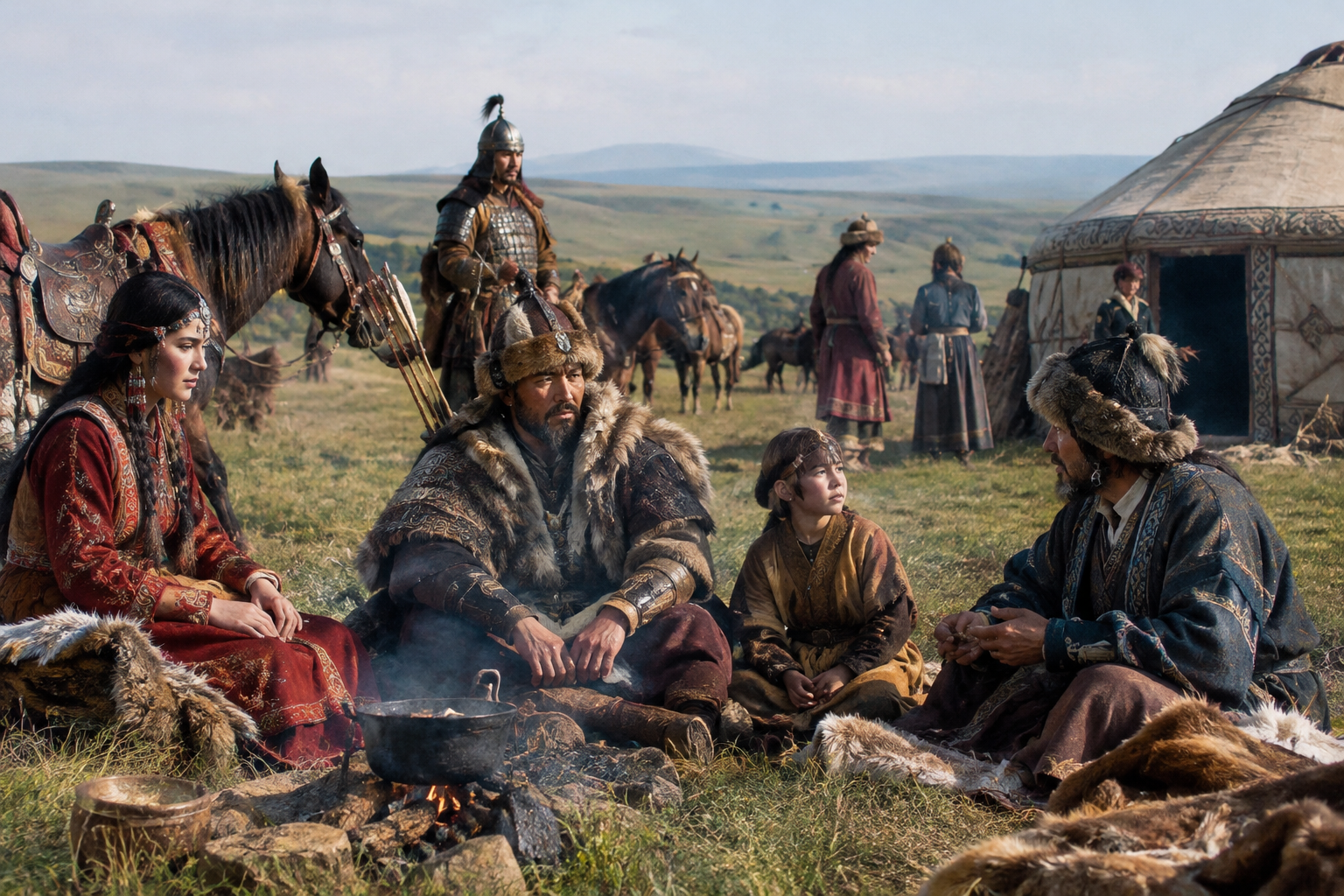
Some Y-chromosome lineages are easiest to understand when they stay politely in one region. R1a1a1b2 is not one of them. It appears instead in a long arc of ancient discoveries stretching from Bronze Age northern Europe through the forest-steppe and deep into Central and South Asia. That alone makes it historically interesting: not because a haplogroup can tell us everything about a people, but because it can reveal one narrow, stubborn line of paternal continuity moving through very different worlds.
As ever with Y-DNA, a caution comes first. A Y-haplogroup tracks only one direct paternal line - father to father to father - and not a person's whole ancestry. Nor does sharing a haplogroup prove close kinship, shared language, or membership in the same historical nation. But when archaeologists recover the same paternal branch from men buried in widely separated times and places, the result can be wonderfully illuminating. In the case of R1a1a1b2, the evidence points toward a lineage with strong ties to steppe and forest-steppe populations, later found among mobile Iron Age groups and in post-Roman and medieval settings farther south and east.
R1a sits within one of the best-known Y-chromosome families of Eurasia, but a specific branch such as R1a1a1b2 has to be treated carefully. We should not simply pour the entire history of broad R1a into this narrower subclade. What the supplied ancient DNA does show is that lineages assigned here were already present in several important prehistoric settings linked to the wider steppe world and its northern neighbours.
One striking early example is RISE189, from Bronze Age Sweden Snorthog, dated 2100 BC. That matters because it places this paternal branch in Scandinavia during a period when northern Europe was deeply entangled with wider Corded Ware and post-Corded Ware developments. It does not mean every Bronze Age Scandinavian man belonged to this lineage, still less that later Scandinavian elites descended from this individual. But it does show that this branch was part of the paternal landscape of the far north surprisingly early.
Farther east, the pattern becomes denser. The EBA Fatyanovo samples - HAN002 and HAN004 from Khanevo near Moscow, HAL001 from Khaldeevo in Yaroslavl, and NAU001 and NAU002 from Naumovskoye in Yaroslavl, dated 2600 BC and 2700 BC - place the lineage within the Fatyanovo horizon of forest-zone Russia. Fatyanovo communities are often discussed as part of the wider Corded Ware-derived expansion into the forests northeast of the steppe. Here the paternal evidence suggests that branches related to steppe-derived male lines had moved into those northern woodlands very early.
Explore Scandinavian Battle Axe DNA
By the Middle and Late Bronze Age, the geographic spread is broader still. mur003 from the Trans-Volga Forest Steppes Muradym dated 1820 BC, I2163 from a Pontic-Caspian Steppes Invader dated 1700 BC, and I0423 from the Late Bronze Age Srubnaya Barinovka Samara Russia dated 1525 BC all point to a lineage moving through, or remaining established within, the great corridor between forest and steppe. Then come the Andronovo Culture individuals I11537 and I6047, both dated 1300 BC, reminders that this paternal branch also belonged to Bronze Age communities tied to the eastward extension of steppe-derived populations.
If the Bronze Age samples show the foundations, the Iron Age samples give the lineage its drama. Here R1a1a1b2 turns up in the kind of archaeological settings that most people immediately associate with mounted mobility, elite burials, and the vast cultural zone often labelled Scythian or Saka.
In the western steppe and forest-steppe, there is UKR095, an Ancient Individual: Scythian Forest Steppes Ukraine Kharkiv dated 389 BC, and MJ34, from the Western-Scythian Black Sea dated 290 BC. These samples matter because they place the lineage in the northern Black Sea world, that complicated frontier where Greek colonies, pastoral confederations, and local farming communities met. A shared haplogroup does not make these men members of one dynasty or tribe, but it does show a paternal presence in the very heartland of Iron Age steppe history.
Then there is Kazakhstan. KOT003, an Elite Saka Iron Age Koktubek East Kazakhstan individual dated 650 BC, and TAL003, from a High Ranking Saka Scythian Grave Taldy Kazakhstan also dated 650 BC, place the branch among high-status Saka burials. Add KSH001 and KSH003 from Iron Age Karashoky I Tasmolinskaya, both dated 600 BC, and the pattern becomes hard to ignore. This is not a stray occurrence. It is a repeated paternal signal in elite and non-elite steppe contexts across a very large region.
Other finds widen the picture further: BSB001 from Sarmatian Bisoba mound 3 burial 1 dated 450 BC, DA382 from the Median Dynasty Turkmenistan dated 800 BC, and I6893 from the Saidu Sharif Buddhist Monastery dated 400 BC. That last sample is particularly revealing, because by the time we reach Buddhist monastic sites in the northwest of South Asia, we are already well beyond the classic steppe homeland. The same paternal branch has entered a world of monasteries, urban contacts, and cross-cultural exchange.
Readers interested in the broader archaeological backdrop may also want to compare this pattern with the community article on Genetic Origins of Scythians: An Archaeogenetic Odyssey, which explores the wider genetic complexity behind the names "Scythian" and "Saka."
The later samples show that the story did not end with the Iron Age. UKR123, from the Iron Age Forest Steppes Ukraine Poltava Chernyakhiv dated 229 AD, places the lineage in the world usually associated with the Chernyakhiv horizon, itself a famously mixed archaeological complex. That alone is a useful reminder that paternal lineages survive political and cultural change with great indifference to the labels historians later apply.
In Central Europe, GHD003 from Post Roman Pannonia Arrabona Gyirmot Barbaricum Hungary dated 550 AD shows the lineage in the unsettled centuries after Roman rule. Pannonia was one of those provinces where imperial borders, migrant groups, and local communities blended into something far less tidy than textbook maps suggest.
And farther south and east again, the lineage appears in medieval contexts: I2959 from a Medieval Ghaznavid Mosque dated 1120 AD, I2960 from a Medieval Ghaznavid Mosque Child also dated 1120 AD, ALN002 from an Iron Age Alai Nura Burial dated 300 AD, and I6946 from Skeleton Lake Hindu Worshipper dated 830 AD. Taken together, these finds show a paternal lineage present across religious and political settings that range from steppe kurgans to monasteries, mosques, and pilgrimage-related landscapes.
Explore Post-Roman Pannonia DNA
The supplied noble-family field is empty here, which is actually a useful discipline. It means we should resist the common temptation to leap from an ancient Y-lineage to a medieval surname, a princely house, or a castle on a hilltop somewhere in Europe. Genetics is at its best when it is precise, and in this case the evidence is strongest for ancient and early medieval population history rather than for any documented noble pedigree.
Still, the absence of a named dynasty does not make the history less interesting. On the contrary, it reminds us that many paternal lines with deep archaeological visibility long predate heraldry, castles, and written genealogies. By the time medieval noble families began building stone residences and preserving charters, lineages like R1a1a1b2 had already been moving through Eurasia for millennia. Castles preserve family memory; ancient DNA preserves something even older, though much narrower: a surviving paternal thread.
That distinction matters. A noble house may one day be associated with a haplogroup through direct testing of authenticated remains or well-documented living-line descendants. But without that level of evidence, the honest claim is not descent - only historical context. In other words, ancient DNA can tell us about the landscapes and populations from which later kingdoms emerged, not automatically about which baron or prince carried which exact branch.
Learn How Archaeogenetics Works
What makes R1a1a1b2 so compelling is the combination of breadth and continuity. In the evidence supplied here, it appears in Bronze Age Sweden, in Fatyanovo forest communities, in Srubnaya and Andronovo settings, among Scythian, Saka, and Sarmatian burials, in post-Roman Hungary, and in medieval Islamic and South Asian contexts. That does not describe a single people. It describes a paternal line that travelled through many peoples.
And that, perhaps, is the real lesson. Haplogroups do not map neatly onto modern identity. They show persistence through upheaval, mobility across frontiers, and the sheer untidiness of Eurasian history. A branch like R1a1a1b2 is not a badge of one civilisation. It is a clue to the men who helped populate several of them.
If you want to explore the wider eastern dimension of this story, the MyTrueAncestry community also has a useful companion piece on Ancient DNA Unveils Eastern Roots of Uralic Languages, Bridging Siberia and Europe, which shows how genetics can illuminate long-distance northern Eurasian connections without reducing them to simple formulas.
Upload your DNA to MyTrueAncestry to see whether your own results show links to ancient individuals from the steppe, the forest zone, or later historical populations. Those matches do not prove direct descent from a Scythian rider, a Saka noble, or any later noble family - but they can place your ancestry in the same deep historical landscapes revealed by ancient DNA.
Comments