Haplogroup R1a1a1b1b

– 5 min read


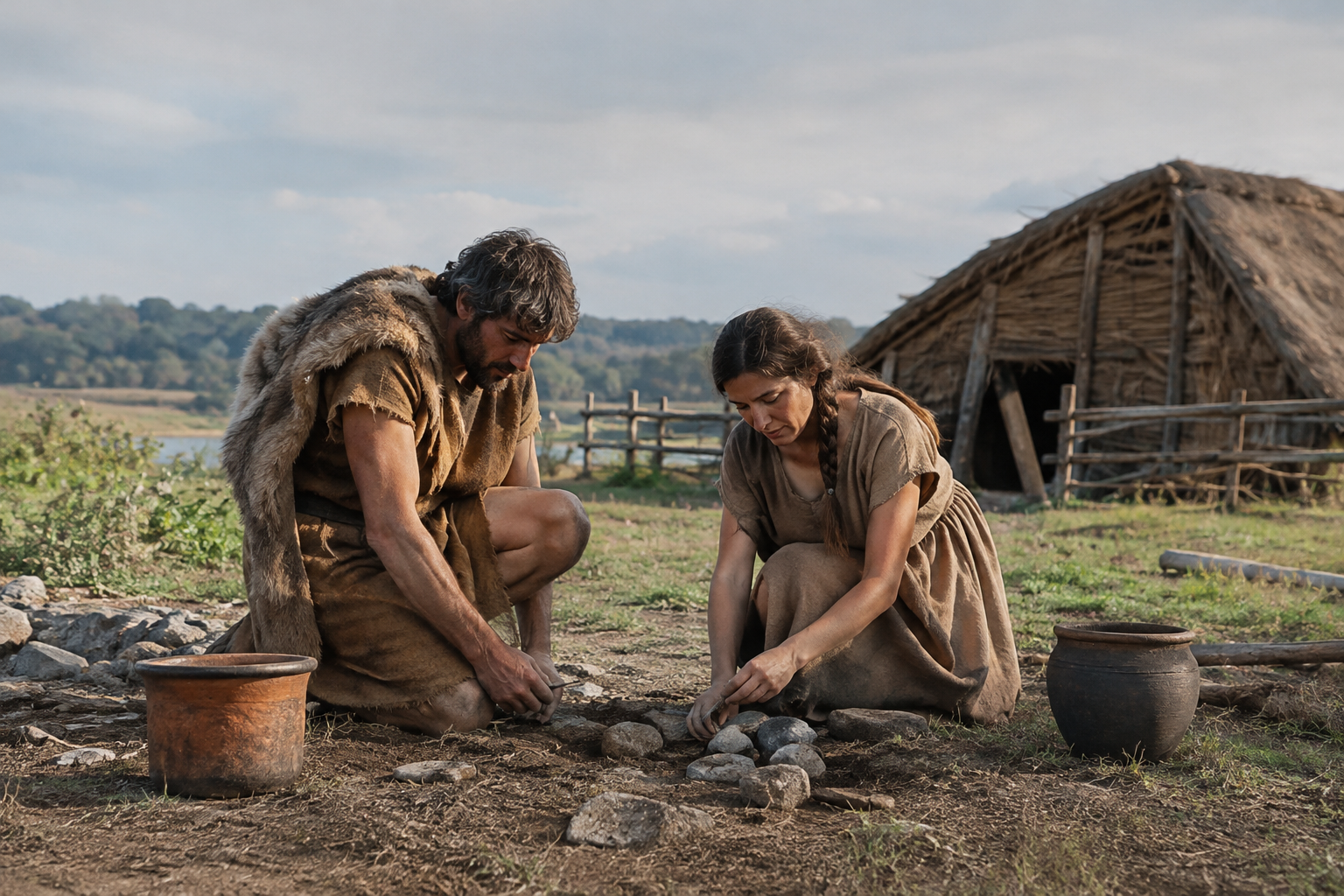
At Schleinbach in Lower Austria, one Bronze Age man dated to around 1875 BC carries the sample ID SLB028. He is the most concrete anchor here for the Y-DNA haplogroup R1a1a1b1b: not a legendary founder, not a dynastic mascot, but a real excavated individual from an Early Bronze Age community on the north side of the Danube world.
That matters because R1a1a1b1b is a very specific paternal branch within the broader R1a family, and ancient examples at this level help pin the lineage to actual places and periods. Y-DNA traces one direct male line only, so it does not define a person's whole ancestry. But when a lineage turns up in a dated burial like SLB028, it gives us a sharp historical snapshot: one paternal line present in Bronze Age Austria, in a region where farming villages, metal exchange, and long-distance human movement were already reshaping society.
Schleinbach sits in a part of Central Europe that was anything but isolated in the early 2nd millennium BC. This was a world of settled agricultural communities, changing burial customs, and growing links across the Carpathian Basin, the Danube corridor, and the lands further north and east. A single Y-chromosome result cannot tell us everything about that movement, but it can show which paternal lines had become part of these local populations.
In that sense, SLB028 is valuable precisely because he is ordinary in the archaeological sense. He represents not a courtly burial or an elite tomb famous from schoolbooks, but the kind of excavated person who lets archaeologists reconstruct population history from the ground up. The presence of R1a1a1b1b in this context fits a broader picture in which branches of R1a had already become established across parts of Central and Eastern Europe by the Bronze Age, though the exact histories of the narrower subclades remain much harder to map than the parent lineage.
A useful regional backdrop comes from MyTrueAncestry's own discussion of Bronze Age Austria, where ancient DNA and archaeology are brought together to show how dynamic these communities were.
The temptation with any R1a lineage is to leap straight into vast stories about steppe expansions, Indo-European languages, or later ethnic groups. Some of those larger histories are relevant in the background, but the narrower branch R1a1a1b1b should not simply be treated as shorthand for the whole of R1a. Ancient Y-DNA nomenclature can also vary in resolution from study to study, which means a reported match to this article's branch needs to be handled carefully unless the exact downstream placement is securely stated.
What we can say with confidence is that SLB028 belongs to a paternal tradition already well at home in Bronze Age Europe. The broader R1a family is frequently associated with populations connected, in different times and places, to the spread of steppe-related ancestry across much of the continent. But one Austrian man around 1875 BC is not proof of a single migration event, still less of a language spoken in his household. He is evidence of presence, not a complete historical script.
Lower Austria in the Early Bronze Age was part of a connected frontier between older local traditions and expanding exchange networks. Metal objects, raw materials, and people moved across this landscape. So did pathogens. That is one reason research on the region has drawn attention not just from geneticists studying ancestry, but from scholars interested in the biological pressures shaping Bronze Age communities.
One relevant research lead comes from work on Early Bronze Age burials in northeastern Austria, including the cultural setting of ancient plague cases at Drasenhofen. Although that study is not a sample card for SLB028, it is useful as regional context for the wider world these communities inhabited: research published on Early Bronze Age graves in Austria highlights how archaeology, biomolecular evidence, and local cultural history can be read together.
This is an important corrective to over-simple ancestry stories. Bronze Age populations were not just moving pieces on a migration map. They were living through episodes of settlement change, kinship formation, exchange, and disease exposure. A haplogroup like R1a1a1b1b belongs inside that lived world.
It is easy to underestimate what one dated male lineage can do. In older histories of Europe, grand narratives were often built from artefacts alone and then matched, sometimes rather lazily, to later peoples. Ancient DNA has made that harder. A sample such as SLB028 gives us a fixed point: this paternal branch, or a very close placement within it, was present in Bronze Age Austria at a specific archaeological horizon.
That kind of fixed point is especially useful in Central Europe, where the Bronze Age was not a blank interval between the Neolithic and the Iron Age, but a period of major social consolidation. Communities here linked the Alpine world, the Danube basin, and the routes leading toward the steppe and the Baltic. If your paternal line falls within R1a1a1b1b, the significance is not that you can claim descent from one excavated man at Schleinbach, but that your direct male line belongs to a branch already moving through the historical currents of Bronze Age Europe.
For readers interested in how genetics is being used to trace later language and population developments in Europe, this companion article is particularly relevant:
Germanic languages and genomics
There is also a deeper prehistoric backdrop. By the time SLB028 lived, Austria had already seen millennia of population change: early farmers arriving from the southeast, interactions with surviving hunter-gatherer groups, and later waves of ancestry linked to steppe-derived populations. The Bronze Age did not wipe that slate clean. Instead, it layered new social formations on top of a long and tangled genetic history.
That is why Y-DNA has to be read alongside archaeology. A man with R1a1a1b1b in Bronze Age Schleinbach was not merely the carrier of a paternal label. He belonged to a local community shaped by marriages, seasonal work, land use, inheritance, and regional contacts. Ancient DNA helps us identify one line of descent within that community, while archaeology reminds us that people never lived as haplogroups alone.
For a wider prehistoric frame on how ancient DNA changed the study of such questions, MyTrueAncestry's overview of the rise of archaeogenetics is worth revisiting.
R1a1a1b1b enters the ancient record here through SLB028, a man from Bronze Age Schleinbach in Austria around 1875 BC. That is a modest piece of evidence, but a very real one. It places this paternal line in a Central European setting shaped by Bronze Age mobility and community formation, and it does so without the usual fog of later legend.
If this is your haplogroup, the strongest historical lesson is not a claim to one tribe, one kingdom, or one heroic ancestor. It is that your direct paternal line belongs to a branch already present in the complex human world of Bronze Age Central Europe, where local lives were tied to much larger networks of movement and change.

Comments