Haplogroup R1a1a1b1a2b3a3a2h

– 4 min read


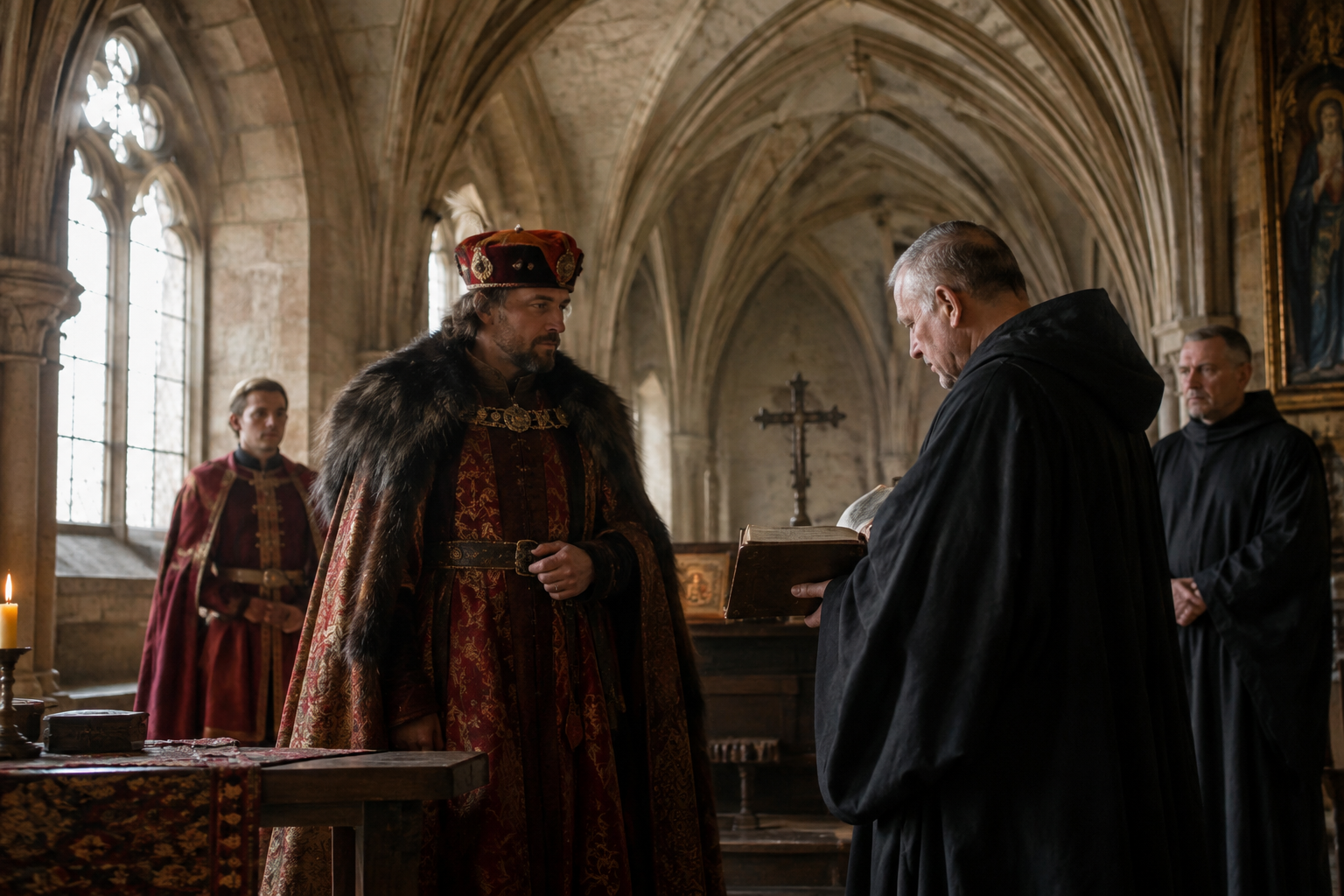
In 1405 AD, a man later identified as HUASper87 was buried in the Gothic vault of the Royal House of Aba at a Benedictine monastery in Hungary. That is already a striking combination of clues: a named noble context, a late medieval burial, and a setting built to preserve family memory as much as mortal remains. For the haplogroup R1a1a1b1a2b3a3a2h, this is not a vague prehistoric signal from a broad region, but a direct paternal line attached to one very specific funerary setting in the Hungarian nobility.
The fascination here lies in scale. Y-DNA traces one narrow line of descent, father to son, not a person's whole ancestry. Yet when that line turns up in an identifiable aristocratic burial, it gives us something unusually concrete: not just a branch on a genetic tree, but a man placed inside the ceremonial world of medieval power, monastic patronage, and family remembrance.
The key evidence in this case is the burial of HUASper87 in the Gothic vault associated with the Royal House of Aba. The Aba kindred occupies an important place in early Hungarian history, emerging among the leading noble lineages of the kingdom and connected in tradition and politics to the formative centuries after the Hungarian conquest of the Carpathian Basin. By 1405 AD, however, we are not looking at a conquest-period horseman or an early tribal chief, but at the long afterlife of lineage itself: how elite families used churches and monastic foundations to anchor status across generations.
The exact haplogroup given here, R1a1a1b1a2b3a3a2h, is a very narrow terminal designation. That matters, because broad statements about all R1a lineages would be misleading. R1a as a parent haplogroup has a deep and complex history across Eurasia, but this article's subclade is evidenced here through a late medieval Hungarian noble burial, and that is the scale at which the story should be told.
A recent ancient DNA study of medieval Hungary's elite has helped frame this wider context, examining how later noble groups could preserve ancestry signals linked to earlier population movements and elite formation in the Carpathian Basin. The relevant research can be found here: https://www.biorxiv.org/content/10.1101/2024.03.20.585718v1.
It is easy to be distracted by the word "royal" and forget the archaeology. But the Benedictine monastery context is crucial. Medieval monasteries were not just religious houses; they were political landscapes in stone. Burials placed within them, especially in family vaults, were statements about legitimacy, patronage, and continuity. A noble house buried its dead there not by accident, but because the place itself helped construct memory.
That makes HUASper87 more than an isolated genetic datapoint. He belongs to a social world in which descent had legal, political, and spiritual weight. In such a setting, a Y-chromosome lineage becomes especially interesting because medieval noble identity often cared intensely about the paternal line, even if real families were, biologically speaking, much more complicated than heraldic ideals allowed.
Still, caution is essential. A single burial in a noble vault does not by itself prove that every man associated with the House of Aba carried the same Y-DNA branch, nor does it magically solve every genealogical problem around medieval Hungarian aristocracy. What it does provide is a documented case where the haplogroup R1a1a1b1a2b3a3a2h is tied to an elite burial context of high historical interest.
By the early 15th century, Hungary was already an old Christian kingdom with centuries of dynastic change behind it. The world of the Aba vault was far removed from the first Magyar conquest of the Carpathian Basin in the 9th and 10th centuries, yet aristocratic families often built their authority on claims of ancient standing. Genetics cannot simply confirm those claims in a neat, one-to-one fashion, but it can show that some later elites retained paternal lines that may have been circulating among earlier regional power networks.
This is one of the reasons medieval elite DNA from Hungary has attracted such attention. The kingdom sat at a crossroads between western, central, eastern, and steppe-connected worlds. Its nobility was never genetically uniform. Instead, what the growing body of archaeogenetic work suggests is a layered society, where some lineages endured, others arrived, and all of them were folded into the political framework of the Hungarian crown.
R1a lineages are well known across large parts of East-Central Europe, the Eurasian steppe, and South Asia, but that broad distribution is precisely why restraint is needed. One cannot leap from a terminal branch such as R1a1a1b1a2b3a3a2h to sweeping claims about Scythians, Slavs, early Indo-Europeans, or medieval dynasties unless the evidence directly supports the connection.
What can be said more responsibly is that a branch within this wider paternal family appears in a medieval Hungarian nobleman buried in an ecclesiastical family vault. That places the lineage within the historical fabric of Christian aristocratic Hungary, a realm shaped by conquest-period inheritances, intermarriage, regional alliances, and centuries of political transformation.
The case also illustrates a broader truth in archaeogenetics: the most revealing ancient samples are not always the oldest. A late medieval burial can be historically richer than a much earlier anonymous grave if the archaeological context is secure and the social meaning of the burial place is clear.
For someone who discovers they belong to R1a1a1b1a2b3a3a2h, HUASper87 offers a historically vivid point of comparison: this paternal line is attested in a 1405 AD noble burial from Hungary, in the Gothic vault of the Royal House of Aba. That does not prove direct descent from the Aba family, nor does it mean every bearer of the haplogroup belongs to a medieval noble house. But it does show that this branch had a place within the elite social landscape of late medieval Hungary.
And that is really the value of a case like this. Instead of a hazy map dotted with modern frequencies, we get one man, one vault, one kingdom, and one paternal line preserved in the archaeological record. R1a1a1b1a2b3a3a2h appears here not as an abstract code, but as part of the lived and carefully commemorated world of medieval Hungarian nobility.


Comments