Haplogroup R1a1a1b1a2b3a3a2g2b

– 4 min read


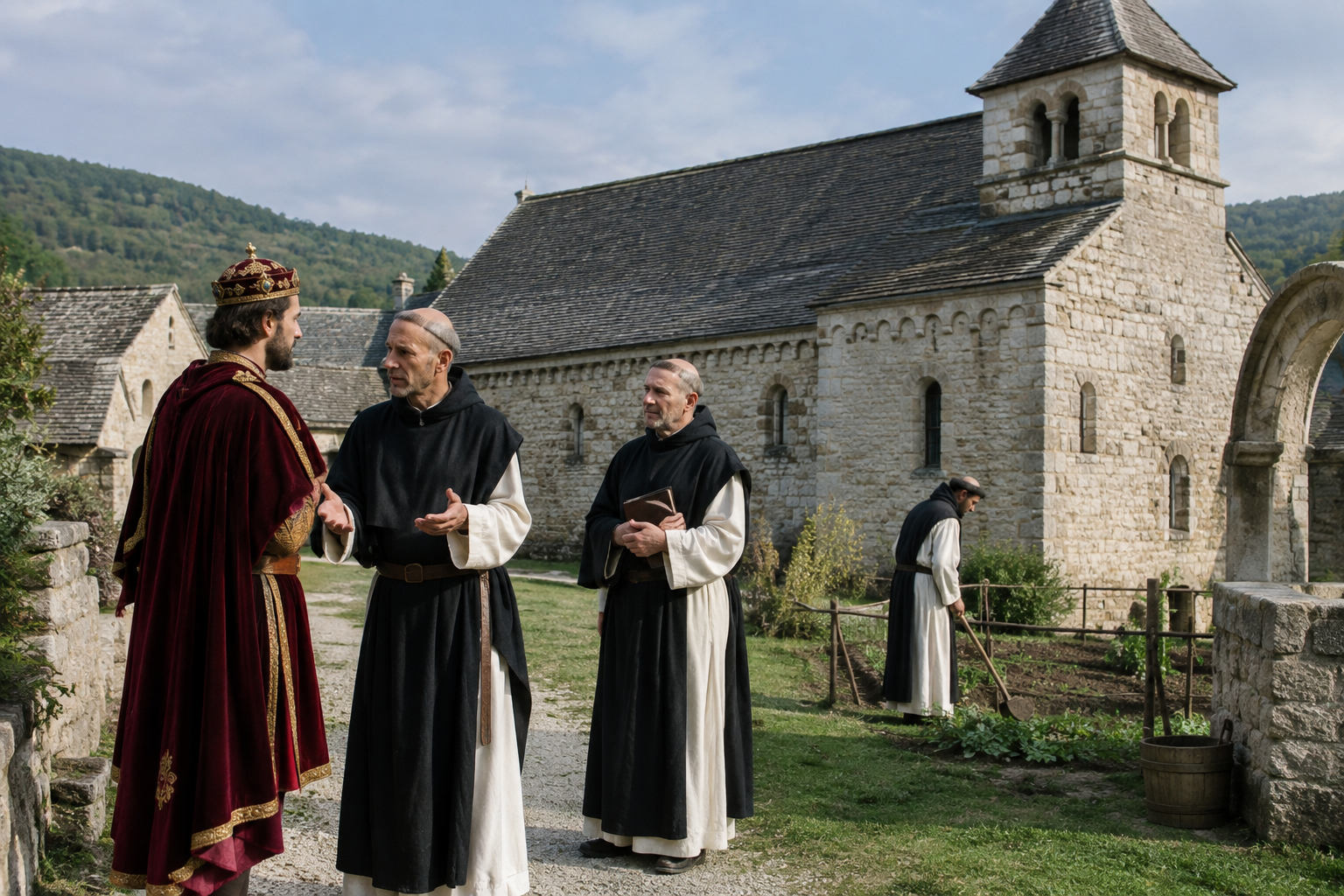
At Abasár in northern Hungary, the burial place associated with the medieval Aba kindred has become one of those rare sites where archaeology, dynastic memory, and genetics meet in the same graveyard soil. One of the individuals reported from the Bolt-tető Benedictine monastery, sample HUAS341, is dated to around 1480 AD and has been associated with the very specific Y-DNA lineage R1a1a1b1a2b3a3a2g2b. That matters because this is not just any late medieval cemetery: it is a place long linked with one of Hungary's most important noble lineages.
The fascination here lies in scale. A haplogroup this narrow is not a grand label for a whole people. It is a tiny twig on the larger R1a paternal tree, tracing one direct male line among countless other ancestors. Yet when such a branch turns up in a historically charged place like Abasár, it offers a rare chance to connect a genetic signature with a real landscape of monasteries, kin groups, and royal-era memory in late medieval Hungary.
Abasár has long occupied a special place in Hungarian historical tradition because of its connection with the gens Aba, one of the early great kindreds of the Kingdom of Hungary. The monastery at Bolt-tető was not simply an isolated religious building in the hills. It belonged to a world in which monastic foundations also served as burial places, status markers, and anchors of family remembrance.
That is what makes HUAS341 so interesting. The sample does not, by itself, prove the identity of every man buried there, nor does it magically solve every genealogical question surrounding the Aba family. But it places this highly derived R1a branch in a burial context tied to a lineage that mattered politically for centuries, well after the first formation of the Hungarian kingdom.
A genetic study of medieval Hungarian elite burials has drawn attention to precisely this sort of context, where archaeology and documented historical settings can be examined together rather than separately. The relevant research can be found here: https://www.biorxiv.org/content/10.1101/2024.03.20.585718v1.
The full label R1a1a1b1a2b3a3a2g2b is the article's focus, but the larger historical backdrop belongs to R1a, one of the major Y-chromosome lineages spread across much of Eurasia. It would be careless, though, to take the broad history of R1a and simply pour it into this much narrower branch as if they were the same thing. A deep subclade like this represents a later, more specific paternal history, and often a much more local one.
In practical terms, that means a man carrying R1a1a1b1a2b3a3a2g2b in late medieval Hungary was not a walking symbol of some vast prehistoric migration. He was a person embedded in a Christian kingdom, a local burial landscape, and a network of noble memory. Y-DNA gives us one line of descent only: father to son, over many generations. Useful, yes; complete, absolutely not.
The date of HUAS341, around 1480 AD, is striking in itself. This is not an early conqueror from the 10th century, nor one of the first rulers of the Árpád age. It is a late medieval individual living in a Hungary already shaped by centuries of state formation, dynastic turnover, warfare, ecclesiastical patronage, and regional lordship.
That later date is valuable because it reminds us that paternal lineages do not vanish when political eras change. A branch associated with an aristocratic or locally important male line can persist across generations, even when the visible face of power shifts from one ruling house to another. Monastic burial places like Abasár are exactly the sort of sites where that continuity may survive in bone long after chronicles go quiet.
There is an important historical caution here. Because the cemetery is associated with the Aba kindred, it is tempting to treat every burial as dynastic and every lineage as a perfect family signature. Archaeology is seldom so tidy. Still, a specific Y-line recovered from this setting is far more historically meaningful than the same label would be in a disconnected, undocumented context.
One of the most interesting questions in Hungarian archaeogenetics is how medieval elite families related to the kingdom's earlier formative populations. Some lineages seem to preserve long local continuity; others point to mobility, intermarriage, or changing political coalitions. The medieval elite were never genetically uniform, and that is precisely what makes them historically intelligible.
Abasár belongs to this wider picture. The site does not stand for all of Hungary, and HUAS341 certainly does not stand for every nobleman of the realm. But together they show how one paternal branch can remain legible inside a social stratum where written history and burial archaeology overlap. Instead of a faceless population trend, we have a concrete lineage in a named place with a strong historical association.
This broader theme also sits well beside recent work on royal and elite burials elsewhere in Hungary, where ancient DNA is helping sort out questions of dynastic identity, biological kinship, and continuity across the medieval centuries.
If all we had were the letters and numbers of R1a1a1b1a2b3a3a2g2b, the story would be thin. What gives it weight is the context: a burial from Abasár, a monastery tied to noble memory, and a late medieval date that places the individual in a mature Christian kingdom rather than a hazy prehistoric panorama. Archaeology turns the haplogroup from an abstract code into a historically situated clue.
That is worth stressing because many readers meet Y-DNA first through maps and frequency tables. Those have their place, but a cemetery like Bolt-tető reminds us that paternal ancestry lived through institutions as well as biology: monasteries, landholding families, commemorative burial grounds, and the politics of remembrance. A lineage persisted not only through reproduction, but through the social worlds that made certain burials possible and memorable.
For someone exploring the haplogroup R1a1a1b1a2b3a3a2g2b today, the Abasár evidence offers something better than a sweeping myth. It suggests that this paternal line was present in late medieval Hungary in a burial environment linked to high-status historical memory, and possibly to one of the country's notable noble kindreds. That is a precise, grounded insight, and in archaeology precision is usually more valuable than grandeur.
So the real significance of this haplogroup is not that it explains all of R1a, or all Hungarians, or all medieval nobility. It is that one very specific paternal branch appears in one very specific and historically resonant place. Sometimes that is how the past survives best: not as a broad slogan, but as a stubborn little line of descent in the earth of an old monastery.






Comments