Haplogroup R1a1a1b1a2a1a2

– 5 min read


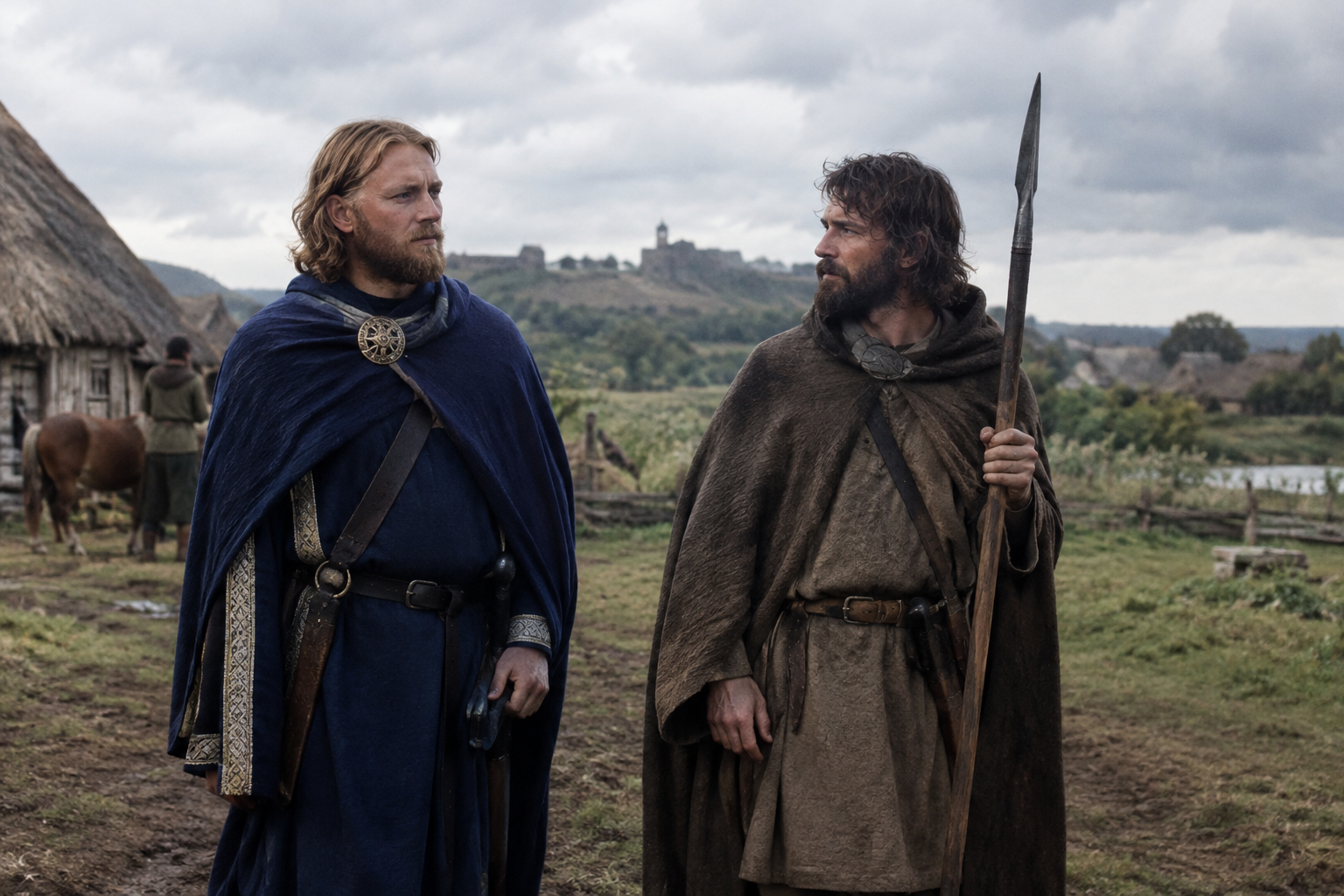
At Buettelborn in Germany, two men buried in the Merovingian period, around AD 600, carry the same reported Y-DNA branch: R1a1a1b1a2a1a2. Their sample IDs, Btb105 and Btb112, are not famous kings or saga heroes. That is precisely why they matter. They place this paternal line in a real early medieval community on Frankish soil, at the point where the old Roman world had broken apart and new local societies were being made in cemeteries, villages, and family networks.
The fascination here is not that one rare lineage turns up once, but that it appears twice at the same site and in the same broad period. Even with sparse published detail, that repetition is archaeologically useful. It suggests that this was not some isolated male passer-by buried on the edge of the world, but part of a living population in which this paternal line had a place.
Buettelborn sits in a region that, by AD 600, belonged to the Frankish sphere. Calling these individuals "Frankish" is therefore a historical shorthand for their time and place, not a magical statement about language, law, or self-identity written in their chromosomes. Early medieval communities in western and central Europe were mixed in all sorts of ways: locally rooted, shaped by post-Roman change, and connected to wider movements of people across frontier zones and former imperial territories.
That makes Btb105 and Btb112 especially interesting. A Y-chromosome lineage tracks one direct paternal line only, but burials like these show how such lines were embedded in actual communities. If two men from the same Merovingian cemetery are both associated with R1a1a1b1a2a1a2, the result fits a wider picture in which early medieval cemeteries can preserve traces of paternal continuity, household structure, and regional diversity all at once.
An ancient DNA study of this broader frontier world has increasingly emphasized that the centuries between AD 400 and 700 were not a simple story of neatly bounded "tribes" replacing one another, but a time of blending and local recomposition. That is the kind of historical setting into which Buettelborn belongs, and it is why these two samples deserve attention rather than being treated as mere codes on a list.
R1a1a1b1a2a1a2 is a very specific twig on the much larger Y-DNA tree of R1a. That distinction matters. The broader parent lineage has a long and wide history across Eurasia, but one should not lazily pour all of that immense background into a narrow subclade and pretend the job is done. The Buettelborn evidence tells us that this particular reported branch, or a very close paternal placement associated with it, was present in Merovingian-period Germany. It does not by itself tell us where every earlier ancestor of that branch lived centuries before.
In other words, the historical value here lies in scale and context. Not "R1a therefore X people," but rather: this sub-branch appears in an early medieval burial ground in western central Europe, twice, within a Frankish-period setting. That is a careful, modest statement, and it is stronger for being careful.
Ancient DNA is often most illuminating when it moves beyond the one spectacular burial and begins to show patterns inside a site. Btb105 and Btb112 are useful exactly because they form a tiny cluster. We are not entitled to invent a father-son relationship, a clan chief, or a family plot unless the excavation report or kinship analysis says so. But two male individuals from the same cemetery sharing the same reported paternal branch is still evidence of recurrence.
That recurrence can mean several things. It may reflect paternal relatives separated by a few generations, a wider local kindred, or simply a branch that had become established in the community. Early medieval cemeteries often worked as social landscapes, where burial was about belonging as much as biology. So repeated Y-lineages can hint at local continuity without reducing the whole site to one bloodline.
This is one of the reasons Merovingian cemeteries are so valuable to historians. They sit in the awkward, productive space between Roman provincial history and the documentary medieval world. Names are often missing, but the dead still preserve a record of settlement, mobility, and kinship that texts only partly describe.
By around AD 600, the old western Roman imperial framework had long since fractured, but that did not mean society had collapsed into neat ethnic blocks. The Frankish kingdoms ruled former Roman territories whose populations already carried centuries of mixture. Soldiers, farmers, craftspeople, migrants, and locally prominent families all formed part of the same changing world. A cemetery in Germany from this period therefore records not a frozen "tribe," but a social community shaped by generations of adaptation.
For haplogroup work, this is crucial. A lineage like R1a1a1b1a2a1a2 appearing in Merovingian Buettelborn does not make the site foreign to its setting; nor does it require a dramatic migration story for each buried man. Early medieval Europe had many paternal lines in circulation, and political labels such as Frankish did not erase that underlying diversity.
That larger lesson has turned up elsewhere as well. When researchers examine post-Roman cemeteries across western Europe, they often find a striking combination of local continuity and wider ancestry connections. If you want a good comparison from the Iberian side of the same broad era, the Madrid material is a useful reminder that seventh-century communities could be socially and biologically diverse without ceasing to be local communities.
The verified research link associated with these burials points to a scientific study relevant to the ancient population in question. Without inventing details beyond the evidence at hand, the key point is that such work has made early medieval cemeteries newly legible. Instead of relying only on artifact styles or later written identities, we can now compare biological relationships, ancestry profiles, and uniparental markers across the same burial ground.
For Btb105 and Btb112, the safest reading is also the most useful one. The reported association with R1a1a1b1a2a1a2 shows this paternal line present in Merovingian-period Buettelborn. The shared site and date give it historical weight. But the evidence does not license a fantasy genealogy stretching straight from these graves to every modern bearer of the branch, still less to some named early medieval dynasty.
If your paternal line falls under R1a1a1b1a2a1a2, the Buettelborn men offer something concrete and valuable: a securely historical foothold in an early medieval Frankish-period community in Germany. Not a mythic founder, not a grandiose claim of ethnicity, but a real archaeological setting in which this line was present more than once around AD 600.
That is often how ancient DNA is most rewarding. It gives a lineage social texture. In this case, the texture is Merovingian, post-Roman, local, and quietly revealing: a paternal branch living among the people who rebuilt Europe after Rome.






Comments