Haplogroup R1a1a1b1a2a1a1a

– 5 min read


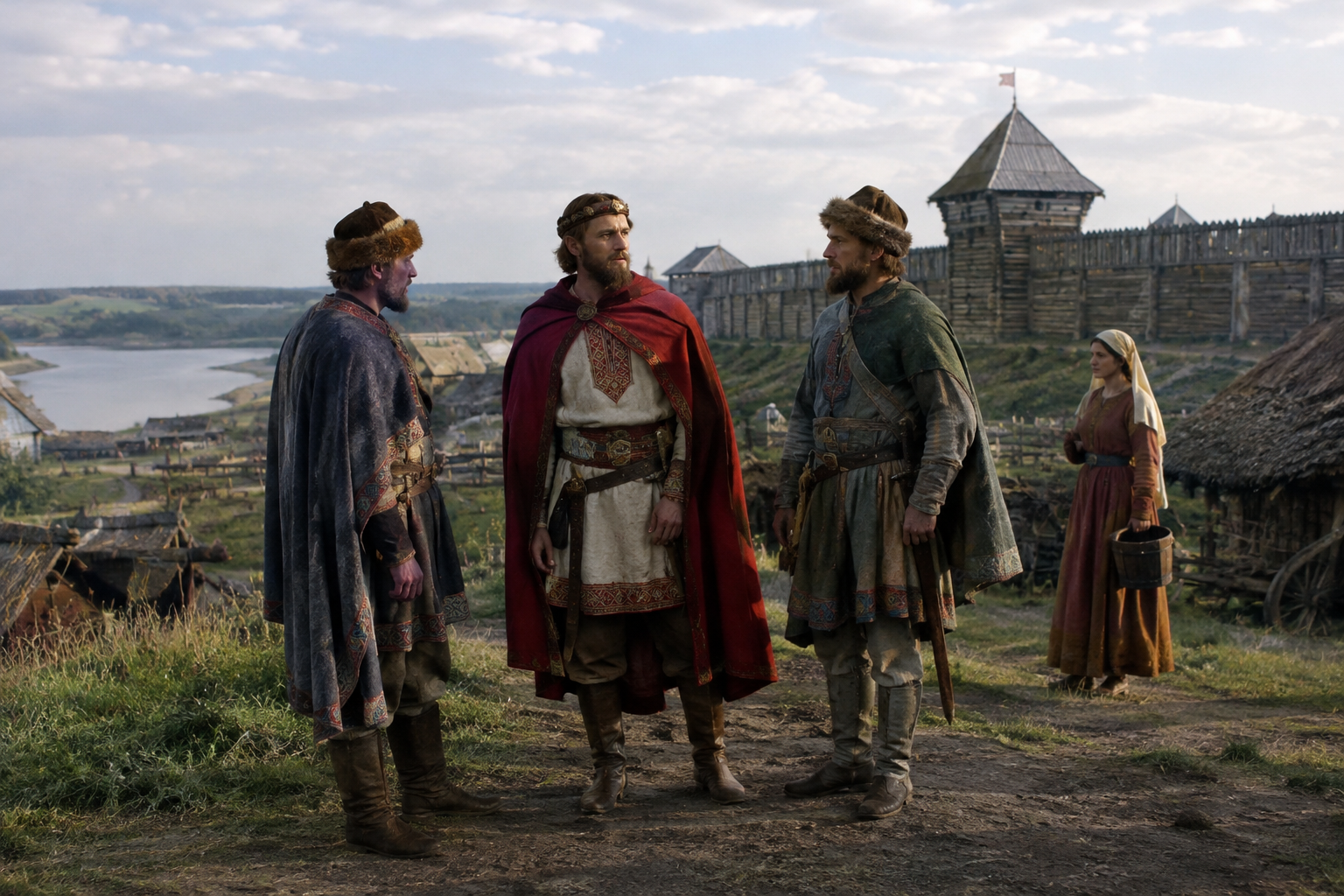
At Korolivka in western Ukraine, one medieval man has become a surprisingly useful guide to a much larger paternal story. The individual identified as KRW007, dated to around AD 1250 and associated with the Principality of Halych-Volhynia, belongs in reporting linked to the Y-DNA haplogroup R1a1a1b1a2a1a1a. That may look like a forbidding string of letters and numbers, but the setting is immediately human: a frontier principality in the lands between Central Europe and the steppe, active at a time when dynasties, merchants, warriors, clerics, and migrants were all moving through the same corridors.
That is what makes KRW007 interesting. He does not stand for an entire people, still less for every man in medieval Rus', but he does anchor this paternal branch in a specific archaeological and historical landscape. Y-DNA traces one direct male line only, not a person's full ancestry, yet when a lineage turns up in a place like Halych-Volhynia it invites a proper historical question: what sort of paternal histories were present in these borderlands by the 13th century?
The Principality of Halych-Volhynia was not some quiet provincial backwater. In the 12th and 13th centuries it sat in a zone of intense political traffic, linking the eastern Slavic world with Poland, Hungary, the Carpathians, and the northern Black Sea region. A man buried there around AD 1250 belonged to a society shaped by diplomacy, warfare, church networks, and regional competition, all under the looming pressure of the Mongol age.
KRW007 matters because the find gives this haplogroup a documented medieval context rather than a merely modern distribution. Even with only one securely named ancient individual in hand here, that is valuable. Ancient DNA is often most illuminating not when it offers a grand answer, but when it pins a paternal branch to a real place and time where historians already know the surrounding world was complex.
An ancient DNA project connected with these medieval remains can be followed through the research archive at https://www.ebi.ac.uk/ena/browser/view/PRJEB81250. What can be said safely is that KRW007 places this lineage in the orbit of a medieval polity whose population was shaped by local continuity as well as long-range contacts.
The wider haplogroup R1a is one of the major Y-chromosome lineages of Eurasia, with deep and complicated prehistoric and historic associations across eastern and central Europe, the steppe, and parts of Asia. But that broad background is not the same thing as proving the specific life-history of R1a1a1b1a2a1a1a. A narrow branch like this has to be treated carefully. One cannot simply inherit the whole story of parent R1a and paste it onto a finer subclade.
What KRW007 shows is narrower and more useful: by the mid-13th century, a man associated with this lineage was living and dying within the political territory of Halych-Volhynia. That places the branch in a region where eastern Slavic, Central European, and steppe-linked histories overlapped. It does not, on its own, prove ethnicity, language, rank, or a particular migration route.
This distinction matters because medieval eastern Europe is so often flattened into tidy labels. Archaeology and genetics both resist that. A paternal lineage can persist through language shifts, political realignments, elite turnover, and ordinary marriage patterns. In other words, the Y-chromosome is excellent at tracing one thread, but the historical cloth is always woven from many threads at once.
Halych-Volhynia was positioned in precisely the kind of region where paternal lineages could accumulate long, entangled histories. To its west lay Polish and Central European connections; to the south, the Carpathian routes and Hungarian sphere; to the east and southeast, the lands tied to the broader Rus' world and the steppe. Such regions are gold for historians because they show how political borders and biological histories rarely match neatly.
By around AD 1250, the old certainties of Kievan Rus' had already been transformed. Successor principalities, changing alliances, and the effects of Mongol expansion all shaped life in the region. A lineage like R1a1a1b1a2a1a1a appearing here should therefore be read against movement and mixture, not against some fantasy of frozen purity.
That wider northern Black Sea and eastern European setting is explored from several angles in MyTrueAncestry's coverage of regional finds. The broader context of mobility and population mixture is especially relevant here.
There is a temptation, when faced with a single named ancient sample, to dismiss it as too slight. That would be a mistake. Single individuals can be historically powerful when they come from the right place and period. KRW007 is useful precisely because he comes from a principality that sat at the meeting point of major medieval currents.
Think of what archaeologists are really after in such cases. Not a fairy-tale founder, but a fixed point. Once a branch is observed in a securely dated medieval context, it becomes easier to compare it with other ancient and modern data as they appear. The sample does not close the case; it starts a better one.
It also nudges us away from over-simple narratives about eastern European paternal history. Medieval populations in this zone were not reducible to one dynasty, one tribe, or one migration. The evidence coming out of eastern and central Europe increasingly shows continuity mixed with repeated episodes of contact, resettlement, and local adaptation.
For readers with this haplogroup, the broader historical backdrop is worth stating plainly. Lineages within the R1a family are common enough in many parts of eastern Europe that they often appear in discussions of Slavic-speaking populations, steppe interactions, and medieval state formation. Yet the ancient DNA lesson is that recurring presence does not equal uniform identity. The same broad paternal family can appear in very different social and cultural settings.
In the case of KRW007, the most responsible reading is that R1a1a1b1a2a1a1a was part of the paternal diversity present in the medieval western Ukrainian sphere. That fits well with a region where local eastern European male lines could endure through shifting political frameworks. It is a historical setting in which continuity and contact would have lived side by side.
The medieval centuries in this part of Europe also remind us that paternal ancestry does not map cleanly onto noble status or famous surnames. In many family-history conversations, people understandably want a straight line from haplogroup to named dynasty. Archaeology is usually less obliging and far more interesting. Most lineages belonged not to kings in chronicles, but to ordinary or locally significant men whose lives were still bound up with major historical change.
For a related case of how medieval eastern European genetics can illuminate ruling worlds without collapsing everything into royal myth, see the discussion of elite and dynastic evidence from nearby regions.
If your paternal line falls under R1a1a1b1a2a1a1a, KRW007 offers something modest but solid: a documented medieval point of presence in the world of Halych-Volhynia, around AD 1250. That does not make every present-day bearer "from" that principality, nor does it prove descent from any named house. What it does suggest is that this branch belonged to the sort of eastern European historical landscape where frontiers, alliances, and deep local roots all mattered at once.
And that, in truth, is the attraction of ancient DNA when it is used properly. Not the invention of grand claims, but the recovery of real men in real places. KRW007 lets this haplogroup step briefly out of abstraction and into the medieval borderlands of western Ukraine, where history was rarely simple and almost never still.


Comments