Haplogroup R1a1a1b1a1a1a1a1c

– 5 min read


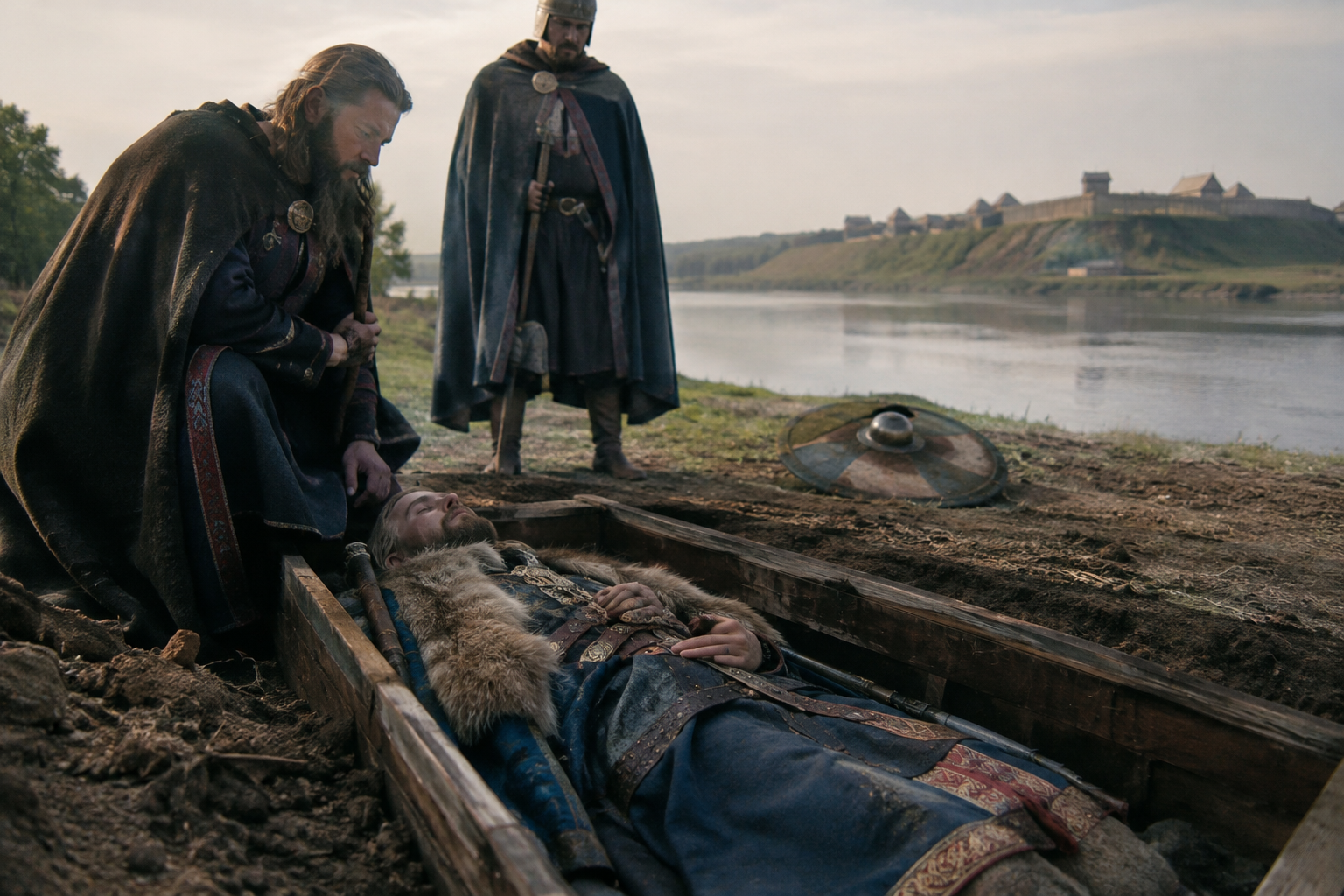
One of the clearest clues for this very specific paternal line comes from a man buried around AD 950 at Sandomierz in southern Poland: sample VK494, described as an elite Viking Rus grave. That short label is enough to make the find arresting. Sandomierz sits in a region that, by the 10th century, was tied into the growing political world of the Piasts, the river routes of eastern Europe, and the long commercial arcs that connected the Baltic to the Black Sea.
The Y-DNA branch associated here is R1a1a1b1a1a1a1a1c. That is an unusually narrow designation inside the wider R1a family, a paternal lineage best known across large parts of Eurasia. But it is important to keep the scale straight: a deep subclade like this is not the same thing as the whole of R1a, and one medieval burial does not by itself map the entire history of the branch. What it does give us is something more valuable archaeologically: a fixed point in time, place, and status.
Sandomierz was not some remote backwater waiting passively for history to happen. In the 10th century it stood in a zone where Slavic polities, Scandinavian-linked traders and warriors, and eastern exchange networks overlapped. A burial identified as elite and connected with Viking Rus culture suggests precisely the sort of milieu in which paternal lineages could travel far from their earlier homelands and become part of new local power structures.
The term Rus itself needs handling with care. In this period it usually points not to a single biological people, but to a political and commercial world shaped by movement: Scandinavians, local eastern Europeans, steppe-facing communities, and others drawn into the same networks. A Y-chromosome lineage traces one direct male line only; it does not capture the whole ancestry, language, or identity of the man in grave VK494. Still, in an archaeological setting like this, that one line matters because it can preserve a sharp signal of mobility and male-linked affiliation.
A genetic study connected with Viking Age mobility in this broader region is linked here in research on ancient DNA from the Viking world. Without overstating what can be said for one sample, VK494 fits the larger picture in which Viking Age and Rus-period communities were not sealed ethnic blocks, but mixed and mobile societies tied together by ships, rivers, warfare, tribute, and trade.
Readers often recognize R1a as a broad paternal lineage with a long prehistoric and historic presence across eastern and central Europe, parts of Scandinavia, and the steppe. But R1a1a1b1a1a1a1a1c is not a synonym for all of that history. It is a much finer twig on that larger tree, and its importance in this article comes from its association with a specific early medieval burial rather than from any sweeping claim about all R1a men everywhere.
That distinction is more than technical tidiness. It is the difference between history and myth-making. A narrow subclade can sometimes point toward a particular medieval network, regional cluster, or line of descent; a parent haplogroup covers far too much ground, both geographically and chronologically, to carry that weight on its own.
So the safest historical reading is also the most interesting one. This branch was present in a high-status burial linked to the Viking Rus world in 10th-century Poland. That places it in a frontier of power, exchange, and cultural blending at the moment when early medieval eastern Europe was being reorganized into new kingdoms, trading hubs, and warrior elites.
It is tempting to picture early medieval Europe as a patchwork of neatly separated peoples: Scandinavians here, Slavs there, steppe groups somewhere over the horizon. Archaeology keeps ruining that tidy map, and Sandomierz is a good example of why. Places on major river corridors were magnets for ambitious men, imported goods, military retinues, and political experiments.
That makes an elite Viking Rus burial in Poland historically plausible in exactly the right way. The significance is not that a "Viking" appeared improbably far from home, but that the very categories of home and abroad were being renegotiated by trade and armed service. A man bearing the paternal line R1a1a1b1a1a1a1a1c could have belonged to a family already embedded in eastern Europe, to one recently drawn into Rus networks, or to a line moving between Scandinavian and Slavic spheres. With the evidence given, we should not choose among those scenarios too confidently.
What we can say is that burials like VK494 belong to the same broad historical moment as the formation of early Polish state structures and the intense interaction of Baltic and eastern European worlds. The archaeological label "elite" also matters. High-status graves are often where we most clearly glimpse the men who moved between political centers, served rulers, or controlled routes and tribute.
The Viking Rus world was not created by genetics alone, nor by a single migration event. It emerged through repeated movement along the river systems leading south and east, especially the great routes linking the Baltic with the Dnieper and Volga basins. Such routes did not merely shift objects. They shifted loyalties, families, languages, and ways of displaying rank.
That is why a lineage like R1a1a1b1a1a1a1a1c appearing in this context is so suggestive. Not because it proves a saga-style origin story, but because it sits exactly where historians expect complexity: in a politically fluid zone where Scandinavian-associated elites operated among overwhelmingly local populations and where identities could be adopted, negotiated, and inherited.
Recent MyTrueAncestry coverage of the spread of Germanic languages is useful background here, because it reminds us that language, ancestry, and paternal descent do not travel in lockstep. The same warning applies to the Rus. A man with one paternal line could live in a multilingual household, serve a ruler of mixed background, and be buried according to a status code shared across communities.
There is a discipline to writing about rare or highly specific haplogroups. The temptation is always to inflate a single data point into a grand migration map. Better, though, to notice what is already striking without embellishment: VK494 anchors R1a1a1b1a1a1a1a1c in an elite early medieval burial at Sandomierz, in a period when Viking Rus connections were helping reshape eastern Europe.
Even one well-contextualized burial can be historically valuable. It shows that this paternal branch was present in a man important enough, or connected enough, to be archaeologically recognized within that milieu. It also places the lineage in a zone where Scandinavian, Slavic, and wider eastern contacts overlapped rather than in a simple one-origin story.
Baltic early medieval genomics
For someone researching this haplogroup today, the most responsible takeaway is not a claim to one famous tribe or dynasty, but a connection to the kind of world represented by Sandomierz around AD 950: mobile, martial, commercial, and deeply entangled across the Baltic and eastern European rivers. In that sense, R1a1a1b1a1a1a1a1c enters the record not as an abstraction, but as the paternal signature of one man buried at the crossroads of the Viking Rus age.
Comments