Haplogroup R1a1a1b1a1a1a1a

– 5 min read


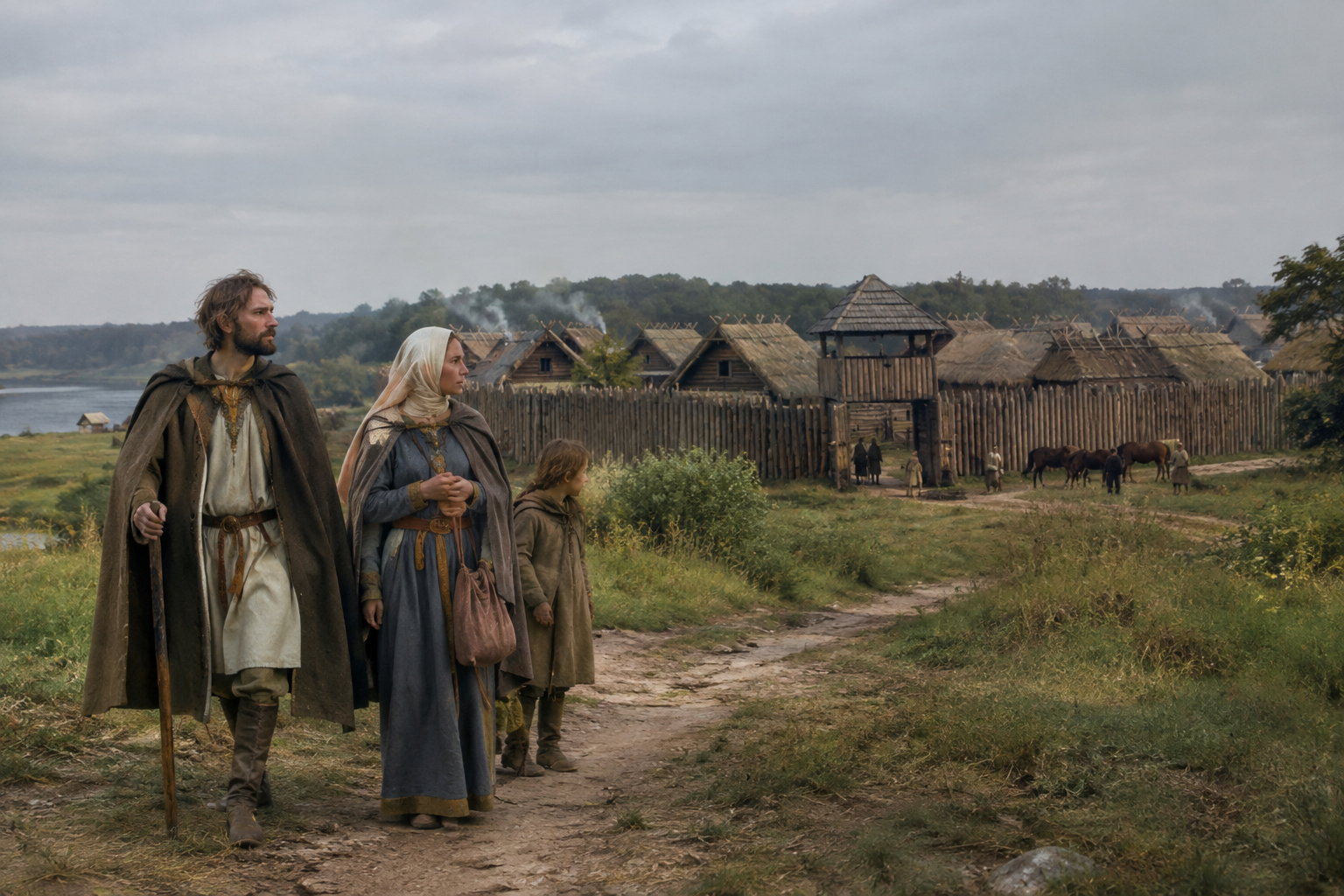
At Grodek nad Bugiem in eastern Poland, one medieval man has become unexpectedly important for the history of a very specific paternal line. The individual known as GRK012, dated to around 1100 AD, is associated here with the Y-DNA haplogroup R1a1a1b1a1a1a1a. That string of letters and numbers looks forbidding at first glance, but it matters because it places one direct male line inside a real archaeological landscape: a frontier region of medieval Poland, close to the Bug River, where political, cultural, and population boundaries were never entirely fixed.
That is the useful starting point for thinking about this haplogroup. Y-DNA traces one strictly paternal line, not a person's whole ancestry, identity, or language. But when a branch like R1a1a1b1a1a1a1a appears in an excavated medieval burial, it gives us something better than general theory: a man, a place, and a date.
Grodek nad Bugiem lies in a part of Poland that has long been a contact zone between the Polish lands to the west and the wider East Slavic world to the east. In the 11th and 12th centuries, this was a region shaped by shifting lordship, ecclesiastical change, trade, and movement along river corridors. A burial from this setting is therefore valuable not because it can stand for everyone, but because it captures one paternal lineage in a historically lively border region.
For GRK012, the most responsible claim is also the most interesting one: by around 1100 AD, this branch was present among men living in medieval eastern Poland. That alone helps anchor the haplogroup in the human geography of the High Middle Ages, when settlement networks, dynastic politics, and Christian institutions were consolidating across much of Central and Eastern Europe.
An ancient DNA project connected with these medieval burials can be followed through the research archive at https://www.ebi.ac.uk/ena/browser/view/PRJEB81250. The archive itself is not a narrative source, but it marks the scientific framework in which these individuals were studied.
The broader haplogroup behind this article, R1a, is one of the major Y-chromosome lineages in Eurasian population history and is especially well known in discussions of Eastern Europe, the steppe, and later Indo-European expansions. But that broad fame can be misleading. The narrow branch R1a1a1b1a1a1a1a is not the same thing as the whole of R1a, and it should not be burdened with every migration story ever attached to its parent lineage.
What the medieval Polish evidence gives us is a secure historical foothold for this particular paternal branch, or for a reported association with it, in a local setting. That is often how archaeogenetics works at its best. It does not begin with sweeping maps and then force ancient people into them; it begins with excavated individuals and asks how far the evidence really lets us go.
In practical terms, someone carrying this haplogroup today should picture not a single tribe or one grand migration arrow, but a lineage that belonged to the complicated male populations of medieval northeastern and eastern Central Europe. Rivers, woodland zones, market routes, and frontier politics all mattered there. So did centuries of earlier mixing that no one grave can fully unravel.
It is tempting to imagine medieval Poland as neatly bounded and homogeneous, but the archaeology tells a more complicated story. The Piast realm expanded through conquest, alliance, church building, and colonisation, while its eastern edges remained entangled with neighbouring powers and local communities. A man buried at Grodek nad Bugiem around 1100 AD lived in a world where political identity and biological ancestry were not identical things.
This is exactly why a site like Grodek nad Bugiem matters. A paternal lineage found there may reflect local continuity, recent movement, marriage networks, military service, or some mixture of all four. Without additional kinship, isotope, or cemetery-wide context, it would be rash to choose just one explanation. But the burial still shows that this branch belonged within the lived population history of medieval Poland, not merely in abstract modern frequency charts.
That point fits neatly with a broader pattern now emerging from ancient DNA across Europe: medieval populations were often more locally rooted than older migration myths assumed, yet they were also threaded through with mobility, exchange, and regional variation. Border regions especially resist simple ethnic labels.
Ancient DNA and Slavic Populations
The Bug River is useful to historians precisely because it has so often been treated as a dividing line while functioning, in practice, as a corridor. Waterways connected settlements, moved goods, and linked communities that modern national narratives prefer to separate. In the medieval period, the eastern Polish borderlands were tied into networks reaching toward Rus', the Baltic zone, and the Central European interior.
That setting makes GRK012 more than an isolated label. If this individual is associated with R1a1a1b1a1a1a1a, then the branch was present in a region where contacts between West Slavic and East Slavic spheres were routine. This does not make the lineage exclusively "Polish," "Rus'," or "Slavic" in any narrow sense. It does, however, place it squarely inside the population history of a region where those historical categories overlapped.
For readers interested in how genetics has been used to think about language spread in northern and central Europe, one useful comparison is the discussion in MyTrueAncestry's post on Germanic-language dispersals. It is not about this Polish burial specifically, but it shows the larger caution needed when linking genes, language, and identity.
There is a slightly old-fashioned habit in public discussions of DNA to assume that a single ancient result is trivial unless it belongs to a king, a warlord, or some glittering elite burial. Archaeology usually teaches the opposite. Ordinary burials are often more revealing, because they show the real fabric of past populations rather than the exceptions preserved in chronicles.
GRK012 is valuable for exactly that reason. He is not presented here as a dynastic founder or a symbolic ancestor of a whole nation. He is better than that: a documented medieval individual from a known region, carrying a paternal line that can now be placed in time and space. For a lineage article, that is the point. We are not collecting legends; we are locating people.
This also helps when comparing medieval Poland with other early medieval and frontier populations around the Baltic and eastern European world. Nearby regions often show mixtures of continuity and mobility rather than clean replacement. The medieval centuries were full of parish formation, settlement expansion, elite restructuring, and cross-border contact, all of which could reshape how paternal lines were distributed on the ground.
Early Medieval Baltic Connections
For haplogroup R1a1a1b1a1a1a1a, the most defensible historical insight is not a grand origin myth but a concrete medieval foothold. The burial of GRK012 at Grodek nad Bugiem, around 1100 AD, places this paternal line in the eastern Polish borderlands at a time when that region sat at the meeting point of political expansion, local continuity, and cross-cultural contact. If this is your Y-DNA line, the ancient evidence currently points toward a story rooted in the real, messy human landscapes of medieval Central and Eastern Europe.

Comments