Haplogroup R1a1a1a1

– 4 min read


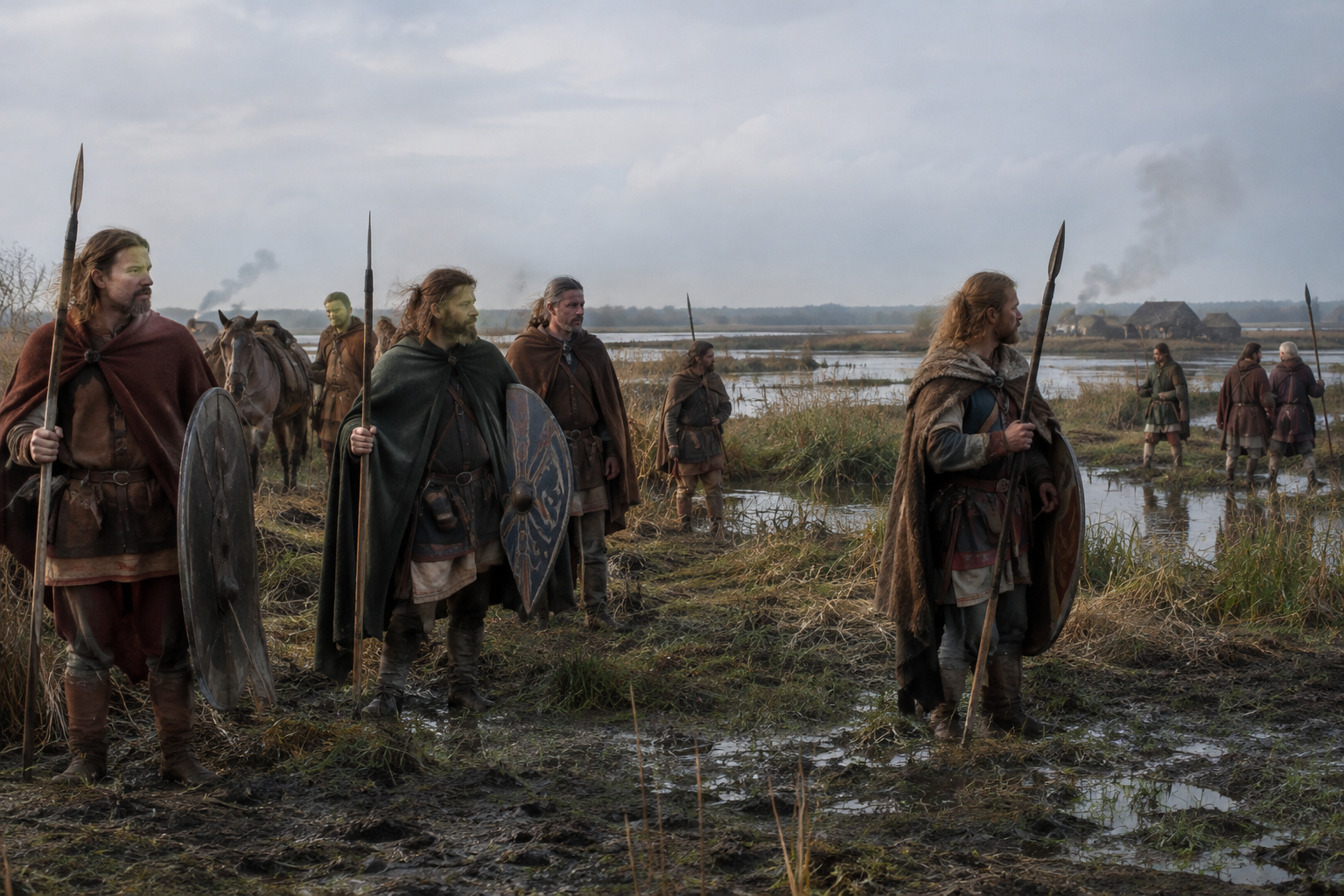
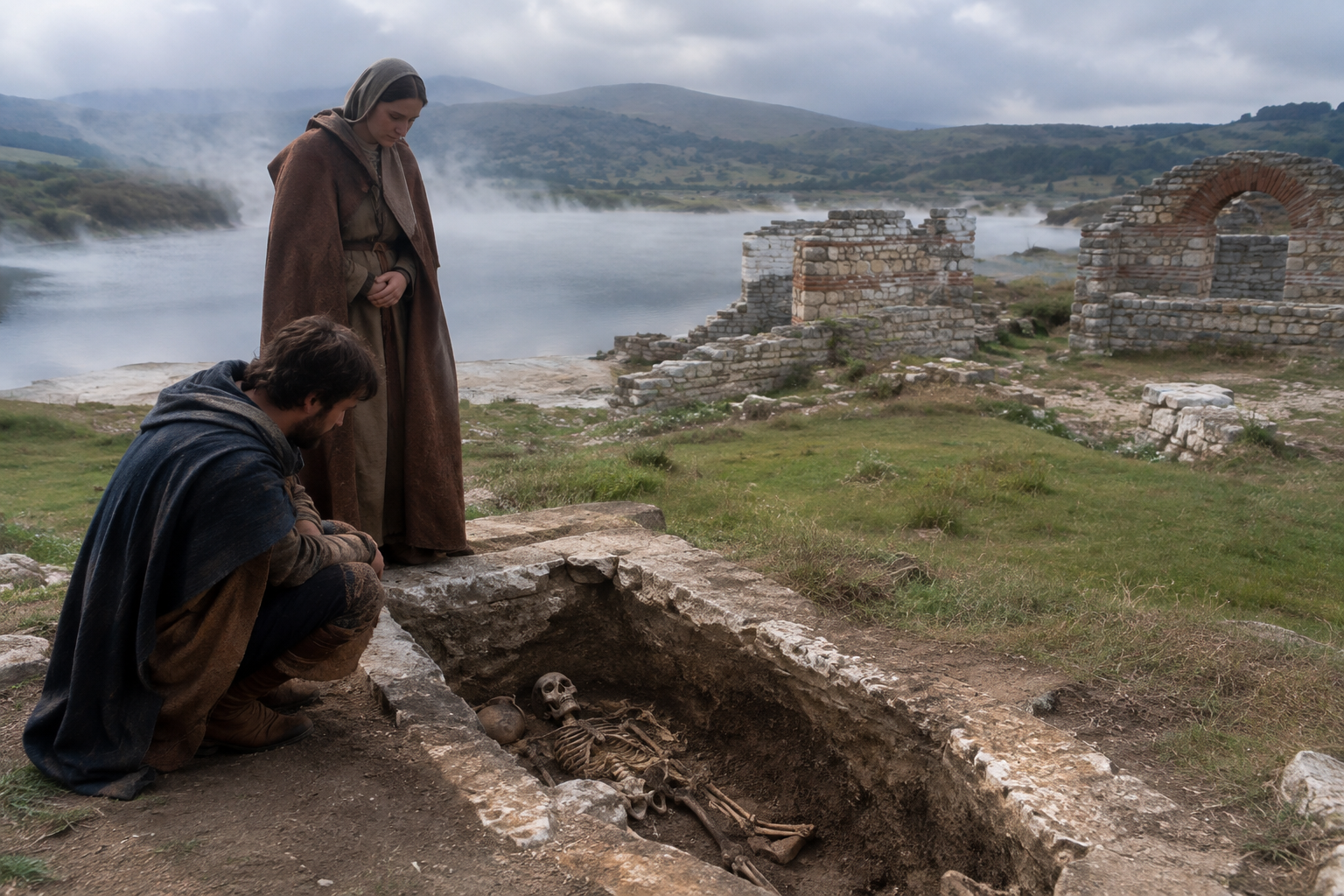
At Alken Enge in Jutland, the dead do not appear as a single neat burial but as the aftermath of violence laid bare in a Danish wetland. Several men from this Early Roman Era bog-war assemblage, dated here between roughly 47 BC and AD 116, are reported with the Y-DNA haplogroup R1a1a1a1: CGG019208, CGG019203, CGG019204, CGG019206, and CGG019214. That is immediately interesting, not because one lineage can explain a battle, but because repeated paternal markers inside one famous conflict landscape hint at a local or regional male-line pattern in Iron Age Jutland.
R1a1a1a1 is a branch within the broader R1a family, one of the best-known Y-chromosome lineages across parts of Eurasia. Y-DNA traces only a direct paternal line, so it is never the whole story of ancestry or identity. But when the same branch turns up in multiple ancient males from one archaeological setting, it becomes a useful historical clue: not a tribal label, not a language by itself, but a thread running through real communities and real events.
Alken Enge is one of those sites that has changed how we imagine northern Europe's Iron Age. Instead of a tidy cemetery, the site preserves the remains of men connected to conflict in the centuries around the Roman world. The individuals listed here, including CGG019208 and CGG019203, belong to that larger setting of war, deposition, and memory in eastern Jutland.
What makes the cluster notable for a haplogroup article is repetition. CGG019204, CGG019206, and CGG019214 are also associated with the same reported Y-DNA branch, R1a1a1a1. One sample on its own can be anecdotal; several from the same conflict horizon begin to suggest that this paternal line was present among the men caught up in the violence represented at Alken Enge.
That still needs careful handling. Shared Y-DNA does not prove these men were close relatives, and it certainly does not turn the whole site into a single clan burial. But it does point us toward an important historical possibility: in Iron Age Jutland, some male lines may have been regionally persistent enough to appear repeatedly in a major wartime assemblage.
A research preprint associated with this material can be found here: https://www.biorxiv.org/content/10.1101/2025.02.28.640770v1. Without over-claiming its contents, the wider significance is plain enough: ancient DNA is helping place famous Scandinavian archaeological sites into a more precise biological and historical frame.
Germanic languages and genomics
The pattern does not begin at Alken Enge. An earlier individual from Jutland, CGG106813 from Nr Hedegord, is dated here to around 322 BC and classified as Iron Age Denmark. That pushes the presence of R1a1a1a1 in this region back before the Early Roman Era conflict horizon represented at Alken Enge.
This is exactly the sort of evidence that matters in archaeology because it gives us continuity without pretending to give us certainty. We are not looking at one dramatic episode alone, but at at least two moments in Danish prehistory: an earlier Iron Age individual from Jutland and a later cluster of conflict-associated men from the same peninsula. Taken together, they suggest that this paternal branch was not a fleeting arrival visible only in one disturbed wartime deposit.
Jutland, of course, was never isolated. It sat in the North Sea and Baltic worlds, connected by exchange, movement, and shifting political landscapes long before Viking Age kingdoms emerged. A lineage appearing there in the later first millennium BC and again around the turn of the era fits a region that was both locally rooted and outward-looking.
There is always a temptation to take a haplogroup and let it do far too much work. R1a as a broad family has a deep and wide history across Eurasia, but that does not mean every narrower branch carried the same story into every region. For this article, the secure ground is more modest and more useful: R1a1a1a1 is reported in multiple ancient males from Iron Age Jutland, including one earlier individual and several from the Alken Enge war assemblage.
That matters because Iron Age northern Europe is often discussed in sweeping terms: Germanic expansions, warrior societies, contacts with Rome, mobility across the North Sea. Yet ancient DNA reminds us that these large themes played out through local populations with their own histories. A repeated paternal branch in Jutland does not define "the Jutes," let alone all Germanic-speaking peoples, but it does belong to the human texture of that world.
It is especially worth stressing that archaeological labels and biological lineages are not interchangeable. "Jute" in a database description is a historical-cultural shorthand tied to place and period, while a Y-DNA branch records one direct male line. A man can belong archaeologically to Iron Age Denmark without his haplogroup serving as a badge of ethnicity.
Scandinavia before the Iron Age
Ordinary settlement history often reaches us in fragments. A bog-war site like Alken Enge is unusual because it concentrates evidence from a moment of collective catastrophe. That concentration makes repeated paternal signals easier to notice, even if the event itself was exceptional.
There is also a methodological point here. Ancient Y-DNA findings become more persuasive when they recur in more than one individual and more than one context. Nr Hedegord gives an earlier Iron Age appearance in Jutland; Alken Enge gives a later cluster in a very different archaeological setting. The combination is not proof of an unbroken dynasty or a single inherited social order, but it does suggest that this line formed part of the male population of the peninsula across several centuries.
For anyone with R1a1a1a1 today, that is the real historical value. Not a fantasy of direct descent from one excavated warrior, but evidence that your paternal line, or a close neighboring branch, was present in Iron Age Scandinavia among men living through both ordinary regional life and extraordinary violence.
North Sea migrations to Britain
The distinctive feature of R1a1a1a1 in this set of evidence is not royal glamour or a vast migration slogan. It is the repeated appearance of the branch in Jutland, from an Iron Age individual at Nr Hedegord to several men in the Alken Enge conflict assemblage. That gives the haplogroup a grounded archaeological setting: northern Europe, Iron Age Denmark, and a region where local continuity and wider connections went hand in hand.
For a modern tester, that is a useful and responsible takeaway. This paternal line was present in ancient Jutland well before the Viking Age, and it appears in one of Scandinavia's most striking conflict sites. That does not tell you everything about your ancestry, but it does place one narrow male-line branch inside a vividly historical landscape.
Comments