Haplogroup R1a

– 6 min read


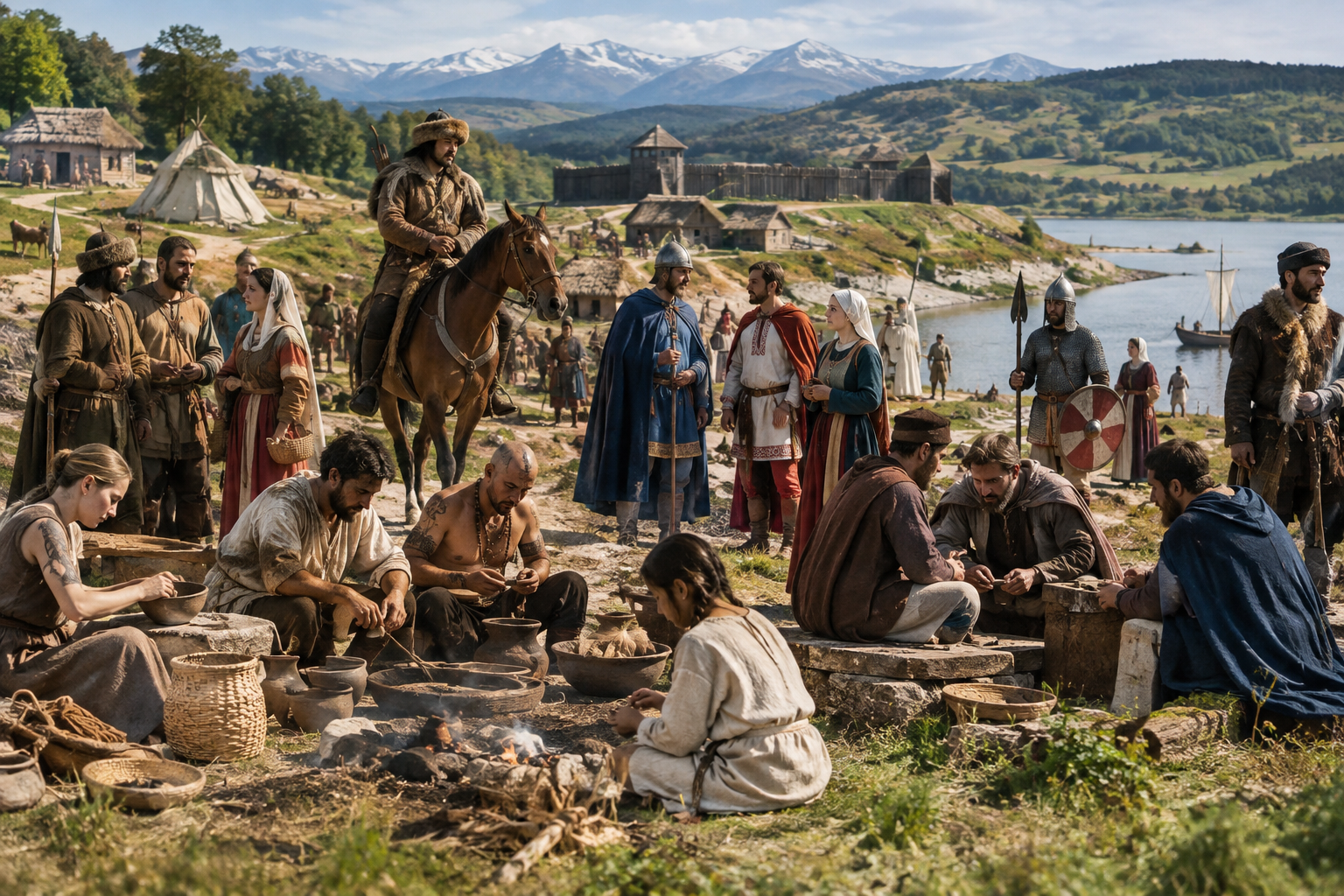
Few Y-chromosome haplogroups have attracted as much historical attention as R1a. It turns up in a striking range of ancient burials, from Mesolithic and Neolithic sites in eastern Europe to Bronze Age graves in Scandinavia, steppe contexts in Inner Asia, and medieval dynastic burials in Poland. That breadth is exactly what makes it so interesting. R1a is not the story of one people, one kingdom, or one language. It is a paternal lineage with a very long archaeological biography.
That point is worth keeping firmly in view. A Y-DNA haplogroup traces one direct paternal line only: father to father to father. It does not describe a person's whole ancestry, culture, identity, or ethnicity. Still, when ancient DNA places the same broad lineage in very different regions and periods, it gives historians and archaeologists a rare chance to watch paternal lines move, persist, and reappear across thousands of years.
Within the wider Y-chromosome tree, R1a is a major branch of haplogroup R, and it has long been discussed in connection with eastern European and Eurasian population history. Ancient DNA has made that discussion much sharper. Instead of relying on modern distributions alone, we can now point to excavated individuals from specific sites, with dates, archaeological settings, and genomes.
The supplied sample list gives an unusually deep time range. Some of the earliest appearances linked here come from the forest and steppe zones north of the Black Sea and across western Russia. NEO202, from Ancient Peschanitsa Russia, dated to 8903 BC, and NEO497, from Ancient Ukraine Vasilevka, dated to 8705 BC, show that paternal lines within the broad R1a story were already present in northern and eastern European landscapes astonishingly early. That does not mean a simple, uninterrupted line from those men to later populations. But it does show that the roots of R1a in this wider region are very old indeed.
By the Neolithic and Eneolithic periods, the picture becomes fuller. We see NEO558 at Ancient Russia Karavaikha, dated to 6327 BC; NEO209 at Ancient Russia Golubaya Krinitsa, dated to 5278 BC; NEO189 from Neolithic Russia Sakhtish II, dated to 3318 BC; and NEO164 from Eneolithic Russia Vasilyevskiy Kordon, dated to 3300 BC. These finds matter because they place R1a-associated paternal lines in the long transition from foraging societies to more mixed economies and more regionally varied prehistoric communities.
For readers interested in that deeper eastern European background, the Sakhtysh material is especially illuminating.
Explore Sakhtysh and Europes Deep Past
When people talk about R1a in prehistory, the conversation often turns to the Bronze Age and to steppe-related movements. That is sensible, so long as we do not oversimplify it. R1a is associated in many studies with lineages that expanded widely during the later prehistoric period, especially across parts of eastern and central Europe and further into Eurasia. But ancient DNA shows a complicated pattern, not a single marching column.
The supplied list includes several samples that sit squarely in this world. I10439, from Corded Ware Culture Moldova Crihana Veche, dated to 2000 BC, and TRM001, from a Bronze Age Axe Grave Prague CWC burial dated to 2100 BC, place R1a in the Corded Ware horizon and its central European extensions. poz533, from Early Bronze Age Poland Sandomierz Swiniary Stare, dated to 1950 BC, adds a crucial Polish anchor. So does NEO518, from Bronze Age Ukraine Igren, dated to 2114 BC.
Then there is the wider steppe. NEO81, from Bronze Age Central Steppes Russia Borovjanka XVII, dated to 1347 BC, reminds us that R1a was not confined to the agricultural and mixed-farming societies of central Europe. It also belonged to the broader worlds of mobility, herding, and exchange across the Eurasian interior. That does not make every R1a lineage "steppe" in some simple sense, but it does show why the haplogroup appears so often in discussions of Bronze Age expansions.
If you want a broader look at how those populations shaped the North Pontic zone, this companion article is a useful next stop.
Explore North Pontic Migrations
One of the most arresting features of the sample set is how widely R1a appears around the Baltic and northern Europe. In Estonia, we find X16 from Bronze Age Estonia Vao, dated to 1000 BC; X11 from Bronze Age Estonia, dated to 960 BC; and X20 from Oeselian Baltic Bronze Age Estonia, dated to 850 BC. In Scandinavia, there is NEO876 from Nordic Bronze Age Denmark Toftum Mose, dated to 2036 BC, and NEO221 from Nordic Bronze Age Sweden Falkoping 5, dated to 1750 BC.
That is a remarkable geographical spread. It suggests that by the Bronze Age, R1a lineages were already part of northern Europe's changing social landscape. These are not identical societies. Estonia, Denmark, and Sweden each had their own local histories. But the repeated appearance of R1a in these settings shows how useful Y-DNA can be for tracking broad paternal patterns across regional archaeological cultures.
The eastern steppe connection remained alive too. UKR039, from Scythian Ukraine Medvyn Tract Girchakiv Lis, dated to 600 BC, puts R1a into the Iron Age world of the north Black Sea, where mounted elites, trade networks, and burial mounds dominate the historical imagination. And DA100, from Hunnic Period Kyrgyzstan Tian Shan Jeti Oguz, dated to 330 AD, shows the lineage appearing far deeper in Inner Asia during Late Antiquity.
These samples do not prove that one single paternal clan swept from the Baltic to the Tian Shan. They do show that branches within the broad R1a family were present in many of the great contact zones of Eurasian history.
Readers interested in the Scythian angle will want to compare this with MyTrueAncestry's work on elite burials from the steppe world.
The medieval evidence is where the story becomes especially vivid, because we can begin to compare genetics with named political worlds. In Sweden, wes009 from Late Viking Age Vasterhus Jamtland Sweden, dated to 1016 AD, and mbv211 from Medieval Vasterhus Sweden, dated to 1313 AD, show R1a continuing into the Christian medieval north.
In central Europe, the Polish material is especially important. We have PCA0186 and PCA0189, both from Medieval Poland Piast Dynasty Lad, dated to 950 AD; PCA0247 from Piast Dynasty Greater Poland Rumin Lad, dated to 1100 AD; PCA0314 from Medieval Piast Dynasty Poland Plonsk Masovia, dated to 1100 AD; and PCA0200 from Medieval Poland Piast Dynasty Lad, also dated to 1100 AD.
These finds matter because the Piasts were not just another medieval population. They were the ruling dynasty that helped shape the early Polish state. That does not mean everyone in Piast territories shared the same paternal line, nor does it mean that every later noble house in Poland inherited that line. But it does show R1a firmly embedded in one of the formative dynastic settings of medieval east-central Europe.
For a fuller look at that dynastic context, the Piast-focused community article is the natural companion.
Discover the Piast Dynastys DNA
The supplied noble-family field is blank here, which is a useful reminder in itself. Genetic history is not always neatly tied to heraldry, pedigrees, or castles. Sometimes the strongest evidence comes not from a famous surname but from a cemetery, a churchyard, or a prehistoric burial ground. Where named noble families and their ancestral seats are available, they can give texture to the later history of a region. But in this case, the real strength of the evidence lies in the chain of excavated men stretching from Mesolithic eastern Europe to medieval Poland and Scandinavia.
That is, in a way, more interesting than a tidy dynastic claim. Castles and chronicles preserve the memory of power. Ancient DNA preserves the quieter history of population movement, local persistence, and long paternal continuity across changing cultures. The two kinds of history can complement each other, but they are not the same thing.
One especially intriguing outlier in the supplied list is 2426, from Dark Ages Italy South Tyrol Malles Burgusio Santo Stefano, dated to 450 AD. Another is I19551, from Medieval Tanzania Songo Mnara, dated to 1340 AD. They are reminders that paternal lineages can surface far from the regions with which we most commonly associate them, whether through mobility, trade, migration, or more complex demographic histories. A haplogroup's presence in a place is a clue; it is not a complete explanation.
R1a is historically compelling because it appears again and again at major turning points: among early eastern European hunter-gatherers, in Neolithic and Eneolithic communities, in the Bronze Age worlds of Corded Ware and the steppe, in Baltic and Scandinavian burials, and in medieval dynastic Poland. It is not the badge of a single people. It is evidence that one broad paternal lineage, with many branches, participated in a very large share of Eurasian history.
For MyTrueAncestry users, that is the real fascination. A Y-DNA result can connect you to a deep paternal story that written genealogy could never reach on its own. But ancient matches and shared haplogroups should be read carefully. They can suggest historical context, regional connections, and long-range paternal affinities. They do not by themselves prove direct descent from a specific ancient individual, royal house, or medieval ruling family.
If you want to see whether your DNA shows links to ancient individuals like UKR039, NEO202, PCA0186, or the many other archaeological samples that bring the past into focus, MyTrueAncestry offers a remarkable way to explore those connections.
Comments