Haplogroup Q2b2a

– 5 min read


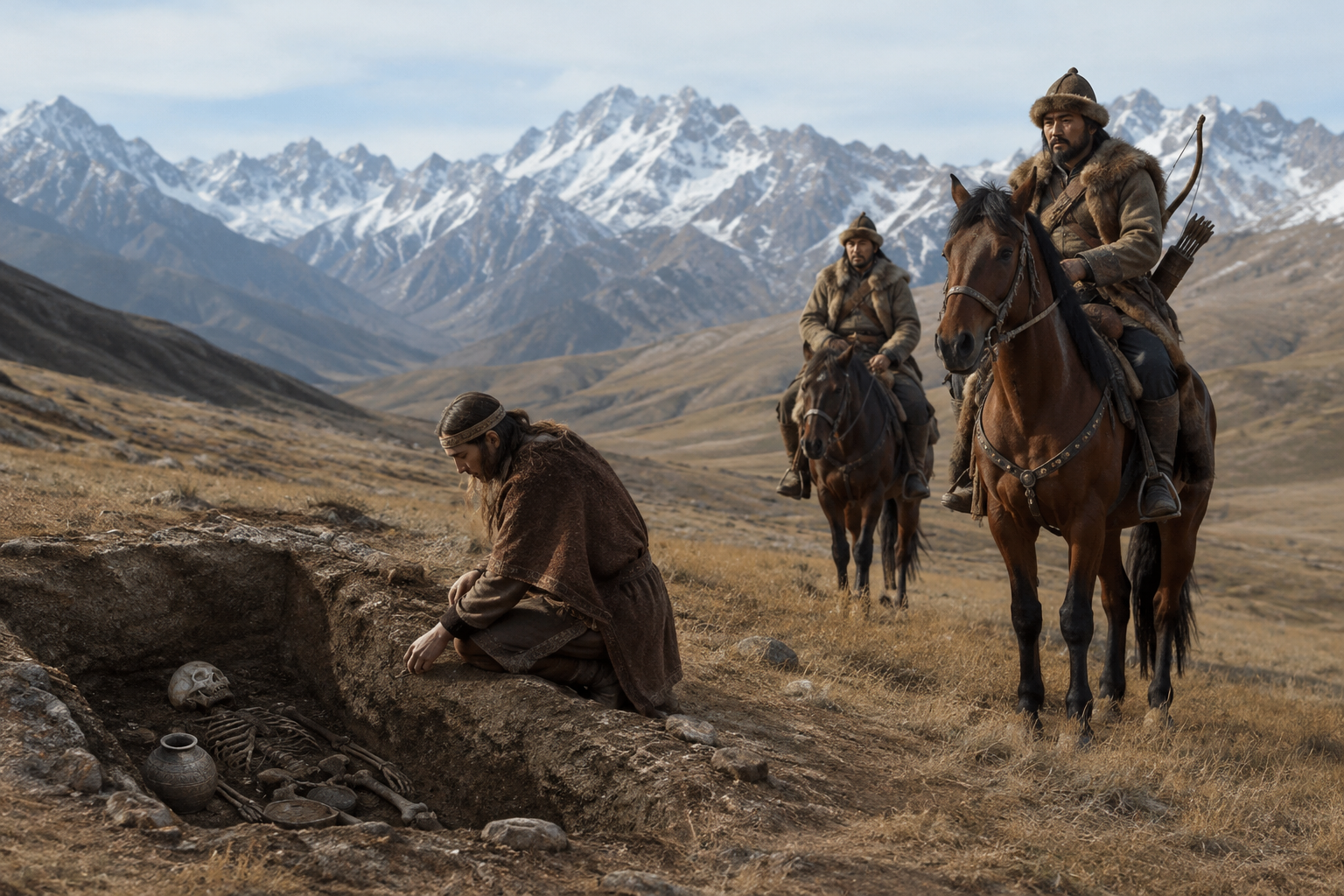
At Mezozombor-Kozsegi temet, in Bronze Age Hungary, one male identified as Hung127 carries the Y-DNA haplogroup Q2b2a, dated here to around 1600 BC. That is a striking find, not because one burial can explain a whole people, but because Q-lineages are far more often discussed in connection with northern and inner Asian histories than with the Middle Bronze Age Carpathian Basin. A lineage that many readers might imagine as distant from central Europe turns up, quite plainly, in a Hungarian burial ground.
The second clue comes much later and much farther east: DA127, from Aktas in the Tian Shan region of Kazakhstan, dated to the Hunnic period around AD 371. Taken together, these two men do not give us a neat, linear family saga. What they do offer is something more archaeologically honest and, in its way, more interesting: evidence that the paternal branch Q2b2a appears in very different settings across the Eurasian steppe world and its neighboring regions, from Bronze Age Hungary to late antique Central Asia.
Y-DNA tracks one line only: father to son, through the direct paternal chain. That makes it especially useful for following the history of a specific male lineage, but it does not describe a person's whole ancestry, language, or identity. A man assigned to Q2b2a could have had most of his ancestry from populations quite different from other men who share that same paternal branch.
That point matters here. Haplogroup Q is a broad paternal lineage with a deep history across northern Eurasia and, in other branches, the peopling of the Americas. But this article is about Q2b2a, a narrower branch, and the evidence in hand is limited to two ancient individuals in two very different archaeological contexts. We should resist the temptation to turn that into a grand single-route migration tale.
Hung127 is the earlier of the two known ancient examples here, placed in Bronze Age Hungary around 1600 BC at Mezozombor-Kozsegi temet. Even with sparse burial detail, the location is historically suggestive. The Carpathian Basin in the second millennium BC was not an isolated pocket. It was a busy world of local communities, regional exchanges, shifting material cultures, and long-distance contacts that linked central Europe with the steppe to the east.
That is precisely why a Q2b2a result matters. It does not mean that Bronze Age Hungary was somehow "Asian" in any simple sense, nor that this individual was a recent migrant from one specific eastern homeland. It does mean that paternal diversity in the Bronze Age Carpathian Basin could include lineages that modern readers may not expect there. Ancient DNA has repeatedly complicated older, tidier maps of Europe, and Hungary is one of the places where those complications are especially revealing.
Research published on ancient populations of the broader region has shown how deeply connected the Eurasian landmass already was by the Bronze Age, with movements of people and ancestry not confined to a single dramatic episode but unfolding across centuries. A useful background study for that wider story is this ancient DNA research on Inner Eurasian population history, which helps explain why an apparently unusual paternal branch can appear in contexts far from where modern assumptions might place it.
Late Bronze Age Central Europe
If one wants a historical setting for Hung127, the key is not to imagine a lone wanderer trudging across a map, but a region that repeatedly absorbed and reworked influences from many directions. The Carpathian Basin sat between central Europe, the Balkans, and the steppe. Goods, styles, technologies, and sometimes people moved through it. A paternal lineage such as Q2b2a may therefore mark older steppe-linked ancestry, more recent mobility, or simply the persistence of a less common line within an already mixed population.
That broader picture has become clearer as more Hungarian ancient DNA has been published. Later periods in the basin, especially the early medieval and conquest eras, show again and again that eastern and western connections were not mutually exclusive. The point is not that every eastern-associated lineage arrived in the same way, but that Hungary repeatedly formed part of a corridor where such lineages could appear, survive, and reappear in new historical settings.
The later sample, DA127, comes from Aktas in the Tian Shan area of Kazakhstan and is dated here to about AD 371, in the Hunnic period. This setting is very different from Bronze Age Hungary, but it belongs to another zone where mobility was ordinary rather than exceptional. The Tian Shan corridors linked steppe, oasis, and mountain worlds, and by late antiquity they were tied into the political turbulence that shaped the Hunnic horizon across Inner Eurasia.
Finding Q2b2a here does not prove a direct genealogical link to Hung127, still less a continuous dynasty passing unchanged from one grave to the next over nearly two millennia. But the comparison is still important. It places this paternal branch within the sort of connected world where lineages could spread, fragment, persist locally, and reappear in quite separate communities. In archaeological terms, that is often how the steppe works: not as a single migrating block, but as a long-lived network of contacts and regroupings.
For readers interested in Hunnic and post-Hunnic movements, this is the more suggestive of the two finds. Not because DA127 can stand for all Huns - it cannot - but because it belongs to a historical period when confederations and frontier populations often brought together men of varied ancestries under shared political labels. A Y-chromosome result here is a clue to diversity within that world, not a tribal badge.
With only two ancient examples supplied here, caution is essential. Yet scarcity can be informative. Q2b2a is not showing up in one single local pocket alone. Instead, the current picture places it in a Bronze Age community of the Carpathian Basin and again in a Hunnic-period context in the Tian Shan sphere. That distribution, sparse though it is, fits a Eurasian past in which paternal lineages could travel through many kinds of historical process: migration, marriage networks, elite incorporation, pastoral mobility, and the survival of older lines within mixed populations.
One should also note the different scales of evidence. The Hungarian sample sits in a settled Bronze Age European context; the Kazakhstan sample belongs to a late antique horizon often associated with large-scale steppe political change. Q2b2a therefore appears not tied to one archaeological culture alone, but capable of turning up in very different social worlds.
For raw genomic context behind one of these datasets, the associated sequence archive is available at this ancient DNA project record. It is most useful as supporting infrastructure for the research rather than as a narrative source in its own right, but it underlines an important point: these identifications come from the steady accumulation of laboratory and archaeological work, not from romantic guesswork.
For someone researching Q2b2a today, the most responsible conclusion is also the most intriguing. This branch is not confined, in the ancient evidence here, to a single people or a single homeland. Instead, it appears in two widely separated Eurasian settings: Bronze Age Hungary and Hunnic-period Kazakhstan. That makes Q2b2a less a marker of one neat identity than a sign of how deeply connected Eurasian history could be, even when the surviving evidence is fragmentary.
In other words, if Q2b2a is part of your paternal line, the ancient story currently available points toward a lineage that could surface in both central European and Inner Eurasian contexts. It is a reminder that paternal ancestry often preserves narrow lines through broad, mixed, and very human histories.
Comments