Haplogroup R1a1a1b1a2a2a1

– 5 min read


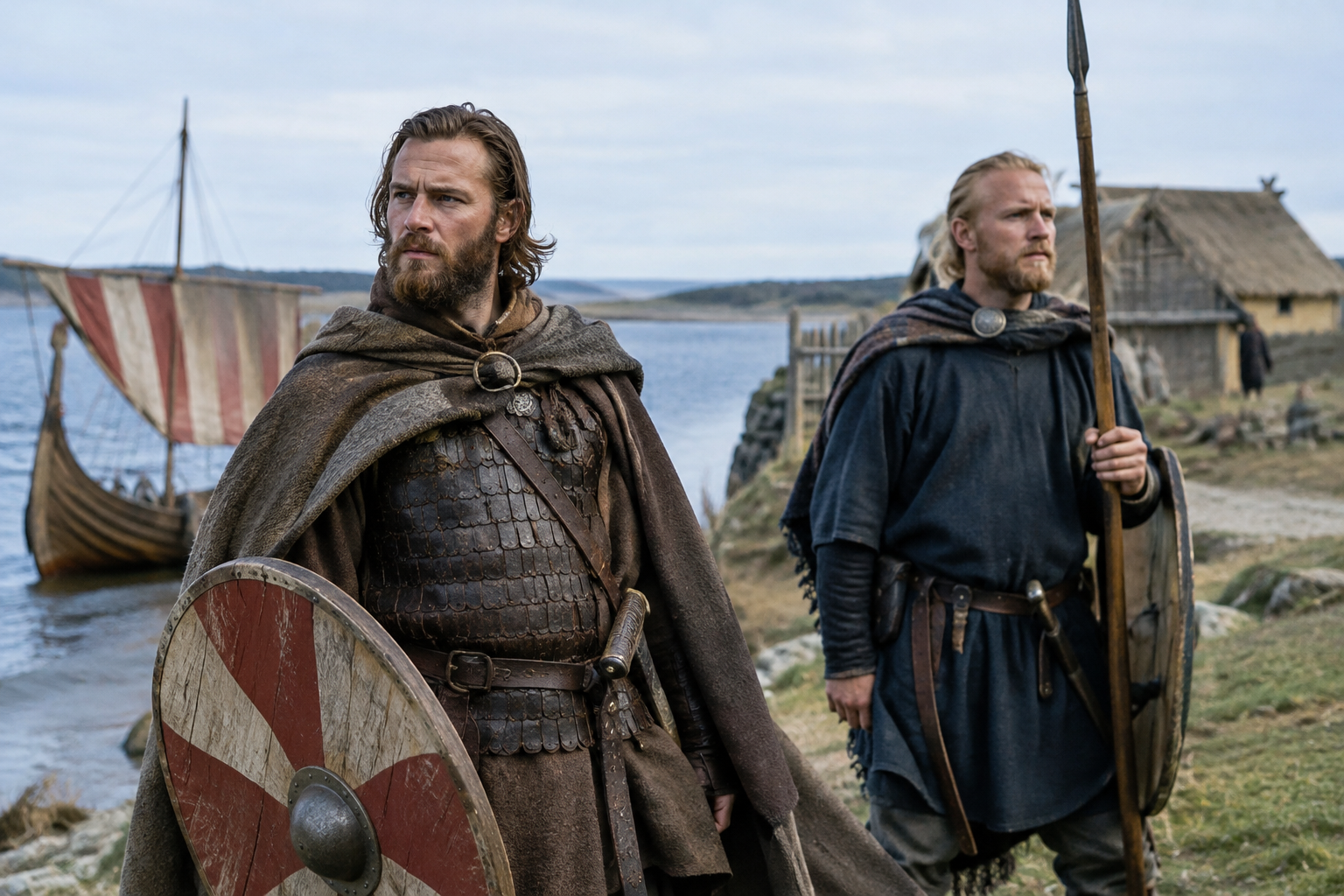
At Bodzia in central Poland, archaeologists uncovered an early medieval cemetery whose dead did not fit neatly into one local story. One of its men, dated around AD 950 and identified as VK156, belongs on MyTrueAncestry to the Y-DNA haplogroup R1a1a1b1a2a2a1. That matters because Bodzia has become one of those rare places where archaeology and genetics both insist on the same point: the Viking Age Baltic world was not a sealed ethnic box, but a connected zone of movement, service, marriage, and ambition.
The same paternal branch also appears in another Viking Age setting, at Fröjel on Gotland in Sweden, where sample VK64 is dated to about AD 975. Even with only two ancient finds named here, the pattern is already suggestive. This is not a haplogroup floating in abstraction. It appears in two important Baltic contexts at nearly the same moment, on opposite sides of the sea, during the century when Scandinavian, Slavic, and wider eastern connections were reshaping northern Europe.
Bodzia has attracted so much attention because the site sits in Piast Poland yet shows unmistakably wider northern and eastern links. The cemetery is usually discussed as evidence for high-status people moving through, or settling within, the emerging Polish realm. In that setting, VK156 is especially interesting not because one Y-chromosome can explain the whole cemetery, but because it adds a paternal clue to a place already known for cultural mixture.
R1a is a broad and widespread Y-DNA family across much of Eurasia, but the branch in this article is far more specific: R1a1a1b1a2a2a1. Y-DNA traces only a direct paternal line, not a person's whole ancestry, status, or language. Even so, when a branch appears in a cemetery like Bodzia, it helps anchor one thread of male-line history inside a world of political expansion and long-distance contact.
An ancient DNA study of Viking Age populations, available at https://www.biorxiv.org/content/10.1101/703405v1, helped establish just how varied these northern communities could be. That is the larger frame in which VK156 is best understood: not as a lonely outlier, but as part of a wider Baltic arena where identities were often composite and careers could be mobile.
The second sample, VK64 from Fröjel on Gotland, comes from one of the most strategic islands in the Viking Age world. Gotland was not simply Scandinavian in a narrow mainland sense. It was a trading hub, a maritime broker, and a place where the eastern Baltic, Sweden, and routes leading toward Rus' and beyond all met.
That makes the appearance of R1a1a1b1a2a2a1 at Fröjel particularly telling. If Bodzia shows this paternal line within the orbit of early Polish state formation, Gotland shows it in a maritime setting famous for connectivity. The value of VK64 lies less in any claim of dynastic identity than in the geographic pairing: one branch, two Baltic-world contexts, both around the late 10th century.
Gotland has featured repeatedly in ancient-DNA discussions because the island preserves evidence for continuity, exchange, and changing populations over very long periods. By the Viking Age, it was already an old crossroads. A paternal lineage found there could have deep local roots, or it could represent later movement through Baltic networks; with the evidence here, the careful answer is that Gotland shows the branch present in a place built on contact.
It is tempting to look at a long subclade label like R1a1a1b1a2a2a1 and imagine that it must point to one people with one homeland and one migration route. History is not usually so obliging. A narrow Y-DNA branch can persist through many cultural changes, passing from father to son while languages, loyalties, and political borders shift around it.
Still, these two Viking Age samples let us say something useful. This branch was present in the late first millennium AD in the Baltic zone, in both Poland and Sweden, and in settings that historians already regard as internationally connected. That is a good example of how a paternal lineage can be historically visible without being reducible to a single ethnic label.
Broadly speaking, many R1a lineages are associated in ancient DNA with eastern and central European as well as steppe-linked histories, but that broader background should not be carelessly collapsed into this exact branch. The article haplogroup is a fine-grained twig on a much larger tree. The evidence here supports its presence in Viking Age Baltic societies; it does not, by itself, prove one grand narrative stretching unbroken from prehistory to any single medieval people.
The late 10th century was a remarkable moment for both Bodzia and Gotland. Across the Baltic, rulers were consolidating power, merchants were linking coasts and rivers, and armed retinues could include men whose origins were not local to the place where they were buried. Archaeology has spent decades dismantling the old fantasy of neatly separated medieval populations; ancient DNA has largely reinforced that correction.
Seen in that context, VK156 and VK64 belong to a world of practical mobility. Men could move for war, exchange, marriage alliances, or elite service. A shared paternal branch in Poland and Gotland around the same time does not require us to imagine the same family in a documentary sense, but it does fit a historical landscape in which male lines could spread through linked Baltic communities.
Early medieval Baltic connections
This is also why Bodzia matters so much to the archaeology of early Poland. The site has often been discussed as evidence for people embedded in transregional networks rather than purely village-based continuity. Fröjel, meanwhile, represents the seaborne side of that same story. Put together, they suggest that R1a1a1b1a2a2a1 belongs, at least in the ancient evidence currently highlighted here, to a Baltic sphere where identities were layered and movement was ordinary.
If we had only VK156 from Bodzia, the haplogroup might look like one more intriguing detail from a famously unusual cemetery. If we had only VK64 from Fröjel, it might seem simply one paternal line among many on a connected island. Together, though, they give the branch a sharper historical setting: the Viking Age Baltic, around AD 950 to 975, on both the Scandinavian and southern Baltic shores.
That does not make the branch uniquely Viking, uniquely Slavic, or uniquely elite. What it does do is place it in exactly the sort of environment where those later labels often overlapped in real life. The men buried at these sites were part of societies shaped by exchange across water, not isolation behind it.
For someone whose paternal line falls under R1a1a1b1a2a2a1, the most defensible insight from these ancient finds is not a promise of one tribe or one royal pedigree. It is something more historically interesting: this branch is attested in the vibrant, mixed, and highly mobile Baltic world of the late Viking Age, appearing in both Bodzia in Poland and Fröjel on Gotland. That places your direct male line, at least in the ancient evidence highlighted here, within one of medieval Europe's busiest contact zones.
Comments