Haplogroup R1b1a1b1a1a2c1a1a1a1a1a

– 5 min read


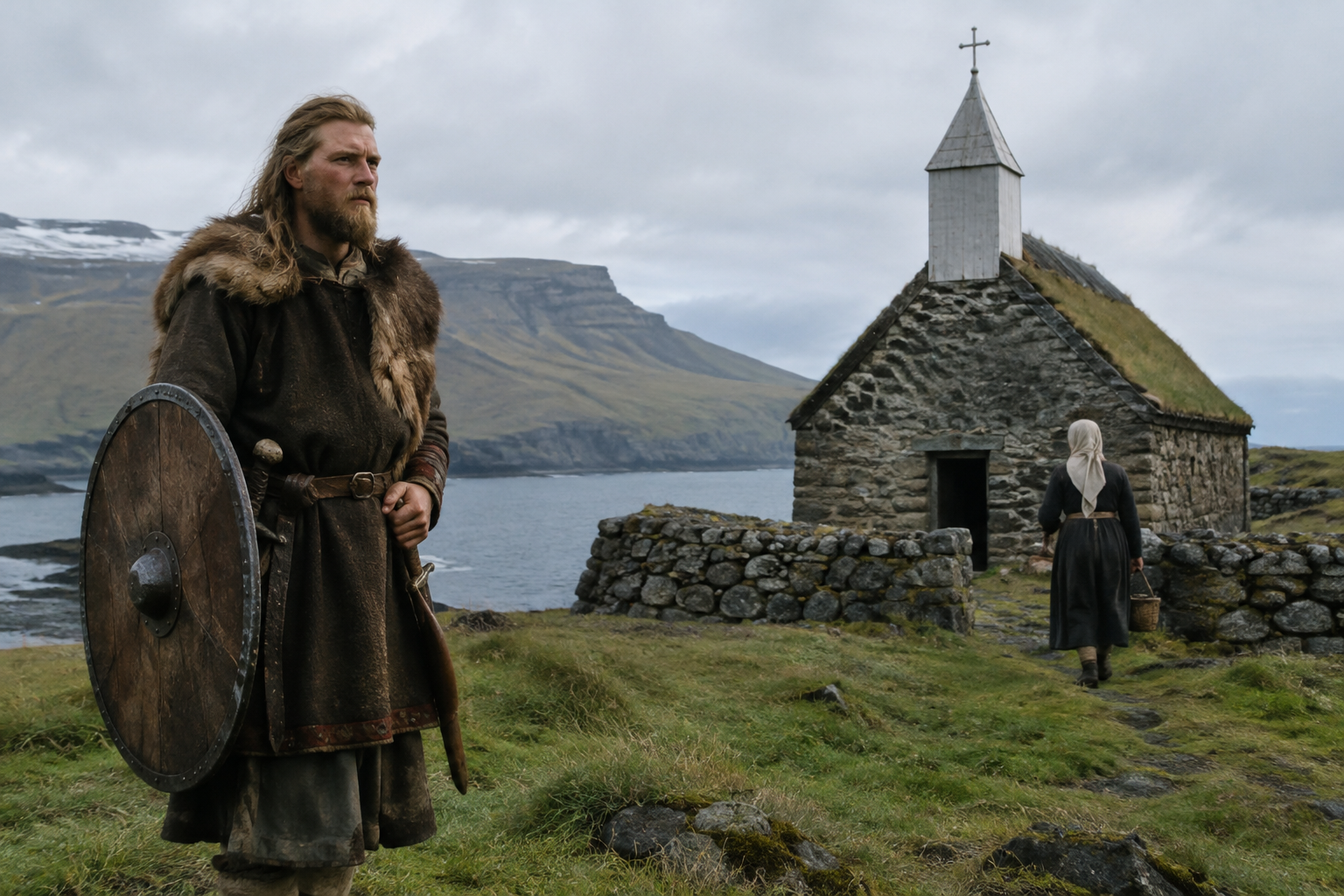
At Hofstadir in Iceland, one of the best known Viking-Age farmsteads in the North Atlantic, an individual dated to around AD 1050 and identified as VK95 carries the long Y-chromosome line labeled R1b1a1b1a1a2c1a1a1a1a1a. That string of letters and numbers is forbidding on first sight, but the setting is wonderfully concrete: not an abstract map of migrations, but a real man from a real settlement at the edge of the medieval Norse world.
He is not alone. A second ancient individual, VK44, from Sandoy Church in the Faroe Islands and dated around AD 1600, is also associated with this same paternal branch. Taken together, these two finds place this lineage in the North Atlantic islands across a span of roughly five centuries, from the late Viking Age into the post-medieval Christian world. That is what makes this haplogroup interesting here: not a grand claim about all of Europe, but a small, sturdy line of evidence connecting two island communities shaped by Scandinavian settlement, seafaring, and long continuity.
Y-DNA follows one narrow line of descent: father to son to son. It is therefore excellent for tracing a direct paternal branch, but it is only one thread in a person's ancestry. The haplogroup in this article, R1b1a1b1a1a2c1a1a1a1a1a, is a very specific twig on the much larger R1b tree, and it would be a mistake to transfer every story ever told about broad R1b lineages onto this particular subclade.
What the ancient evidence does show is that this paternal line appears in two North Atlantic contexts with strong historical significance. One is Viking-Age Iceland, settled largely during the late 9th and 10th centuries and then transformed into a literate Christian commonwealth. The other is the Faroe Islands, whose population history also reflects the meeting of migration, isolation, and continuity over centuries.
An ancient DNA study of North Atlantic island populations has helped place such individuals into that wider setting, and the research trail linked to these samples begins with a genetic study of ancient Icelandic and related North Atlantic material. Even without pushing beyond the evidence, that is enough to anchor this haplogroup in a recognisable historical world.
Hofstadir is one of those Icelandic sites that immediately carries historical weight. It belongs to the age when Iceland had already been settled for generations, when farms were major social units, and when conversion to Christianity had formally taken place but older habits and local identities still shaped daily life. A man living there around AD 1050 was part of a society balancing memory of migration with the realities of an established island community.
The sample VK95 matters because it places this paternal branch in Iceland at precisely that transitional moment. Around AD 1050, Iceland was no longer a frontier in the first-settlement sense. It was a functioning medieval society with law, churches, regional ties, and a growing written culture that would later produce the sagas. A Y-line found there may reflect earlier settler ancestry, but the sample itself belongs to the settled North Atlantic world, not merely to the moment of initial colonisation.
That distinction is important. People often want a Y-haplogroup to tell a simple origin story, yet VK95 instead points to persistence: a paternal line still present in Iceland generations after the first voyages from Scandinavia and the British Isles. It tells us less about one dramatic crossing and more about the families who stayed, reproduced, and became part of Iceland's long demographic history.
The second ancient individual, VK44, comes from Sandoy Church in the Faroe Islands and is dated to about AD 1600. This is a very different setting from Viking-Age Hofstadir, yet that is precisely why the pairing is so useful. By the early modern period the Faroes were firmly Christian, organised around parish life, and tied into the Scandinavian and North Atlantic world in new administrative and economic ways.
A church burial context also reminds us that the same paternal line can pass through strikingly different historical environments without changing its biological identity. The men represented by VK95 and VK44 did not live in the same political order, the same religious world, or the same cultural moment. Yet their shared Y-line suggests that this branch endured through major social change, from the Norse commonwealth era to post-Reformation Atlantic Christianity.
The Faroe Islands are especially valuable for population history because their settlement and later isolation can make lineages easier to track across time. That does not mean every Faroese family descends from one paternal founder, or that one sample stands for the whole islands. It does mean that VK44 gives this haplogroup a second fixed point in the North Atlantic, centuries after the Viking Age.
Faroese ancestry and selection
These two samples work best when read against the broader history of North Atlantic settlement. Iceland and the Faroes were linked by sea routes, kin networks, trade, church organisation, and overlapping spheres of Scandinavian influence. Ships carried people, livestock, timber, news, clerics, and marriage partners between islands and mainland ports for centuries.
So a lineage appearing in both places is historically plausible without any need for melodrama. The Norse expansion into the North Atlantic was not a single-wave ethnic event but a process involving settlers with varied backgrounds, including people connected to Scandinavia and the British-Irish world. Over time, those founding populations became local island societies in their own right.
For that reason, R1b1a1b1a1a2c1a1a1a1a1a should be understood here as a North Atlantic medieval paternal line attested in island communities, not as a badge of one exclusive identity. The archaeology gives us people in place; the genetics gives us one line of descent; history explains how such a line could persist across centuries of settlement, conversion, and community life.
Two ancient men are not a dynasty, a tribe, or a complete population survey. But they are not trivial either. In ancient DNA, a well-dated individual from a named site can be more informative than pages of guesswork, because he fixes a lineage to a real historical landscape.
VK95 shows this branch in late Viking-Age Iceland. VK44 shows it again in the Faroe Islands around AD 1600. The significance lies in the pattern: the same paternal branch appearing in two related island worlds that were central to Norse expansion and its aftermath. That gives descendants today a historically grounded point of connection, especially if family history already points toward Icelandic, Faroese, or broader North Atlantic ancestry.
The most responsible reading of R1b1a1b1a1a2c1a1a1a1a1a is also the most interesting. This is a paternal line attested not in legendary founders or borrowed prestige, but in real men from Iceland and the Faroe Islands, living centuries apart in communities shaped by Norse settlement and long island continuity. If this is your Y-DNA line, the ancient evidence does not promise a named saga hero. What it does offer is something sturdier: a documented place in the lived history of the medieval North Atlantic.
Comments