Haplogroup Q1b1a1a2b2
– 5 min read


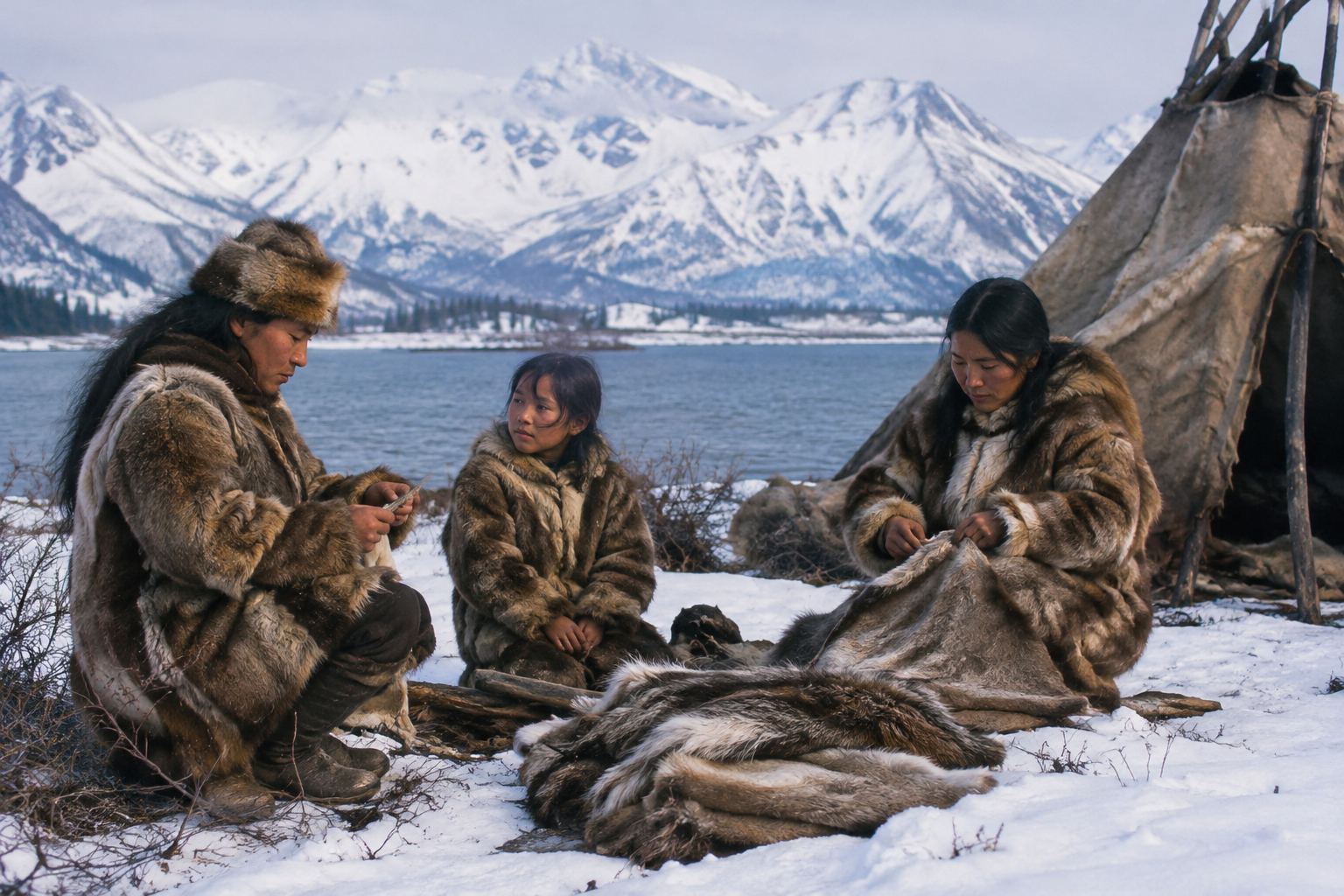
In around AD 1235, an ancient individual identified as I5319 lived in the world of the Alaskan Athabaskans. That single sample is a small piece of evidence, but it is an unusually evocative one. It places the Y-DNA haplogroup Q1b1a1a2b2 in a northern Indigenous American context, and that matters because lineages like this are best understood not as abstract labels on a tree, but as the surviving paternal traces of real communities in real places.
With this haplogroup, the story is necessarily careful rather than sprawling. We are not dealing here with a long parade of named kings or a cemetery full of closely described graves. We have a specific ancient individual, a date in the early second millennium AD, and a regional setting in Alaska that sits within the much larger human history of the peopling of the Americas and the later diversity of northern peoples. That is enough to say something meaningful, so long as we resist the temptation to say more than the evidence allows.
The sample I5319, dated around AD 1235 and described as an Alaskan Athabaskan individual, gives this article its firm archaeological footing. The crucial point is not that one man can stand for all Athabaskan history; plainly he cannot. The value lies in having an ancient paternal lineage anchored to a particular Indigenous population in the subarctic north, centuries before modern genetic reshuffling and colonial disruption transformed the demographic landscape.
Y-DNA follows a direct paternal line: father to son, and so on. That makes it powerful, but narrow. A man carrying Q1b1a1a2b2 was not "nothing but" that lineage, and neither are his descendants today. Still, ancient Y-DNA can reveal continuity, local survival, and the endurance of male lines within communities whose histories were long told primarily through language, archaeology, and oral tradition.
A broader ancient DNA study of northern populations, available at this research link, has been associated with the sample record used here. Without overstating details that are not explicitly provided, the study context is enough to place I5319 within the growing body of work showing that Arctic and subarctic North America preserved deep and regionally distinctive genetic histories.
The first thing to say about Q1b1a1a2b2 is that it belongs to haplogroup Q, one of the major Y-chromosome lineages associated with the ancient ancestry of Indigenous peoples of the Americas. That much is well established at the level of the parent haplogroup. The second thing to say is just as important: a precise branch such as Q1b1a1a2b2 is not interchangeable with haplogroup Q as a whole. One cannot simply transfer every grand statement about the origin and spread of Q onto this exact subclade.
So what can be said responsibly? This branch is consistent with an Indigenous American paternal heritage, and the ancient individual I5319 shows that it was present among Alaskan Athabaskan people in the medieval period. That makes the haplogroup historically interesting not because it proves a single migration episode all by itself, but because it ties one paternal line to a northern community shaped by long-term movement, adaptation, and local continuity in a demanding environment.
In public discussions of ancient DNA, there is often a rush toward huge maps and sweeping arrows. But with northern North America, the more revealing story is often regional. Languages, lifeways, and kin networks changed across time, and lineages endured through those changes. A haplogroup such as Q1b1a1a2b2 belongs in that sort of history: not as a magic ethnic stamp, but as one thread in the settlement history of the far north.
By the thirteenth century AD, Alaska was no empty frontier waiting to be "discovered." It was a peopled landscape of river systems, seasonal rounds, exchange routes, and communities with their own deep histories. To locate I5319 in an Athabaskan context is therefore to place him inside a world of interior northern adaptation, where geography mattered enormously and where social ties were maintained across large distances.
That is one of the reasons an ancient paternal lineage from this context is so valuable. In northern regions, archaeology often has to work hard against preservation limits, sparse settlement traces, and later historical upheaval. Ancient DNA can sometimes restore a different sort of visibility, showing that present-day Indigenous populations are connected to older regional populations in ways that can now be traced directly in the genome as well as through culture and oral history.
It is also worth noting what the label "Athabaskan" does and does not mean in such an article. It identifies a cultural and linguistic context for the sample. It does not mean that one Y-chromosome lineage defines all Athabaskan peoples, nor that every community shared the same paternal structure. Ancient northern societies were varied, and any single male lineage is only one part of that larger human picture.
Readers sometimes assume that one sample is too little to matter. In one sense, that is true: one individual cannot prove the full distribution, age, or social role of Q1b1a1a2b2. But archaeology is full of cases where one securely placed find changes the conversation. A single dated coin can fix a chronology; one inscription can reveal a name; one skeleton with readable DNA can anchor a lineage to a time and place.
That is exactly the value of I5319. The sample demonstrates that this paternal branch, or a reported association with it, belongs in the documented ancient history of Alaska rather than being treated only as a feature of modern DNA testing. For people carrying this haplogroup today, that makes the lineage feel less like an abstract code and more like a historical inheritance rooted in an Indigenous northern past.
There is also a wider methodological point. Ancient DNA has transformed our understanding of population history not because it gives simple answers, but because it lets us test old assumptions against dated human remains. In the Americas, that has been especially important for showing both deep ancestry and later regional diversification. If you want the broader background to that revolution in method, MyTrueAncestry has also explored it in Ancient DNA and the Rise of Archaeogenetics.
Alaska sits near one of the great thresholds of human history: the wider North Pacific and Beringian zone through which the earliest ancestors of Indigenous Americans once moved. But one must be disciplined here. An individual living around AD 1235 is not a direct witness to the first settlement of the Americas many millennia earlier. What he offers instead is evidence of later continuity within a region whose population history remained dynamic long after the first arrivals.
That distinction matters. The ancient and medieval north was not frozen in time. Communities interacted, moved, split, and re-formed. Technologies and trade networks changed. Yet paternal lines could persist through all this, carried from one generation to the next. Q1b1a1a2b2, seen through I5319, looks less like a relic and more like a surviving branch within that long northern history.
For someone researching Q1b1a1a2b2, the strongest supported insight is refreshingly concrete: this paternal line is represented in the ancient record by an Alaskan Athabaskan individual, I5319, dating to around AD 1235. That does not turn every modern carrier into a direct descendant of that one person, and it does not flatten the complexity of Indigenous American history into a single branch. But it does place the haplogroup inside a real archaeological landscape of northern North America, where paternal continuity and regional identity can be studied together rather than imagined separately.
Comments