Haplogroup Q1b1a1a2a
– 5 min read


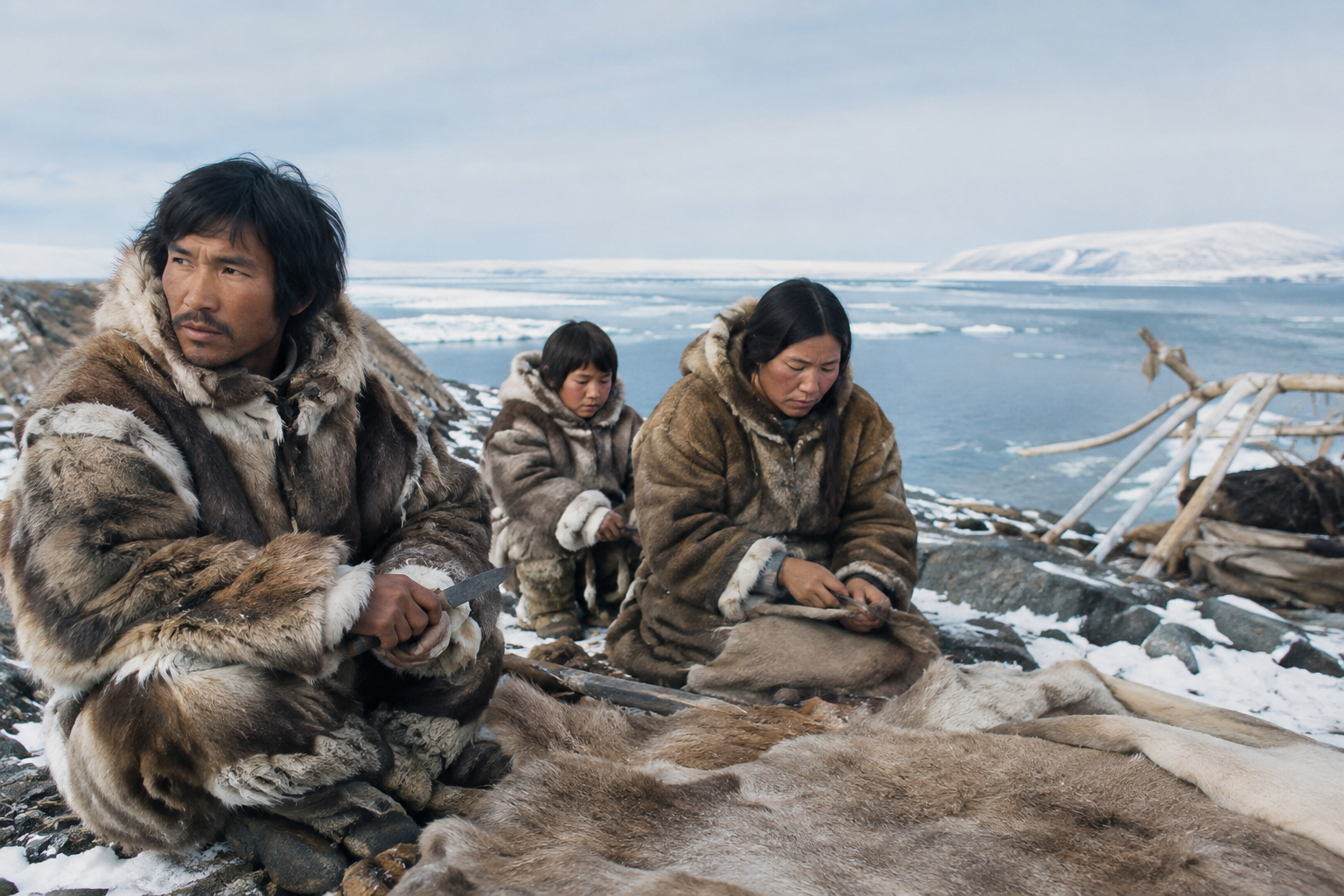
One of the clearest ancient signposts for Q1b1a1a2a is a man identified as I1125, dated to around AD 1325 in the Inuit Bering Strait region. That is already enough to make him historically interesting. We are not looking at a stray lineage in an unexpected place, but at a paternal branch appearing in one of the great Arctic crossroads: the narrow zone between Alaska and Siberia where sea ice, hunting routes, kin networks, and long-distance contacts shaped life for centuries.
For anyone researching this haplogroup today, that matters because Q lineages have a deep history across northern Asia and the Indigenous Americas, but a precise branch like Q1b1a1a2a is not the same thing as the whole of haplogroup Q. Y-DNA tracks one direct paternal line only, yet even that single line can anchor a remarkable story when it turns up in a securely dated Arctic individual such as I1125.
The Bering Strait is often imagined as a remote fringe. Archaeology tells a rather different story. It was a lived-in maritime world, busy with movement, exchange, and adaptation, where communities managed sea-mammal hunting, coastal travel, and communication across difficult waters. A man from this setting, carrying Q1b1a1a2a, belongs to that very human geography rather than to some abstract migration diagram.
By the early second millennium AD, the Inuit world of the western Arctic was dynamic and highly mobile. Technologies, seasonal camps, and social ties helped connect groups over long distances. So when a paternal lineage like Q1b1a1a2a appears here, the most sensible reading is not a dramatic one about a single heroic migration, but a quieter and more convincing one: this branch formed part of the male-line diversity carried within Arctic peoples whose history was already shaped by repeated movement and regional contact.
A genetic study of Arctic and neighboring populations, available at https://www.biorxiv.org/content/10.1101/203018v1, helped place ancient northern individuals into a broader population framework. Even where one paper cannot answer every question about a fine-scale subclade, that kind of research is valuable because it shows how ancient genomes can illuminate the peopling and re-peopling of the Far North.
Ancient Americas settlement waves
It is worth being exact here. Q1b1a1a2a is a narrow paternal branch within the wider haplogroup Q, a major Y-chromosome lineage strongly associated with northern Eurasian and Indigenous American population history. That broader fact is useful background, but it should not be lazily transferred wholesale onto every sub-branch. The ancient sample I1125 gives us evidence for this particular line in the Inuit Bering Strait world around AD 1325; it does not by itself map the entire earlier history of the branch in all regions.
Still, even one securely placed ancient individual can be informative. Fine-grained Y-DNA branches often survive through local continuity, founder effects, and the demographic realities of small or regionally connected populations. In the Arctic, where communities could be both mobile and relatively small in number, paternal lines might persist for long periods while still being redistributed across settlements and seasonal networks.
This is one reason Arctic ancient DNA is so valuable. It does not merely confirm that northern peoples existed where we knew they existed. It lets us see how lineages were structured within those societies, and how individual male lines fit into larger histories of adaptation, expansion, and contact.
A date around AD 1325 places I1125 in a period when the Arctic was anything but isolated from history. This was a time of developed Inuit lifeways across broad northern coasts, with established knowledge systems and social organization suited to one of the most demanding environments on earth. The Bering Strait in particular linked American and Siberian shores in ways that outsiders have often underestimated.
What makes I1125 useful is precisely that he is not an imported royal corpse, a legendary founder, or a text-bound historical celebrity. He is valuable because he is ordinary in the best archaeological sense: a real person from a real northern community. His Y-DNA assignment gives a rare fixed point for Q1b1a1a2a in the late prehistoric or early historic Arctic.
And that, in turn, helps frame a more realistic understanding of paternal ancestry. Men carrying the ancestors of this branch were part of functioning communities with local histories, not merely dots along a migration arrow from one continent to another. The lineage belongs inside that social world.
There are few regions where genetics and archaeology meet so dramatically as they do around the Bering Strait. Over very long timescales, this broader zone is central to discussions of movement between northeast Asia and the Americas. But one of the lessons of recent archaeogenetics is that such movement was not a single event with a neat beginning and end. Northern populations continued to diversify, mix, separate, and reconnect long after the first settlement of the Americas.
That larger context makes an Arctic sample like I1125 more than a local curiosity. He belongs to a historical landscape where deep-time dispersals and later regional histories overlap. A branch such as Q1b1a1a2a may therefore interest people whose paternal ancestry points toward Indigenous American or far northern Eurasian connections, but the evidence should be handled carefully: one medieval Arctic individual shows confirmed presence, not exclusive ownership of the branch by one modern identity or nation.
In other words, the Bering Strait is important not because it gives us a romantic origin myth, but because it forces precision. It is a contact zone, a homeland, and a corridor all at once. Ancient Y-DNA from this region can therefore say something meaningful about continuity without pretending to tell the whole story.
There is a temptation, whenever haplogroup Q appears, to jump straight to Ice Age maps and the first peopling of the New World. Those vast horizons are certainly relevant in the background. But the presence of Q1b1a1a2a in I1125 also reminds us that lineages survive through nearer, more tangible histories: fathers, sons, households, hunting partnerships, village ties, and marriages arranged within the realities of Arctic life.
This is where archaeology keeps genetics honest. A medieval individual from the Inuit Bering Strait was not simply a relic of an ancient founding population. He was part of a later society with its own innovations, social networks, and historical momentum. The Y-chromosome line he carried had reached that moment through all the messy, ordinary business of human continuity.
That is also why direct paternal ancestry should never be mistaken for total ancestry. A man assigned to Q1b1a1a2a would still have had many other ancestors from many other lines, just as modern testers do. Yet the paternal line remains valuable because it preserves one thread clearly enough for us to follow.
Pre-European disease in the Americas
At present, the most concrete ancient clue supplied here for Q1b1a1a2a is that late medieval Arctic man, I1125, from the Inuit Bering Strait. That is a modest amount of evidence, but it is not trivial. It anchors this paternal branch in a specific place and period that mattered enormously in the human history of the North Pacific and the Indigenous Arctic.
For descendants and family historians, the sensible takeaway is not a grand claim to one famous tribe or a single migration episode. It is something better: this lineage has a documented foothold in the working, seafaring, highly connected Arctic world of the Bering Strait, where human communities turned a harsh environment into a durable homeland.
Comments