Haplogroup Q1b1a1a1g

– 5 min read


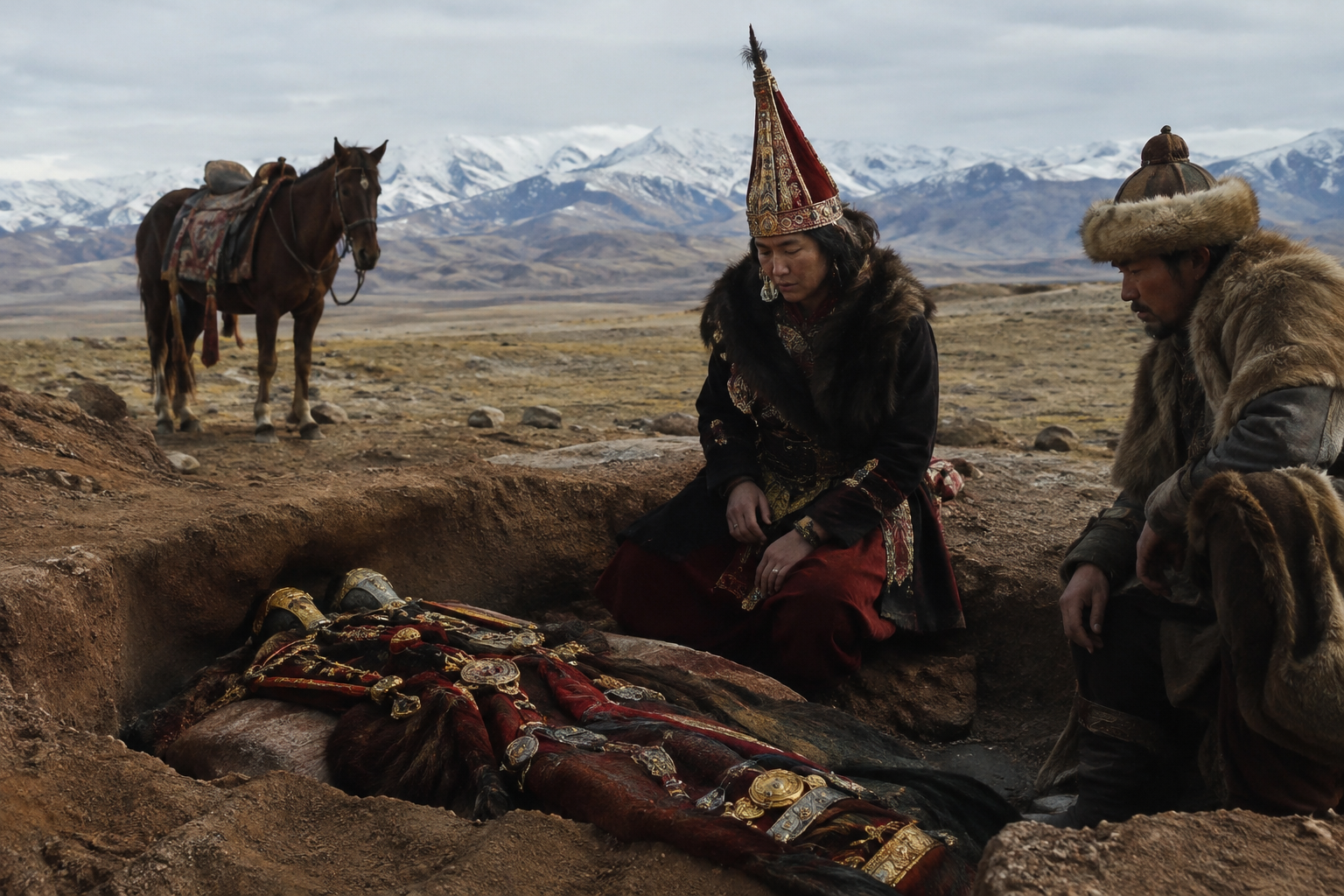
At Berel in eastern Kazakhstan, one of the best-known Iron Age cemetery landscapes of the Altai steppe, an individual labelled BRE016 has been associated with the Y-DNA haplogroup Q1b1a1a1g. The burial is dated to around 300 BC and identified as an elite Scythian grave from the Pazyryk horizon. That makes it a striking place to begin, because Berel is not some vague steppe backdrop: it belongs to a world of monumental kurgans, high-status burial traditions, and far-reaching connections across Inner Asia.
For anyone tracing this paternal line today, that is the first important point. Q1b1a1a1g is a very specific branch of Y-DNA, tracing one direct male line only, not the whole ancestry of a person or population. In the evidence here, its significance lies not in grand claims about all Scythians, but in its appearance within an archaeologically famous elite setting in the Altai region.
The Berel cemetery sits in a landscape that was central to the eastern steppe world in the Iron Age. The Pazyryk cultural sphere, spread across the Altai and neighbouring regions, is famous for its kurgan burials and for the remarkable preservation sometimes found in frozen tomb contexts. Berel itself has long mattered to archaeology because it shows how mobile pastoral elites displayed rank, memory, and authority through burial.
In that setting, BRE016 matters because he anchors Q1b1a1a1g to a concrete archaeological context rather than a purely modern distribution map. We are not dealing here with an abstract lineage floating free of history. We are looking at a paternal branch reported from a man buried in an elite Scythian context in East Kazakhstan, within a steppe society that linked the Altai, the wider Saka-Scythian world, and exchange zones stretching well beyond them.
The historical label needs handling carefully. "Scythian" can be used loosely in older writing for many steppe peoples, but Berel is better understood through its specific eastern context: the Pazyryk-related world of the Altai during the Iron Age. That is already interesting enough without trying to force a single tribal name onto every grave.
Haplogroup Q has deep importance across northern Eurasia and, in other branches, in the peopling of the Americas. But that broader story should not be lazily pasted onto Q1b1a1a1g. What the Berel evidence actually gives us is something more precise and more historically useful: one narrow paternal line present among Iron Age steppe elites in the Altai zone.
That matters because the eastern steppe was never genetically simple. Ancient DNA has steadily undermined the old picture of neatly bounded "peoples" moving like billiard balls across a map. Elite cemeteries could contain lineages with different deeper origins, while still belonging to one recognisable archaeological culture. A branch like Q1b1a1a1g appearing at Berel fits that wider lesson rather well.
It also reminds us that elite identity and paternal descent are not the same thing. A man buried as part of the Pazyryk elite was participating in a social and political system of the Iron Age Altai. His Y-chromosome tells us about one male line within that system, not the entire ancestry of the cemetery, let alone the whole Scythian world.
The Berel burial belongs to a period when eastern Kazakhstan and the Altai were part of a connected corridor rather than an isolated frontier. Horses, herding economies, prestige objects, and burial customs moved across these highland and steppe networks. So did people. That is one reason ancient DNA from the broader region has proved so useful: it lets us test whether archaeological similarity always meant close biological continuity. Usually, the answer is more complicated.
A useful way to think about BRE016 is not as "the Scythian haplogroup" but as one thread in that complicated fabric. If this branch turns up in an elite burial, it suggests that men carrying this paternal line could be incorporated into high-status groups in the eastern Iranian-speaking steppe world, or at least in populations archaeologists place within that broad horizon. That is a statement about social placement in a real historical landscape, not about modern identity politics.
Research on ancient steppe populations has repeatedly shown that these societies combined continuity with movement. Some lineages persisted locally; others reflect older east-west contacts across Inner Asia. Even when we are cautious about assigning exact migration routes to one sample, Berel still places Q1b1a1a1g in a region where such contacts were normal rather than exceptional.
The strongest claim here is straightforward: an ancient individual from an elite Pazyryk-era burial at Berel, BRE016, dated around 300 BC, has been linked with the article's branch, Q1b1a1a1g. Beyond that, one has to keep one's footing. A single sample is excellent evidence for presence, but not for exclusivity, dominance, or an unbroken elite dynasty.
Still, presence matters. Archaeology often gives us splendid graves and frustratingly silent family histories. Y-DNA adds a narrow but valuable line of evidence. In this case it shows that a branch of haplogroup Q was part of the paternal landscape of Iron Age eastern Kazakhstan at the elite level. That is a better, sharper claim than vague talk of "steppe ancestry."
An ancient DNA study of Scythian elites and related Inner Asian material provides the research setting in which this kind of result becomes meaningful, linking archaeological status, chronology, and paternal line evidence into one frame of interpretation: https://www.science.org/doi/10.1126/sciadv.aef0108.
There is another reason Berel deserves attention. Eastern Kazakhstan sits close to one of the great hinge-regions of Eurasian history, where the Altai, the steppe, and routes toward Xinjiang and Mongolia all meet. Over many centuries, that made it a place where communities could absorb influences from several directions while maintaining strong local traditions.
That broader setting helps explain why a lineage like Q1b1a1a1g may appear here without needing any melodrama attached to it. The Altai was not peripheral; it was central to steppe history. Political authority, herd wealth, seasonal mobility, and long-distance exchange all met in such landscapes. Elite graves at Berel are one of the clearest archaeological expressions of that world.
That also makes this haplogroup worth noticing for family historians. If your direct paternal line falls under Q1b1a1a1g, the present evidence does not entitle you to declare yourself descended from a Scythian prince. But it does place your lineage in a historically vivid zone of Iron Age Eurasia, among populations whose power, mobility, and burial customs shaped the eastern steppe.
The real value of Q1b1a1a1g is not that it solves the whole history of the steppe. It is that it has a secure foothold in one of the most evocative archaeological settings of Iron Age Inner Asia: the Berel elite cemetery of East Kazakhstan. For a paternal lineage study, that is exactly the kind of finding that matters most - specific, datable, and rooted in a known historical landscape.
If you carry this branch today, Berel offers a sensible starting image for your deep paternal past: not a mythic ancestor on horseback, but a documented man from a real cemetery, buried in the Pazyryk-era Altai around 300 BC, where archaeology and genetics briefly meet.
Comments