Haplogroup Q1b

– 6 min read


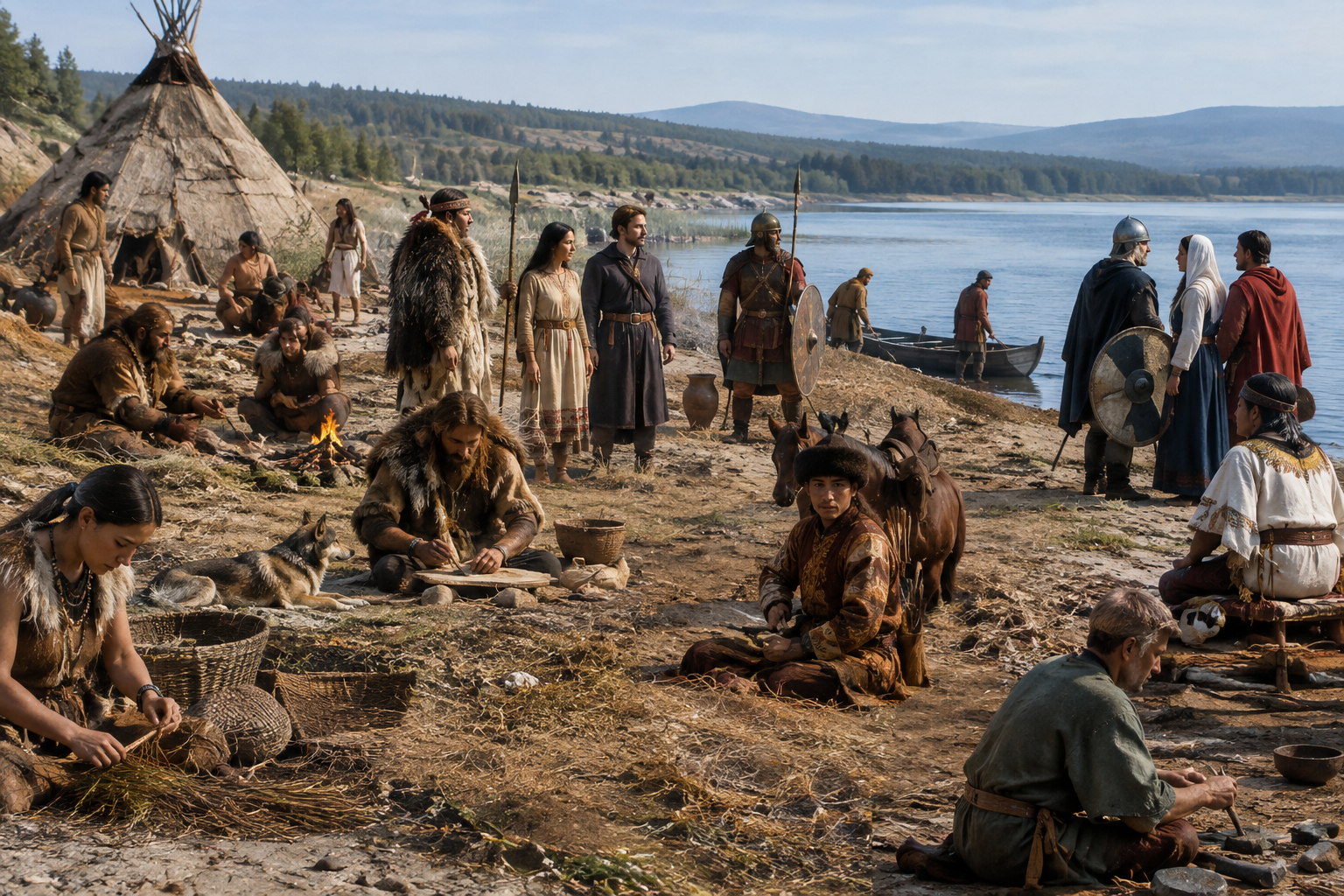
Haplogroup Q1b is a reminder that the paternal history of Eurasia was never tidy. If you only knew later medieval chronicles, castle genealogies, and the grand self-descriptions of noble houses, you might imagine the past as a set of neat regional boxes. Ancient DNA rather ruins that illusion. Q1b appears in a striking spread of ancient contexts, from the forest zones of Russia and Siberia to the steppe fringe, into Scandinavia, later in Iron Age Kazakhstan, post-Roman Hungary, Viking Age England, and - on a very different branch of the wider Q story - even in the Andes at Machu Picchu.
That does not mean one simple migration, one people, or one dynasty. It means that Y-DNA haplogroups trace one direct paternal line only, not a person's whole ancestry. Q1b sits within the broader Y-chromosome haplogroup Q, a lineage best known for its importance in northern Eurasia and, in other branches, in the peopling of the Americas. What makes Q1b historically interesting is precisely that it turns up in places where many readers would not expect it, allowing us to follow fragments of male-line history across huge distances and long spans of time.
The safest way to approach Q1b is not to force it into a single ethnic label, but to look at where ancient evidence places it. The supplied samples suggest a deep association with northern Eurasia: riverbanks, forest-steppe zones, Siberian communities, and later steppe-linked societies. That pattern fits a broader picture in which branches of haplogroup Q were part of ancient populations spread across the north of Eurasia long before the familiar kingdoms and nations of recorded history took shape.
Some of the earliest clues come from prehistoric Russia and Siberia. NEO100, from Ancient Russia Ural River Beach, dated to 7977 BC, places this paternal line in the wider Ural region at a very early date. Then there is NEO72 from Ancient Siberia Forest Steppes Mergen, dated to 6406 BC, and NEO922 from Ancient Russia Vengerovo, dated to 5599 BC. These are not the remains of kings in stone tombs. They are earlier and, in some ways, more revealing: evidence that paternal lines connected with Q1b were already moving through the northern belt of Eurasia in the Mesolithic and Neolithic worlds.
Explore Siberia and early Uralic roots
That early distribution also warns us against simplistic narratives. We are not looking at a lineage that suddenly appears with one historical invasion. We are looking at something older, layered, and geographically broad, later carried into very different societies by very different men.
The archaeological range of the samples is one of the most striking features here. At Sakhtish II in Russia, two Neolithic individuals, NEO181 and NEO185, both dated to 3318 BC, help anchor Q1b in the forest-zone populations of prehistoric eastern Europe. They are especially interesting because Sakhtysh has become an important site for understanding the long survival and interaction of forager traditions in northeastern Europe.
Farther east, the three individuals from Ancient Fofonovo Buryatia Russia - NEO199, NEO200, and NEO201, all dated to 5219 BC - point toward the Baikal-Buryatia region. Add I20308 from Ancient Russia Glazkovskaya Sosnovy Mys 2, dated to 2675 BC, and a picture emerges of continuity, or at least repeated presence, across the wider Siberian and trans-Baikal world.
Then comes the surprise that makes archaeogenetics so enjoyable: NEO599, the Neolithic Denmark Sjaelland Vanlose Mose Bog Skeleton, dated to 3191 BC. A Q1b-related paternal line turning up in Neolithic Denmark should not be read as proof of some giant replacement event. But it does show that lineages with deeper northern Eurasian roots could appear far to the west in prehistoric Europe. Ancient populations were mobile, mixed, and often more connected than later historical maps suggest.
Read more on Sakhtysh forest foragers
Other samples mark the steppe-facing edge of the story. NEO516, from Bronze Age Ukraine Igren, dated to 2114 BC, places the lineage in the north Pontic zone. NEO902, from Bronze Age Kazakhstan Sjauke, dated to 1854 BC, carries it deeper into Central Asia. By the Iron Age, ESZ014 from the Scythian Grave Eleke Sazy East Kazakhstan, dated to 550 BC, shows Q1b in a context strongly associated with steppe elites and mounted societies.
None of this means that Q1b was "the Scythian haplogroup" or "the forest hunter-gatherer haplogroup." Ancient cultures were genetically diverse. But the samples do show that this paternal line belonged to men living in many of the environments that shaped northern Eurasian history: forest, river corridor, open steppe, and frontier exchange zone.
The later samples are perhaps the most tantalising, because they bring Q1b into recognisable historical settings. MFC011, from the Post Gothic Period Pannonia Arrabona Menfocsanak Barbaricum Hungary, dated to 550 AD, places the lineage in the shifting political landscape of post-Roman central Europe. This was a world of former imperial provinces, Gothic memories, steppe intrusions, local communities, and new ruling groups. A lineage like Q1b turning up here is exactly the sort of thing that reminds us how mixed those frontier societies could be.
Then there is VK260, the Viking Invader Ridgeway Hill England individual, dated to 998 AD. That is a splendidly awkward sample for anyone who wants medieval populations to be genetically straightforward. A Viking-age context in England containing this paternal line does not prove that Q1b was common among Scandinavians, nor that one can identify a Viking by haplogroup alone. But it does underline the breadth of movement around the North Sea and the eastern connections already present in Viking networks.
Discover the steppe worlds behind these lineages
And then, on the American side of the wider haplogroup Q family, we encounter MP55 and MP78a, both from Inca Peru Machu Picchu and dated to 1500 AD. Scientifically, one must be careful here. These samples illuminate the broad significance of haplogroup Q as a paternal lineage with deep roots in northern Eurasia and major branches in the Americas. They do not mean that a medieval Eurasian Q1b carrier and an Inca nobleman were close kin in any genealogically useful sense. But together they show just how vast the long story of haplogroup Q really is.
What Q1b reveals is not a single empire or tribe but a long habit of movement across the northern half of the world. The lineage appears in early Russian and Siberian contexts, in the trans-Baikal region, in Bronze Age Ukraine and Kazakhstan, in a Scythian burial in East Kazakhstan, in post-Roman Hungary, and in a Viking-associated burial in England. That distribution makes sense only if we take mobility seriously - not as an exception, but as normal human behaviour.
This is exactly where ancient DNA helps historians. Written sources usually begin late and speak mainly for the powerful. Ancient DNA, by contrast, catches ordinary burials, remote communities, and forgotten frontiers. It can show paternal-line persistence across a region, or the arrival of a new lineage in an old landscape, without pretending to tell us everything about language, identity, or culture.
Explore the wider Q story into the Americas
That caution matters. Sharing a broad haplogroup does not prove direct descent, shared ethnicity, or membership in a noble lineage. It simply means two men belong to branches of the same paternal tree, sometimes separated by many thousands of years.
In this case, no specific noble families or castles were supplied alongside Q1b, and that absence is itself worth noting. Too often, genetic history gets dragged at once into heraldry, coats of arms, and ambitious family legends. But a haplogroup article does not need a castle to be interesting. Q1b has a story older than masonry and broader than any one dynasty.
If later noble houses in eastern Europe, central Europe, or the North Sea world ever carried branches related to Q1b, that would need to be shown by direct evidence, not guessed from geography. A medieval fortress in Hungary or a manor in England may stand in regions where Q1b appears in ancient or early medieval burials, but that is contextual history, not proof of genealogical continuity. The real value lies in seeing how landscapes later dominated by castles had already been crossed for millennia by men from very different paternal backgrounds.
For MyTrueAncestry users, Q1b is the sort of haplogroup that opens doors rather than closing them. It points toward the deep north of Eurasia, toward Siberian and forest-steppe prehistory, toward steppe-era interactions, and toward some remarkably wide later dispersals. It is a paternal clue, not a complete identity. But it is a powerful one.
If your own Y-DNA belongs somewhere in this part of the tree, ancient samples such as NEO100, NEO181, NEO599, ESZ014, MFC011, or VK260 offer historical context that no surname list can provide. They are not your proven ancestors. They are something arguably more useful at first: real men from real archaeological settings who show where related paternal lines once lived, moved, and endured.
Upload your DNA to MyTrueAncestry to explore how your results compare with ancient individuals, archaeological cultures, and historical populations. You may discover links to the same broad paternal world that carried haplogroup Q across Siberia, the steppe, medieval Europe, and, in other branches of the wider Q family, all the way into the Americas.
Comments