Haplogroup Q1a1a

– 5 min read


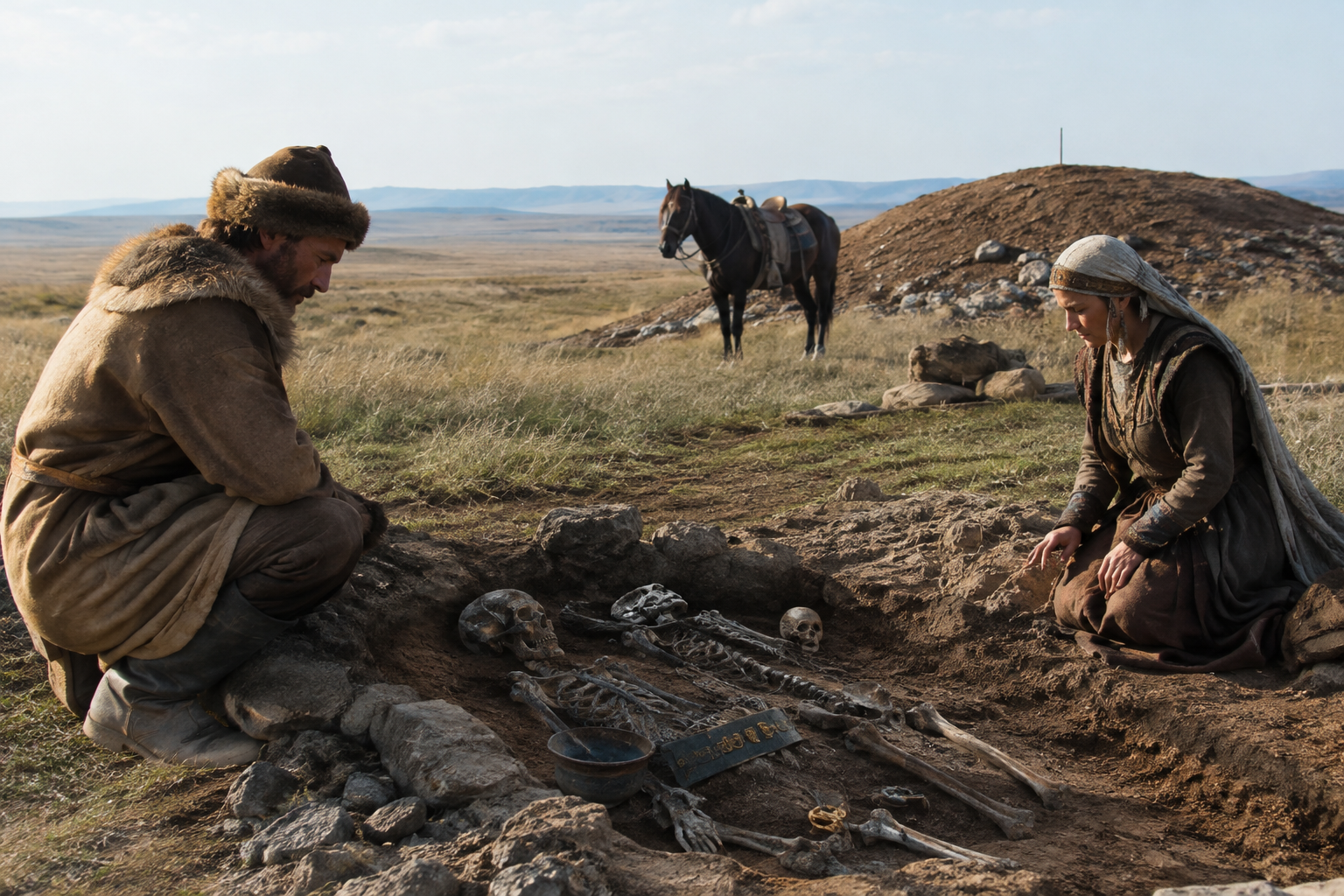
In the Iron Age cemeteries of Birlik in northeastern Kazakhstan, two male burials now stand out for more than their date or their steppe setting. One, sample BIR010, is dated to around 640 BC and comes from a Birlik mound associated with the Tasmolinskaya horizon. The other, BIR002, comes from the Scythian grave at Korgantas and is dated to around 262 BC. Both have been linked with Y-DNA haplogroup Q1a1a, placing this paternal line squarely inside the world of Iron Age Central Asian nomads.
That matters because Q1a1a is not just a label on a chromosome tree. It is a direct paternal lineage, traced father to son, and in this case it appears in burials from the eastern steppe during a period when mobile societies were shaping the political and cultural history of Eurasia. These two men do not prove a dynasty, a tribe, or a single migration event. But together they offer something more careful and more interesting: a glimpse of how one paternal branch appears within the mixed and shifting populations often grouped under broad names such as Saka or Scythian.
The strongest anchor for this article is the Birlik-Korgantas cluster itself. Birlik lies in the Pavlodar region of Kazakhstan, part of the great corridor between the Altai, the Kazakh steppe, and the wider Inner Asian world. Sample BIR010, from around 640 BC, belongs to an earlier Iron Age horizon than BIR002, which comes several centuries later from the Scythian grave at Korgantas. That time depth is important. It suggests that this paternal line was not a one-off intrusion at a single cemetery but part of a longer male-line presence in the region.
Archaeologists have long known that the Iron Age steppe was not occupied by one uniform people marching in lockstep across the map. Burial customs, material culture, horse equipment, weapon styles, and mound traditions show both connections and regional variation. Ancient DNA has sharpened that picture. Research on Scythian-era populations in this wider zone has shown that eastern steppe groups were often genetically mixed, drawing on older local lineages as well as broader movements across Inner Asia. A study of these populations published at https://advances.sciencemag.org/content/7/13/eabe4414 helped demonstrate just how varied those Iron Age communities could be.
Haplogroup Q is a large Y-chromosome family with deep roots in northern Eurasia and a very wide later history. Some branches of Q are famous because they are prominent in Indigenous populations of the Americas; others appear across Siberia, Central Asia, and parts of Eurasia. But that broad fame can be misleading. Q1a1a is a narrower branch, and the evidence here concerns its appearance in specific Iron Age steppe burials, not an all-purpose story about every man who ever carried haplogroup Q.
That distinction matters in archaeology. A Y-DNA branch tells us about one paternal line only. It does not automatically identify language, ethnicity, social rank, or total ancestry. A man buried in an Iron Age mound in Kazakhstan may carry Q1a1a while also belonging, in autosomal ancestry and cultural life, to a population shaped by multiple older and contemporary streams. Ancient DNA has repeatedly shown that steppe identities were historical coalitions, not neat biological boxes.
The two Kazakhstan samples make best sense when placed in that broader eastern steppe setting. By the first millennium BC, this was a zone of long-distance mobility. Horses, herding economies, prestige goods, and mounted warfare tied together communities from the Altai to the western steppe, while mountain corridors and open grasslands allowed repeated contact with populations farther east and south.
That is exactly the sort of environment in which a paternal branch like Q1a1a might persist, spread locally, or appear in different cultural settings without implying a single dramatic conquest. Ancient DNA studies of the steppe increasingly show both continuity and renewal: some lineages endure in a region for centuries, while others arrive through fresh contacts and become part of new social formations. For readers interested in the bigger genetic background of that world, the MyTrueAncestry article on Ancient DNA and Genetic History of the Mongolian Steppe is especially relevant.
In practical terms, BIR010 and BIR002 show Q1a1a present on the Iron Age steppe on either side of a gap of several centuries. That does not mean the two men were closely related in any genealogical sense; the chronological distance is far too great for that sort of easy leap. But it does mean the branch belongs in the historical conversation about eastern Scythian-era populations rather than being treated as an accidental or isolated signal.
The terminology of the steppe can be slippery. Greek writers used "Scythian" broadly and from their own vantage point. Persian sources used "Saka" for related but not identical groups. Archaeologists, meanwhile, classify sites by burial forms, regional styles, and chronology, which is why a burial may be described as Scythian in one sense and Tasmolinskaya in another. These are overlapping historical languages, not interchangeable facts.
That makes the Birlik evidence all the more useful. BIR010 comes from a Tasmolinskaya-associated Iron Age mound, while BIR002 is explicitly described as a Scythian grave at Korgantas. So the shared Q1a1a signal appears across labels that are connected but not identical. Rather than flattening those distinctions, the DNA helps us see how paternal lines could pass through neighboring steppe traditions that archaeologists parse more finely than classical authors ever did.
Research on Iron Age Kazakhstan and surrounding regions has increasingly emphasized this regional complexity, with eastern groups often differing from western Scythian populations in both ancestry and local historical development. Readers who want another Central Asian case study may find Unraveling Iron Age Saka Culture through Ancient DNA Analysis in Kyrgyzstan a useful comparison.
There is a temptation, whenever an ancient Y-line turns up in a striking archaeological context, to turn it into a heroic badge: warrior blood, royal blood, tribal blood. The evidence here is subtler and better. Q1a1a appears in two Iron Age male burials from northeastern Kazakhstan, one in the earlier first millennium BC and another in the later Scythian period. That gives the lineage historical depth in a region central to steppe exchange and mobility.
It also places Q1a1a in a part of the ancient world where paternal lineages were moving through real social systems: mound-building communities, horse-centered economies, and regional power networks that connected Kazakhstan to the wider Inner Asian sphere. Another study relevant to long-term population history across Inner Asia and adjacent regions is available at https://www.science.org/doi/10.1126/sciadv.aef0108, though the key point for this article remains the specific archaeological presence of Q1a1a in the Birlik-Korgantas material.
For someone researching a modern Q1a1a paternal line, the most defensible lesson is not a grand claim of descent from "the Scythians" in the singular. It is that this branch is firmly at home in the documented male-line diversity of Iron Age eastern steppe populations, including burials in Kazakhstan such as BIR010 and BIR002. In other words, Q1a1a belongs to the real human history of the Central Asian steppe: not as myth, but as excavated, dated, and genetically observed evidence.

Comments