Haplogroup Oa1c1a1b1a

– 4 min read


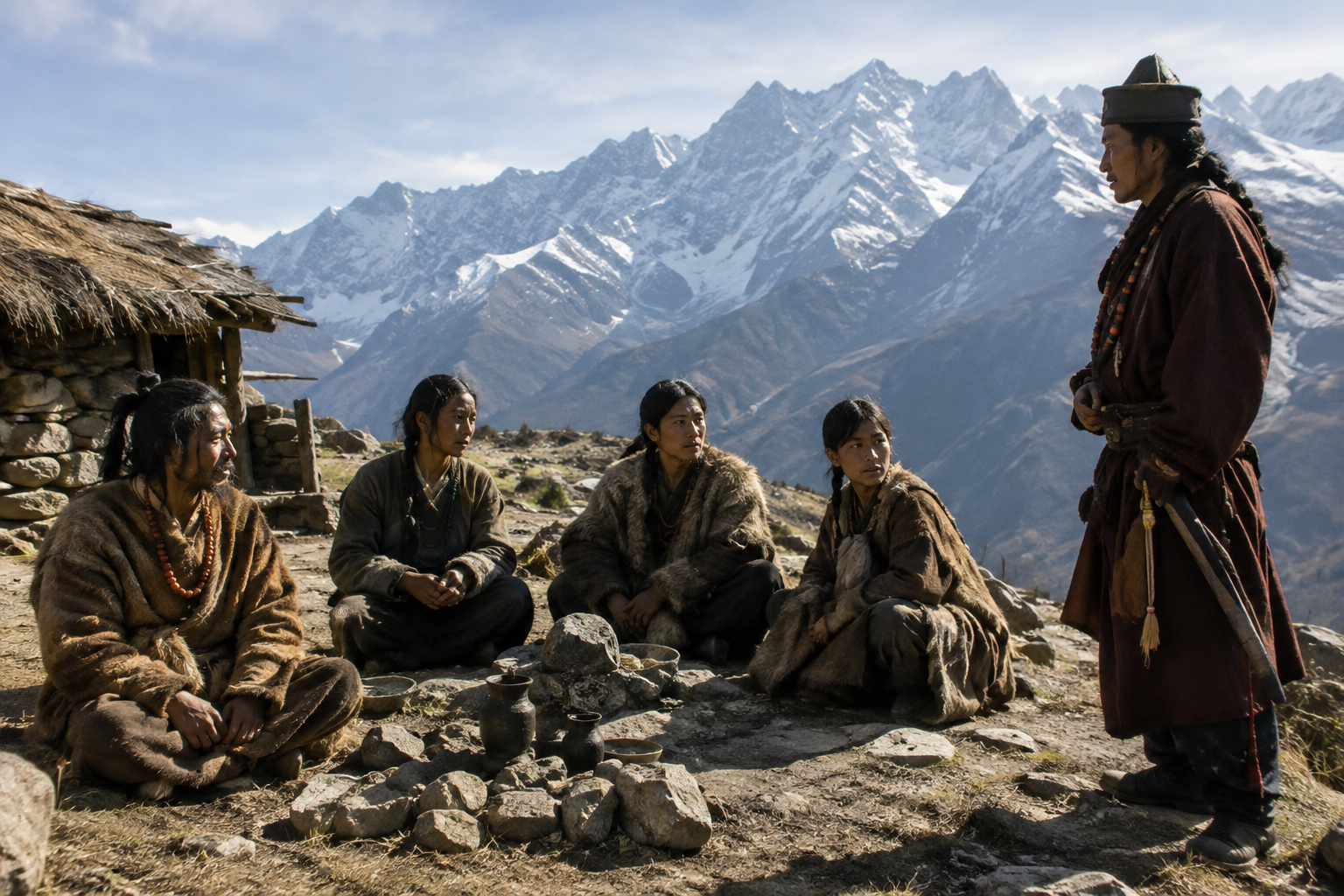
At the Kyang site in the Himalayas, several men dated to around 200 BC were found carrying the same paternal line now labeled Oa1c1a1b1a: KM4, KS8, KS9, and KS20_KS25. That is immediately interesting, not because one burial can stand for a whole people, but because repeated Y-DNA signals at one mountain site hint at continuity in male lines within a high-altitude community that lived on a major corridor between the Tibetan Plateau and the southern Himalayas.
Those Kyang individuals are joined by a later example from Iron Age Samdzong in Nepal, sample S143_S173, dated to about AD 550. Taken together, these finds place this paternal branch in the trans-Himalayan world across many centuries. Y-DNA follows one direct male line only, not a person's full ancestry, but it can be especially revealing when the same branch appears again and again in neighboring mountain societies.
The Kyang samples are the strongest starting point because they form a cluster rather than a one-off occurrence. Four individuals from the same broad setting and period, all associated here with Oa1c1a1b1a, suggest that this was not an accidental arrival of a single outsider. Instead, it looks more like a paternal lineage that had become established in a Himalayan community by the late centuries BC.
That matters because the Himalayas are often imagined as barriers first and landscapes second. Archaeology has steadily corrected that picture. Valleys, passes, and river routes made these uplands difficult, certainly, but not sealed. Communities in places like Kyang were part of a world of movement linking Tibet, Nepal, and regions further afield, while still maintaining very local identities.
A genetic study of ancient Himalayan populations published in Nature Communications helped sharpen this broader picture by examining ancient individuals from the region across time. For Oa1c1a1b1a, the importance of the Kyang group lies in its repetition: KM4, KS8, KS9, and KS20_KS25 collectively show that this paternal line had a durable place in the eastern or central Himalayan genetic landscape well before the medieval period.
Ancient DNA from Himalayan Ladakh
It is important to be careful with a precise label like Oa1c1a1b1a. A narrow subclade is not the same thing as the entire parent haplogroup O, which is widespread across East and Southeast Asia and has a very deep and complex history. The presence of this branch in ancient Himalayan men does not mean every movement of haplogroup O led here, nor does it license sweeping claims about language or ethnicity from Y-DNA alone.
What it does suggest is rather more concrete. By the late Iron Age, one paternal line within the broader East Asian Y-chromosome world was already embedded in Himalayan populations. When several men from the same site share that branch, the result is a small but valuable sign of local male-line persistence.
This is where ancient DNA is at its most useful: not as a machine for dramatic origin myths, but as a way of testing whether a lineage appears briefly, repeatedly, or continuously in a real archaeological landscape. In the case of Oa1c1a1b1a, the answer so far points toward repetition in the Himalayan sphere.
The later sample S143_S173 from Iron Age Samdzong, dated around AD 550, extends that pattern forward in time. Samdzong lies in Upper Mustang, a region famous in archaeology for its dramatic cliff-associated mortuary landscapes and for its position on routes linking the Tibetan world with the Nepalese Himalayas. Even without overloading the genetics, this is a historically charged setting: a place where trade, upland adaptation, and cultural exchange met in difficult terrain.
The significance of S143_S173 is not that it proves direct descent from one particular Kyang man. We cannot say that. Rather, it shows that the same reported paternal branch appears again in a later Himalayan context, centuries after the Kyang cluster. That makes Oa1c1a1b1a look less like an isolated signal and more like part of a continuing mountain population history.
Across the first millennium AD, Himalayan societies were anything but static. Contacts with Tibetan polities intensified, exchange networks operated across passes, and local communities adapted to changing political and ecological conditions. A lineage surviving across this span fits well with a world of both mobility and continuity: people moved, but some male lines remained rooted in the region.
If there is one historical lesson in these samples, it is that the Himalayas should not be treated as a blank edge between civilizations. Kyang and Samdzong belong to a long-lived upland world in which communities managed herding, exchange, and seasonal or permanent movement across altitude zones. Genetics adds another layer to that story by showing that some paternal lines persisted within these connected landscapes for centuries.
That does not mean everyone at these sites belonged to the same lineage, or that Oa1c1a1b1a dominated the entire region. Ancient communities were rarely so simple. But when four men around 200 BC at Kyang and another man around AD 550 at Samdzong are associated with the same branch, the repeated pattern deserves notice.
It also sits neatly beside broader East Asian ancient Y-chromosome research, which increasingly shows that paternal history was shaped by both coastal and inland routes, local founder effects, and later population layering rather than one tidy expansion. The Himalayan evidence belongs to that larger picture, but with its own distinctly high-altitude character.
Ancient East Asian Y-Chromosomes
Five ancient men are not enough to write the entire history of Oa1c1a1b1a. They are enough, though, to anchor it archaeologically. Instead of discussing the haplogroup only as a modern distribution or a theoretical branch on a tree, we can place it among real people living in the Himalayan region around 200 BC and again around AD 550.
That is valuable for anyone researching this paternal line today. The best-supported ancient story for Oa1c1a1b1a, based on the evidence here, is not one of palaces or famous dynasties but of enduring presence in Himalayan communities positioned along mountain routes. In other words, it is a lineage with a visible ancient foothold in the trans-Himalayan world.
For Oa1c1a1b1a, the clearest ancient picture comes from the Himalayas: a cluster at Kyang around 200 BC and a later presence at Samdzong around AD 550. That does not reduce a whole ancestry to one mountain corridor, but it does give this paternal line a credible archaeological setting - one shaped by altitude, exchange, and long-term local continuity.


Comments