Haplogroup O2a2b2a1a2

– 5 min read


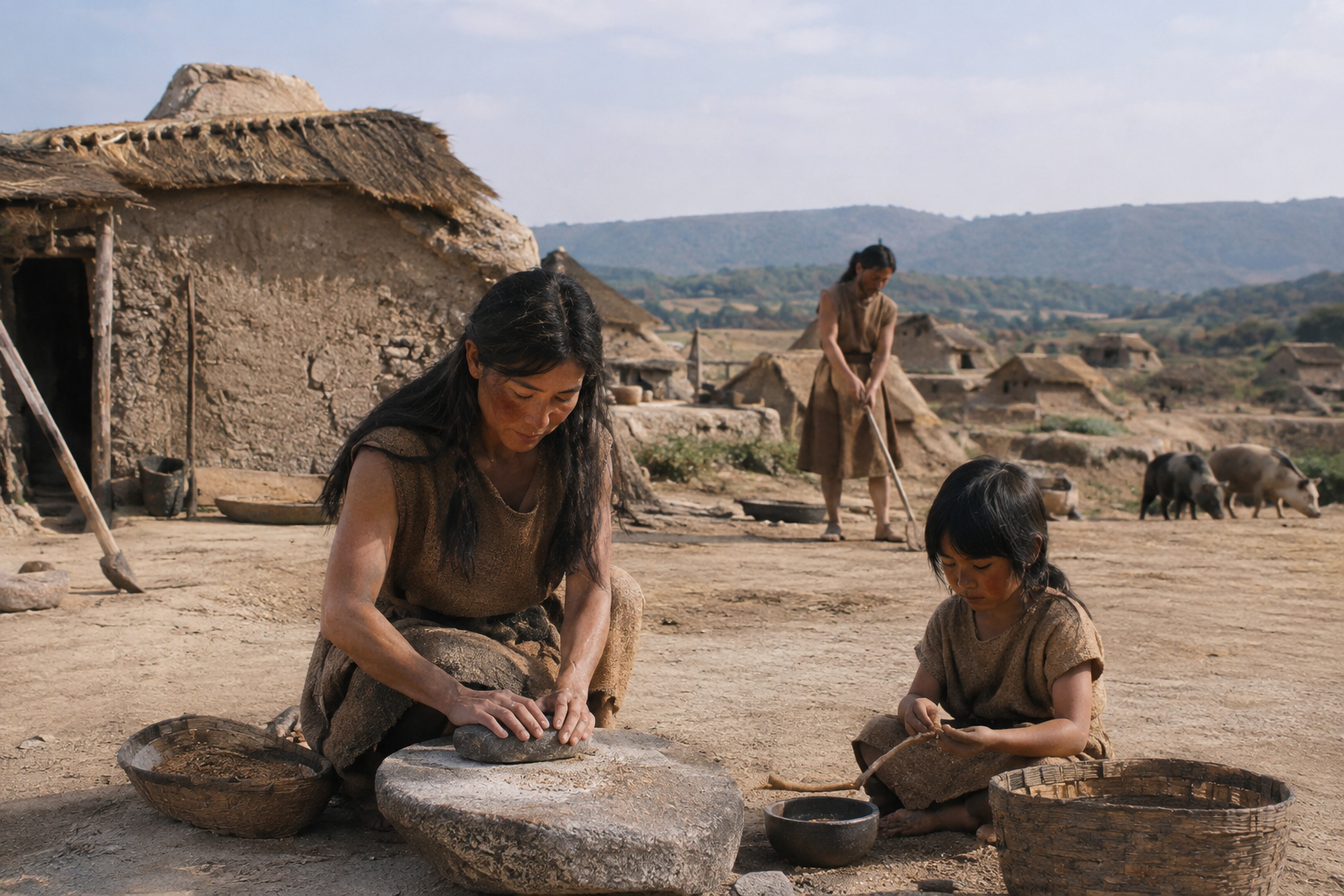
At Shimao in Shaanxi Province, the archaeology is already dramatic enough without embellishment. This vast late Neolithic walled center in northern China, flourishing around 1900 BC, has become one of the most discussed prehistoric sites in East Asia because it forces a rethink of what early complex society looked like north of the Yellow River heartland. Among the ancient individuals associated with the site is sample Shimao_HYW_2, reported here with the Y-DNA haplogroup O2a2b2a1a2.
That matters because Y-DNA follows one direct paternal line only: father to son across generations. It does not define a whole person or a whole population. But when a lineage like O2a2b2a1a2 appears at a major center such as Shimao, it gives us a precise male-line data point inside a much larger story of settlement, hierarchy, mobility, and regional interaction in late Neolithic China.
Shimao is not a minor village inflated by modern enthusiasm. It was a large fortified settlement with stone architecture, monumental construction, and evidence of substantial social organization. For many years, older narratives of early Chinese civilization leaned heavily toward the Central Plains alone; Shimao has helped break that habit by showing that major centers also emerged in the loess highlands to the north.
In that context, Shimao_HYW_2 becomes especially interesting. A haplogroup assignment like O2a2b2a1a2 does not tell us his occupation, status, or language, and it certainly does not let us turn one man into the emblem of an entire polity. What it does do is anchor this paternal branch in a very consequential archaeological landscape: one of the largest and most surprising late Neolithic centers in China.
The broader genetic and archaeological picture for the Middle Yellow River has been changing quickly, as studies of ancient populations in the region have begun to trace long-term continuity alongside episodes of interaction and mixture. A useful point of reference is MyTrueAncestry's discussion of 6,000 Years of Genomic History in the Middle Yellow River, which helps place sites like Shimao into a wider regional frame.
The first thing to say about O2a2b2a1a2 is that it is a narrow paternal branch, not a broad civilizational label. It sits within the larger O haplogroup family that is important in East and Southeast Asian paternal history, but the deeper history of that parent lineage should not simply be pasted onto this exact subclade as though nothing changed along the way.
With the evidence here, the safe claim is modest and useful: this branch is represented in an ancient male associated with late Neolithic Shimao. That gives researchers and testers a concrete archaeological anchor in northern China around the transition toward the Bronze Age world. It is one fixed point in time, and fixed points are precious in archaeogenetics.
That restraint matters. A single ancient Y-chromosome assignment cannot by itself prove a direct line from Shimao to every later regional population, nor can it identify a dynasty, tribe, or language community. But it can show that one paternal line now found in living men was already present at an early urbanizing center in the Yellow River sphere nearly four thousand years ago.
Shimao has attracted so much attention partly because it unsettles an old map of "core" and "edge". Northern Shaanxi was once too easily treated as marginal to the story of early Chinese complexity. Archaeology has made that impossible. Monumental building, defensive works, and large-scale planning all point to a society that was locally powerful and regionally connected.
That is the real historical value of placing O2a2b2a1a2 at Shimao. The lineage is not turning up in an abstract nowhere. It appears in a place that sat within networks linking the northern frontier zone, the Loess Plateau, and the wider Yellow River world. A paternal lineage found here belongs to a human landscape of movement and contact, not an isolated pocket frozen in time.
MyTrueAncestry has also explored Shimao from an archaeological angle in Ancient Sacrifice in Neolithic Shimao, Northern China. That wider context is worth keeping in mind: the site is significant not because of one chromosome result, but because its archaeology and genetics together show a large, socially complex community operating well outside older textbook expectations.
The challenge with a lineage article based on one ancient sample is not lack of importance, but scale. Shimao_HYW_2 is informative because he comes from a famous site at a crucial period, yet one individual cannot stand in for the whole male population of Shimao. Ancient settlements, especially large ones, often contained multiple paternal lines, sometimes over many generations.
Still, even one sample can sharpen historical questions. Was this branch common in the communities that built and occupied northern walled centers? Did it persist locally into Bronze Age populations of the Yellow River region? Or does it mark only one strand in a more mixed paternal landscape? Those are exactly the kinds of questions ancient DNA is beginning to answer as sample numbers grow.
A broader survey of changing male-line patterns in East Asia is helpful here. MyTrueAncestry's article on Ancient Y Chromosomes Reveal Coastal and Inland Migrations that Shaped East Asian Paternal History offers the larger backdrop: ancient Chinese paternal history was not a single straight line, but a set of overlapping regional developments.
Ancient DNA is most useful when it is tied firmly to archaeology, and Shimao is a good example of that principle. The site matters because excavation has already shown it to be a major center of late Neolithic northern China; genetics then adds another layer by identifying ancestry patterns and paternal branches among the people buried there and in related regional populations.
Research published on ancient populations of the region has helped place northern Chinese sites into a longer history of demographic change and continuity, including work connected to the Shimao horizon and the wider Yellow River zone. One relevant scientific starting point is this ancient DNA study, which is associated with the sample context cited here and reflects the expanding effort to connect archaeological sites in China with securely studied genomes.
That combination of evidence is the important thing to hold on to. A haplogroup by itself is a code. A haplogroup attached to a dated person from a major excavated site becomes history.
If your direct paternal line falls under O2a2b2a1a2, the strongest takeaway from the present evidence is not a grand claim of identity but a solid archaeological foothold. This branch is represented by an ancient male, Shimao_HYW_2, from late Neolithic Shimao in Shaanxi around 1900 BC, placing your wider paternal story within the world of early complex societies in northern China.
That is already quite remarkable. It suggests that this line was present in a community participating in one of the most important prehistoric developments of the Yellow River region: the rise of large fortified centers before the full flowering of later Bronze Age states.
For family historians, the value of O2a2b2a1a2 lies in that mix of precision and humility. It does not hand you a named king or a ready-made legend. It gives you something better grounded: a documented paternal link to the human world around Shimao, where archaeology and ancient DNA are jointly reshaping our picture of early northern China.

Comments