Haplogroup O2a2b1a2a1a4a1

– 4 min read


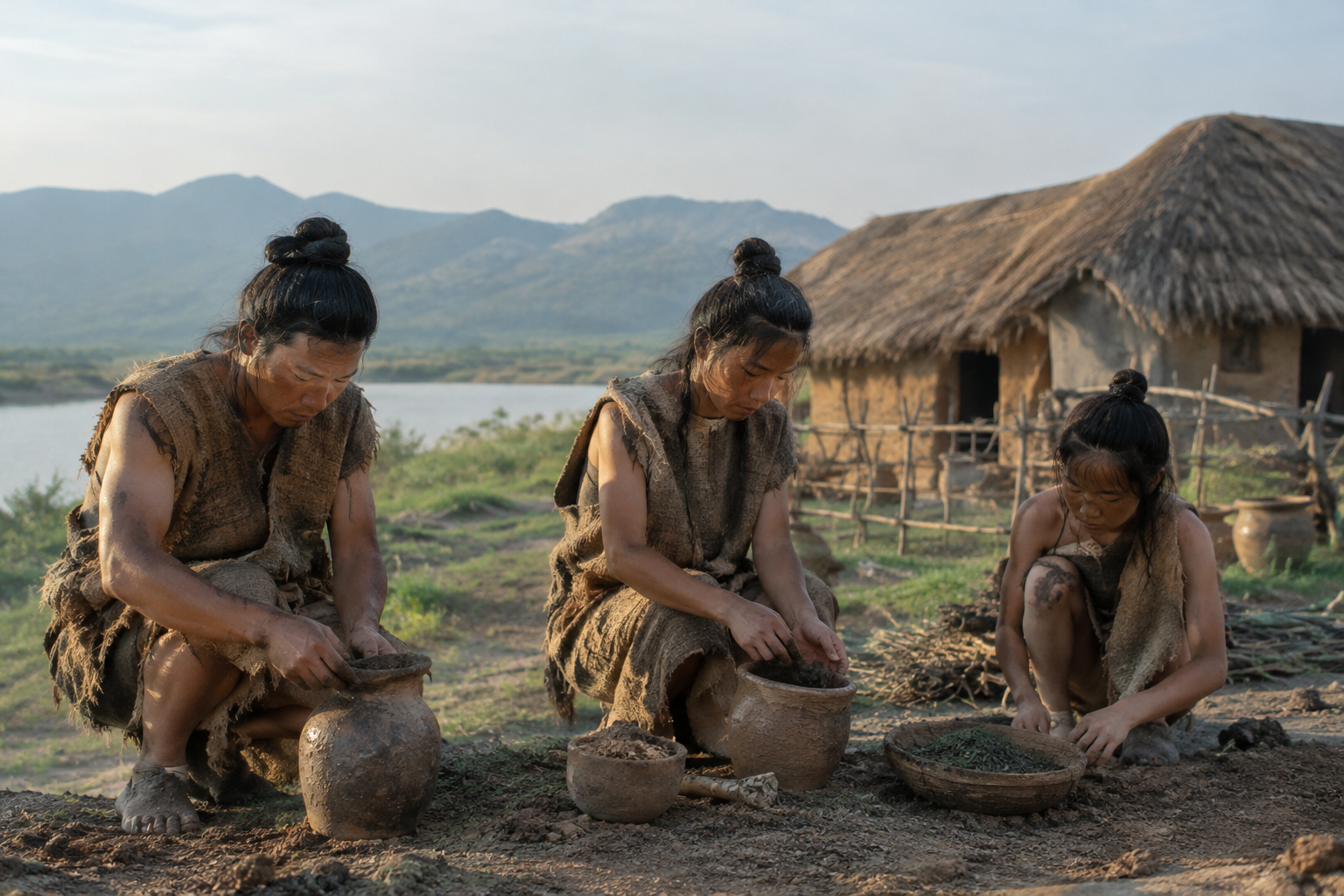
At Baligang, on the Tuan River in Henan, three men dated to around 3000 BC carry the same very specific paternal signal: O2a2b1a2a1a4a1. Their identifiers, BLG_M13-67, BLG_M13-69, and BLG_M13-76, are not the sort of names that invite romance. But archaeologically they are far more interesting than romance. They place this lineage in the Middle Yellow River world during the Late Neolithic, in one of the regions central to the making of early northern Chinese farming societies.
That matters because Y-DNA tracks one direct paternal line only, not a person's whole ancestry, yet even that narrow line can be historically revealing when it appears more than once at the same place and period. Here, the repetition is the point. O2a2b1a2a1a4a1 is not turning up as a stray, isolated result. At Baligang it appears as a small cluster, suggesting that this branch had a real foothold among communities living in Neolithic Henan.
Baligang sits in a landscape that archaeologists have long treated as crucial for understanding the development of agriculture and village life in the Middle Yellow River region. By about 3000 BC, northern China was already home to settled farming communities whose histories were local, layered, and anything but simple. A lineage like O2a2b1a2a1a4a1 becomes meaningful in this setting because it is anchored to a place where long-term population history can actually be examined.
The three Baligang individuals do not, by themselves, define a people or a culture. That would be far too grand a claim. But they do show that this paternal branch was present in Henan during the Late Neolithic, and present in multiple men at one site rather than in a lone outlier. In ancient DNA, that sort of repetition often gives us our first solid foothold.
A broader ancient DNA study of the region is associated with this research release, which has helped place Middle Yellow River populations into a longer sequence of regional genetic history. Even without pressing the evidence too far, Baligang belongs to that bigger story: one in which local communities were not static, but neither were they simply replaced wholesale every few centuries.
Middle Yellow River Genomic History
The exact label here is important. O2a2b1a2a1a4a1 is a very narrow branch inside the much larger O family of Y-chromosomes, one of the major paternal lineages of East Asia. It would be careless to take every broad statement ever made about haplogroup O and pin it onto this one terminal twig. The useful historical claim is more modest: this specific branch is documented at Baligang in Late Neolithic Henan.
That may sound restrained, but restraint is what keeps ancient DNA useful. Once a precise subclade is found in securely dated archaeological individuals, it gives descendants and researchers something far firmer than guesswork. It marks a paternal line that was already established in the agricultural societies of north-central China around five thousand years ago.
BLG_M13-67, BLG_M13-69, and BLG_M13-76 are valuable not because each is individually famous, but because together they show pattern rather than accident. Three occurrences in the same Late Neolithic site suggest local continuity of male lines within that community or within closely related households over time. That is not the same as proving close kinship; without explicit kinship data, one should not turn them into a ready-made family tree. But it does suggest that this paternal branch was socially rooted enough to appear repeatedly in the burial population.
This is one of the quiet strengths of ancient Y-DNA. A single result may be anecdotal. A cluster starts to look demographic. And in a site such as Baligang, that demographic hint matters because it helps us think about how farming populations in the Middle Yellow River reproduced themselves, organized male descent, and persisted across generations.
It is also a reminder that the paternal landscape of Neolithic China was not a blank map waiting for later dynasties to write upon it. Long before states and imperial houses, there were already enduring male lineages embedded in village worlds, fields, river systems, and local burial grounds.
Henan is often approached through the grandeur of later Chinese history: capitals, bronze foundries, kings, and textual tradition. But the Baligang men belong to an older layer, before those familiar historical frames. Around 3000 BC, this was a world of Late Neolithic communities whose importance lies precisely in their pre-dynastic character. They show us the human foundations on which later historical China was built.
That is one reason lineages like O2a2b1a2a1a4a1 deserve attention. They help move the discussion away from retrospective imperial maps and back toward actual prehistoric populations. A paternal branch documented in Neolithic Henan is not yet a dynasty, not a surname, not an ethnicity in the modern sense. It is something more basic and, in its way, more revealing: evidence for men living, reproducing, and being buried in one of the major cradles of early Chinese civilization.
East Asian Paternal Migrations
Ancient East Asian Y-chromosome studies increasingly show that inland and coastal histories were both important, and that regional branches became established in different ways across time. The Baligang evidence speaks most directly to the inland story: the development of paternal lines within the farming societies of the Yellow River zone. It does not need to be turned into a sweeping migration epic to be significant.
Indeed, one of the most interesting things about this case is its plainness. There are no royal burials here, no dramatic inscriptions, no named conquerors. Instead there is a cluster of Late Neolithic men from the same place, all pointing to the same narrow paternal branch. In archaeology, that kind of ordinary repetition is often where the real historical substance lies.
Baligang also sits comfortably beside other work on ancient China showing that social identity and genetic ancestry do not always line up neatly. Population history in the Central Plains involved continuity, mixture, and change over long periods. A repeated Y-line at one site is therefore best read as a local anchor within a much larger and more complicated human landscape.
DNA and Social Hierarchy in Ancient China
For someone researching O2a2b1a2a1a4a1 today, the clearest ancient signal is this: the branch is documented in multiple men from Late Neolithic Baligang in Henan, around 3000 BC. That does not identify a surname, a tribe, or an unbroken genealogy to any famous historical figure. What it does offer is something more archaeologically solid - a place, a period, and a community in which this paternal line was already present more than five millennia ago.
In other words, this haplogroup currently points not to legend, but to the settled world of Neolithic north China. And that is a strong beginning: a paternal line rooted in one of the formative landscapes of early Chinese history.


Comments