Haplogroup O2a2b1a1a1d

– 5 min read


At Mogou Cemetery in Lintan, in today's Gansu, a cluster of Bronze Age men dated to around 1450 BC has become unusually important for anyone interested in Y-DNA haplogroup O2a2b1a1a1d. The reason is refreshingly concrete. This is not a hazy story built from one stray chromosome, but a repeated signal from the same archaeological setting: MogouM119, MogouM282_5, MogouM316_3, MogouM336_5, MogouM403_4_2, MogouM48_2, and MogouM506_1 are all tied to the Mogou cemetery and the Qijia cultural horizon in Bronze Age northwestern China.
That matters because Y-DNA follows one direct paternal line only. It does not describe a person's whole ancestry, language, or identity. But when the same paternal branch appears again and again in one cemetery, it gives us a rare chance to look at how male lineage persistence may have worked inside a real Bronze Age community rather than in a modern map of averages.
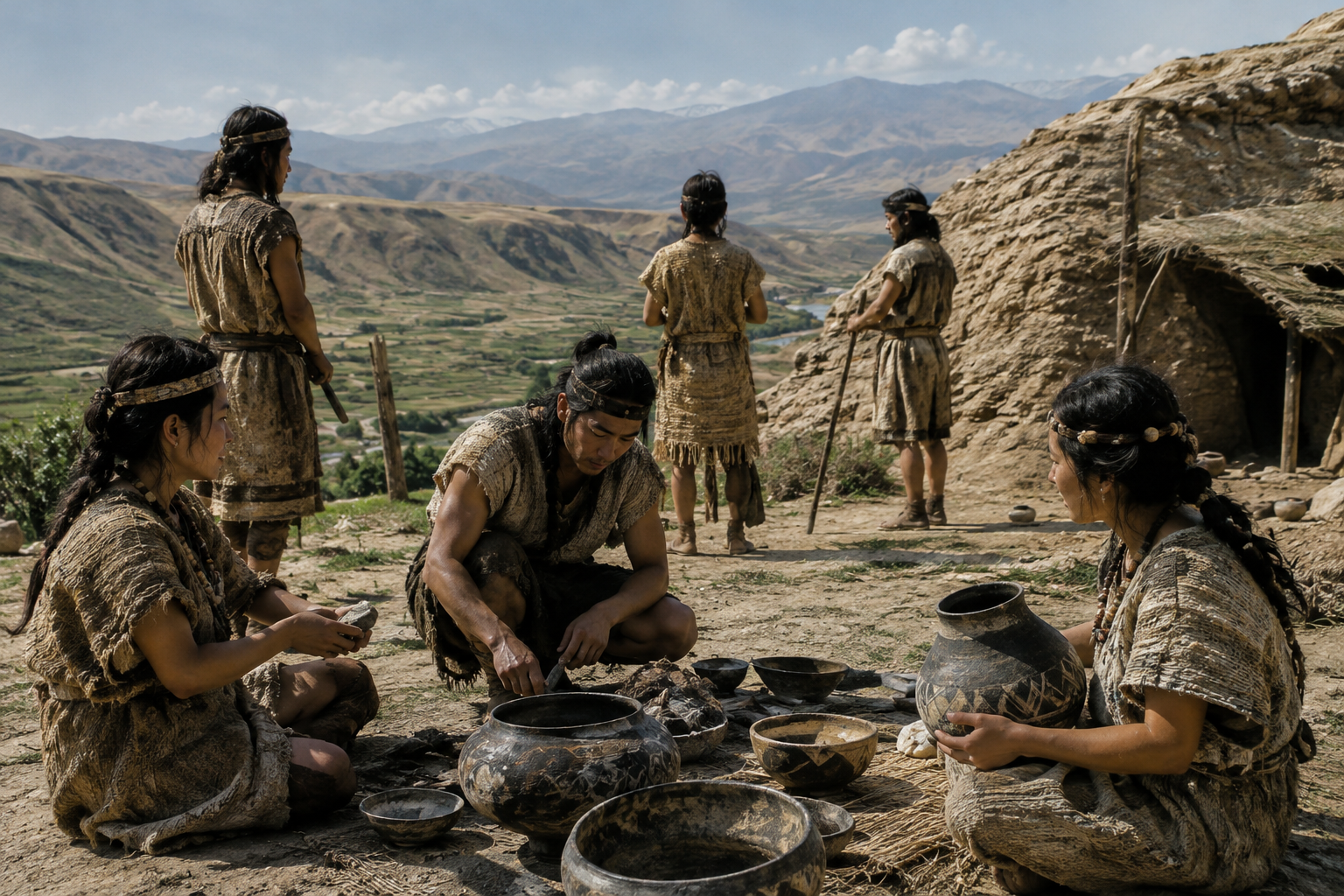
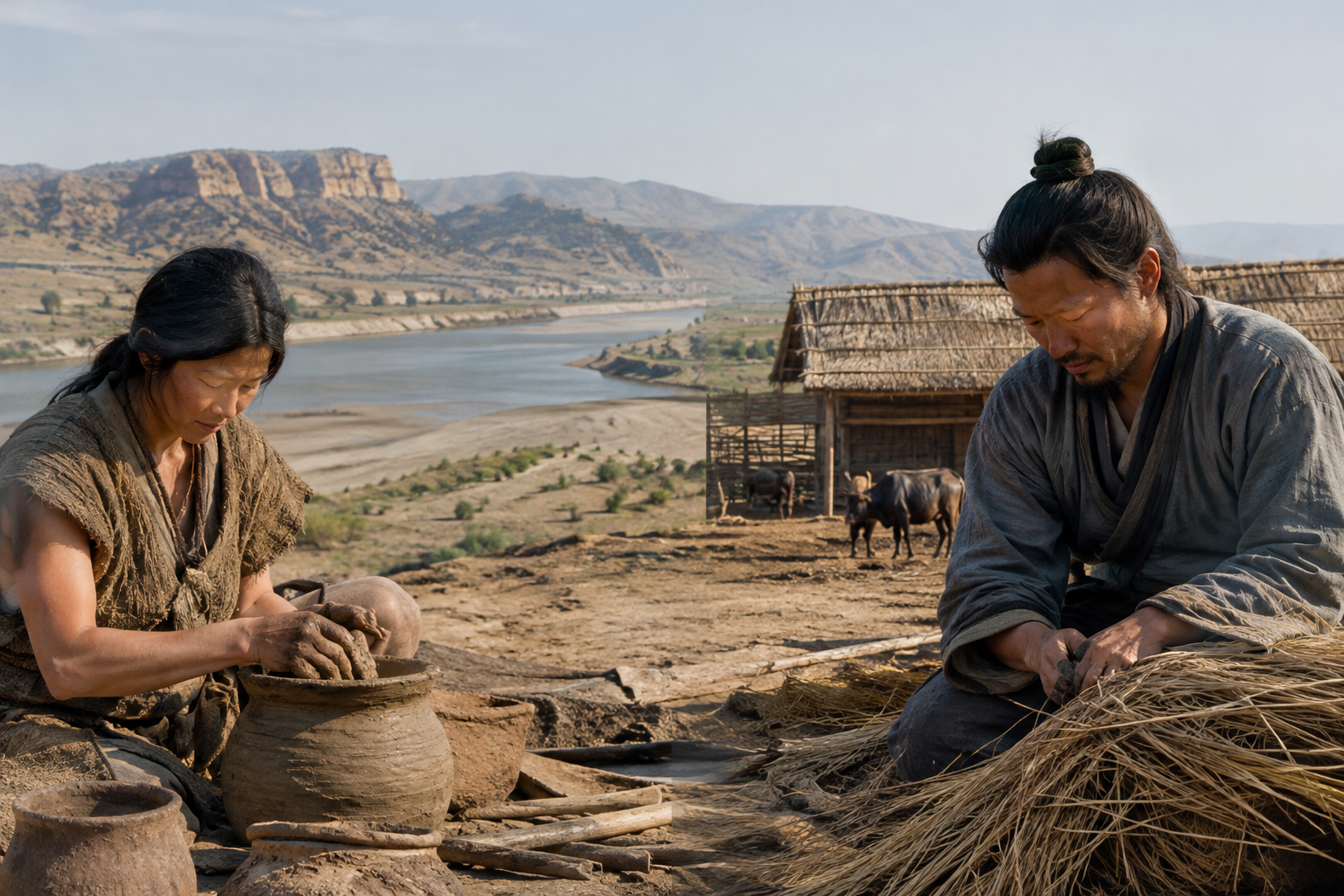
Mogou sits in a frontier zone that was never merely peripheral. Gansu was a corridor: a region linking the Yellow River world, the northeastern Tibetan Plateau, and wider Inner Asian networks. By the Bronze Age, communities here were farming, herding, burying their dead in formal cemeteries, and participating in exchanges that make any tidy boundary between "China" and "steppe" look much too simple.
The seven Mogou males associated here with O2a2b1a1a1d all belong broadly to that setting. Their repeated appearance at one cemetery suggests that this paternal line was not an isolated curiosity. It seems to have been established, and perhaps locally common, among at least some men buried there. That is already a more interesting finding than the old habit of treating ancient Y-DNA as if one burial automatically stood for an entire people.
An ancient DNA study examining these Bronze Age Gansu burials helped bring that local picture into focus, showing how mortuary communities in the region could preserve distinct paternal patterns while still belonging to a wider, mixed human landscape. For readers who want the wider archaeological context, MyTrueAncestry has also covered Bronze Age Gansu population history and burial practices.
It is worth lingering over the list, because repetition is the real story here. MogouM119, MogouM282_5, MogouM316_3, MogouM336_5, MogouM403_4_2, MogouM48_2, and MogouM506_1 are not scattered across centuries and continents. They are all placed at Mogou, all around the mid-second millennium BC, and all associated with the same broad archaeological milieu.
That lets us say something careful but meaningful. The branch reported here as O2a2b1a1a1d was present among multiple Bronze Age males in this cemetery community. What we cannot safely do is jump from that fact to claims of a single ruling dynasty, a single family plot, or a neatly bounded ethnic group. Cemeteries are social places, not just genetic spreadsheets. Still, seven related paternal signals in one place strongly imply continuity of male lines within the population using the cemetery.
There is another reason this cluster matters. Ancient East Asian Y-chromosome evidence is still patchier than many people assume, especially once one asks for securely contextualized burials rather than broad modern-frequency claims. A cemetery like Mogou, with multiple relevant males, helps anchor discussions of paternal history in excavated reality.
The exact haplogroup name here is very narrow: O2a2b1a1a1d. That is not the same thing as the whole parent haplogroup O, or even every branch of O2. One of the common mistakes in popular genetics is to take the deep history of a huge parent lineage and casually paste it onto a tiny downstream branch. We should resist that temptation.
What the Mogou evidence supports is more modest and more useful. By around 1450 BC, a paternal lineage associated with this branch was present repeatedly in a Qijia-related Bronze Age community in Gansu. That places the lineage within the historical formation of northwestern Chinese populations during a period when farming societies, mobile pastoral influences, and regional interaction were all shaping daily life.
Broader work on ancient East Asian Y chromosomes has increasingly shown that paternal history in the region was formed by both inland and coastal processes, with different branches rising to prominence in different times and places. That bigger frame helps explain why a Gansu cemetery matters so much: it shows one local expression of a much larger and more uneven paternal landscape. MyTrueAncestry readers interested in that wider picture may enjoy this overview of ancient Y chromosomes in East Asia.
East Asian Y-Chromosome Migrations
One of the most appealing features of the Mogou finds is that they come from a region historians and archaeologists already know to have been a contact zone. Gansu is not simply "central" or "marginal"; it is a place where routes, ecologies, and cultural habits met. That makes repeated paternal continuity especially revealing. It suggests that even in a region open to exchange, local male descent lines could remain visible across a cemetery population.
This is where archaeology does the heavy lifting. The Qijia cultural label tells us about a Bronze Age archaeological tradition, not a tribe named in texts and not a genetic essence. The Mogou males belonged to a community participating in that tradition. Their Y-DNA helps us trace one strand of biological inheritance inside that world, while the archaeology reminds us that material culture, subsistence, and social practice were never reducible to a haplogroup.
A regional genetic study tied to these remains is linked here: https://ngdc.cncb.ac.cn/gsa-human/browse/HRA014036. Even without overstating what one link can prove, the existence of research around these burials is important because it keeps the discussion attached to excavated populations rather than speculation.
If your own Y-DNA falls under O2a2b1a1a1d, the Mogou cemetery does not prove direct descent from any one buried man. Ancient DNA almost never works like that. What it does offer is a historically grounded glimpse of where this paternal line, or a very close branch associated with it, appears in the archaeological record: Bronze Age northwestern China, within a cemetery community linked to the Qijia horizon.
That is valuable because it gives the lineage a setting as well as a label. These were not abstract carriers of markers. They were members of a settled Bronze Age society in Gansu, living in a region shaped by agriculture, mobility, and long-distance contact. Their repeated presence suggests that this paternal line could persist locally across multiple burials within one community.
Readers interested in how later Chinese kinship patterns can also become visible through ancient DNA may want to compare this Bronze Age case with a much later example from imperial history: female exogamy in a Tang dynasty clan.
The strength of O2a2b1a1a1d in the current ancient record is not a royal pedigree or a sweeping migration legend. It is something better: a compact, well-focused cluster of Bronze Age evidence from Mogou Cemetery in Gansu. Seven men associated with one archaeological community make this branch visible in a specific place and time, showing that one paternal line had real staying power in a frontier society of northwestern China.
That is the sensible lesson for ancestry research. If this is your Y-DNA line, the ancient evidence points toward a paternal history connected, at least in part, to the human worlds forming in Bronze Age northwestern China, where local continuity and wider regional contact existed side by side.
Comments