Haplogroup O2a2b1a1a1b1a1a
– 5 min read


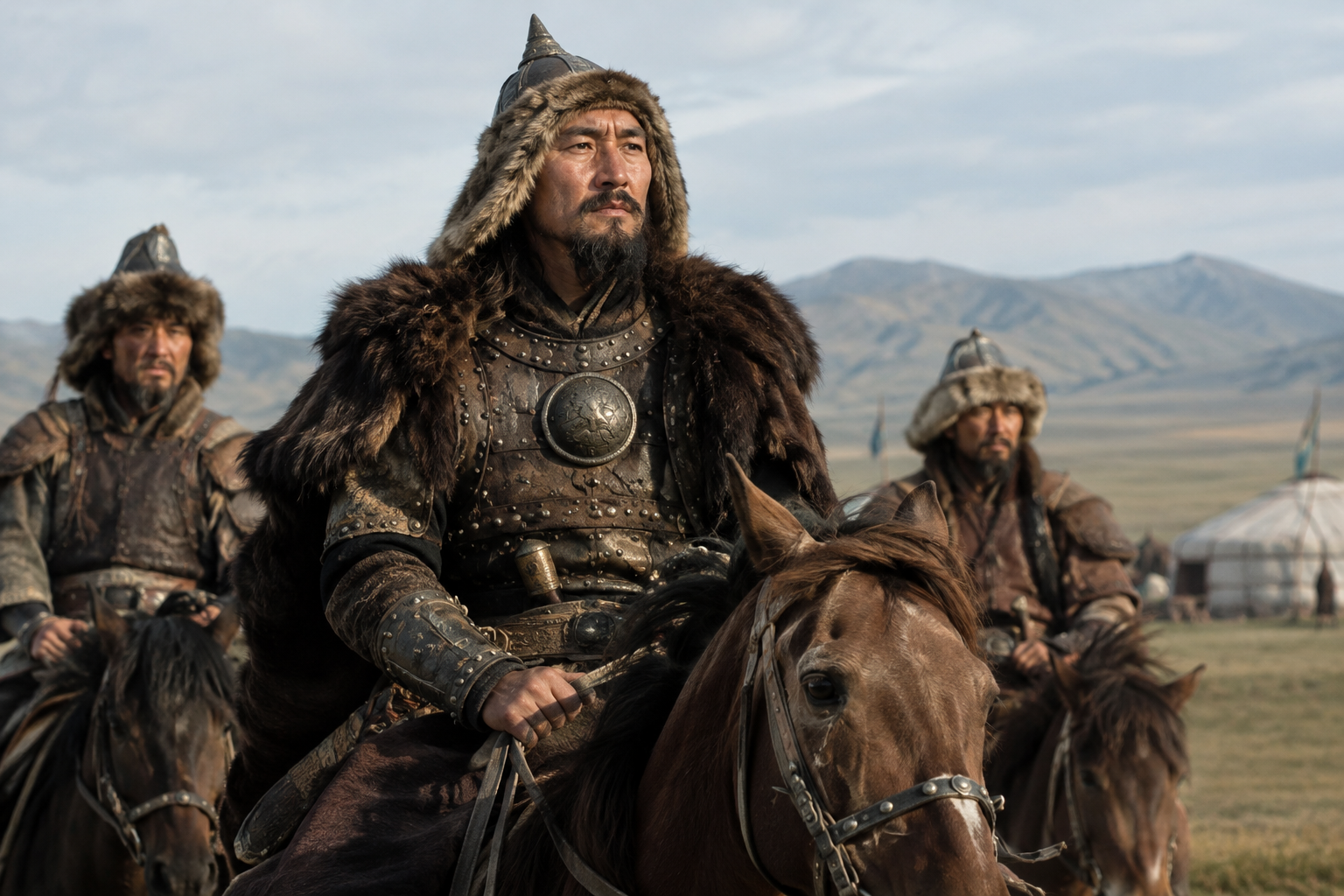
In the late medieval cemetery at Shar Khad in Sukhbaatar, Mongolia, one man identified as SHR001 offers a small but telling glimpse into the paternal history carried by haplogroup O2a2b1a1a1b1a1a. He is dated to around AD 1325, which places him in the centuries after the great imperial expansion of the Mongols, when the steppe was still deeply connected by movement, tribute, trade, and military service. A single Y-chromosome result cannot tell us everything about him, of course, but it can place his direct paternal line inside a wider East Asian story that is archaeologically and historically important.
That is what makes this case interesting. O2 is a major East Asian Y-DNA family, and branches within it are especially relevant to the long interaction zone linking northern China, Inner Mongolia, Manchuria, and the Mongolian steppe. The very precise subclade name O2a2b1a1a1b1a1a is much narrower than the broad O2 umbrella, so it should not be treated as if it automatically carries the full history of every O2 lineage. What the Shar Khad individual does show is that a paternal branch ultimately nested within that East Asian cluster was present in medieval Mongolia.
Shar Khad sits in a region that belonged to the great communications web of the Mongol world. By the early 14th century, Mongolia was no isolated backwater. It was tied into routes running outward toward North China, Central Asia, and beyond. A burial from this setting therefore matters because it belongs to a world in which people, languages, and lineages circulated across extraordinary distances, yet were still anchored in local communities and landscapes.
For SHR001, the headline fact is not imperial glamour but historical placement. Around AD 1325, steppe populations were living in the aftermath of the Mongol Empire's largest conquests. A paternal lineage such as O2a2b1a1a1b1a1a appearing in this context fits a broader pattern seen in ancient DNA: medieval Mongolia was not genetically uniform, and its communities drew on lineages with deeper roots across eastern Eurasia.
An ancient DNA study on the Mongolian steppe has helped frame exactly this kind of question, tracing how populations in Mongolia changed across time and how eastern Eurasian paternal lines appear in different periods and settings. The relevant research trail for this sample points to genetic work on ancient individuals from the Mongolian region, though one should be careful not to overstate what a supplementary research link alone can prove about every fine-scale subclade assignment.
Y-DNA follows one line only: father to son, back through time. That makes it wonderfully sharp for tracing paternal descent, but also rather narrow. A man with haplogroup O2a2b1a1a1b1a1a could have had ancestors from many different populations through his mother's side, his grandmothers' lines, and countless other branches of his family tree. So the value here lies in identifying one thread, not the whole cloth.
The distinction between O2 and O2a2b1a1a1b1a1a is worth keeping clear. O2 as a wider paternal family has a broad East Asian distribution and deep time depth. The exact branch in this article is a much finer twig on that tree. With only one named ancient sample in hand, it would be careless to claim a grand migration route or a specific founding event for this exact subclade. What we can responsibly say is that this paternal line, or a reported line associated with it, appears in a late medieval Mongolian individual from Shar Khad.
The old habit was to imagine the steppe in crude ethnic blocks: this tribe here, that tribe there, each one neat and static. Ancient DNA has been steadily dismantling that picture. Mongolia was repeatedly shaped by mixtures of local continuity, incoming ancestry, political confederations, and shifting elite networks. That makes a lineage like O2a2b1a1a1b1a1a historically plausible in several ways: through long-standing eastern Eurasian presence on the steppe, through incorporation of peoples from neighboring regions, or through the ordinary movement of men and families within imperial and post-imperial systems.
That point is especially important for the Mongol centuries. The empire did not create movement out of nothing, but it dramatically intensified it. Soldiers, herders, captives, administrators, merchants, and craft workers all moved across zones that had once been more loosely connected. A paternal lineage found in Mongolia in the 14th century therefore belongs to a world of mobility, but mobility of many different kinds, not one simple tale of conquest.
East Asian Y-Chromosome Migrations
To understand why this branch matters, it helps to zoom out from medieval Mongolia and think about the longer map of East Asian paternal lineages. Branches within O2 are prominent in discussions of demographic growth tied to agricultural societies, state formation, and regional expansions in East Asia. But the steppe should not be treated as merely receiving these lineages from elsewhere in one late wave. Northern East Asia has long been a frontier of interaction, with populations moving between farming zones, forest margins, and pastoral regions over many centuries.
That broader picture is why a find like SHR001 deserves attention even without royal names attached to it. It helps place a modern tester's paternal line inside an ancient borderland where worlds met: the Chinese agrarian sphere, Inner Asian pastoral networks, and the political formations of medieval Mongolia. The steppe was not just a corridor people crossed. It was also a place where lineages stayed, multiplied, and became local.
Readers following East Asian population history more generally may find it useful to compare this steppe case with work on northern China and neighboring zones, where ancient DNA has revealed both continuity and change over long stretches of time.
Middle Yellow River Genomic History
There is a temptation, when faced with a very precise haplogroup label, to expect an equally precise historical biography. Archaeology is rarely so obliging. For SHR001, we do not need an invented saga. The real value lies in the combination of date, place, and paternal lineage: a man buried in late medieval Mongolia whose Y-DNA falls within an East Asian branch that helps illuminate the human background of the steppe after the height of Mongol imperial power.
Even a single burial can sharpen the map. It tells us that this paternal ancestry was not just part of modern distributions reconstructed backward, but part of the lived population history of Mongolia itself. That is often how archaeogenetics advances: not always by huge dramatic revelations, but by pinning one definite human life to one definite place and time.
If your paternal line belongs to O2a2b1a1a1b1a1a, the Shar Khad evidence offers something modest but real: this branch, or a reported lineage closely associated with it, appears in a documented late medieval Mongolian context. That does not make every modern carrier "Mongol" in any simple ethnic sense, nor does it pin your family story to one empire or one tribe. What it does suggest is that your direct male line belongs to the wider East Asian paternal world that was active in, and connected to, the Mongolian steppe during a historically pivotal age.
Comments