Haplogroup O2a2b1a1a1a2a1a1

– 4 min read


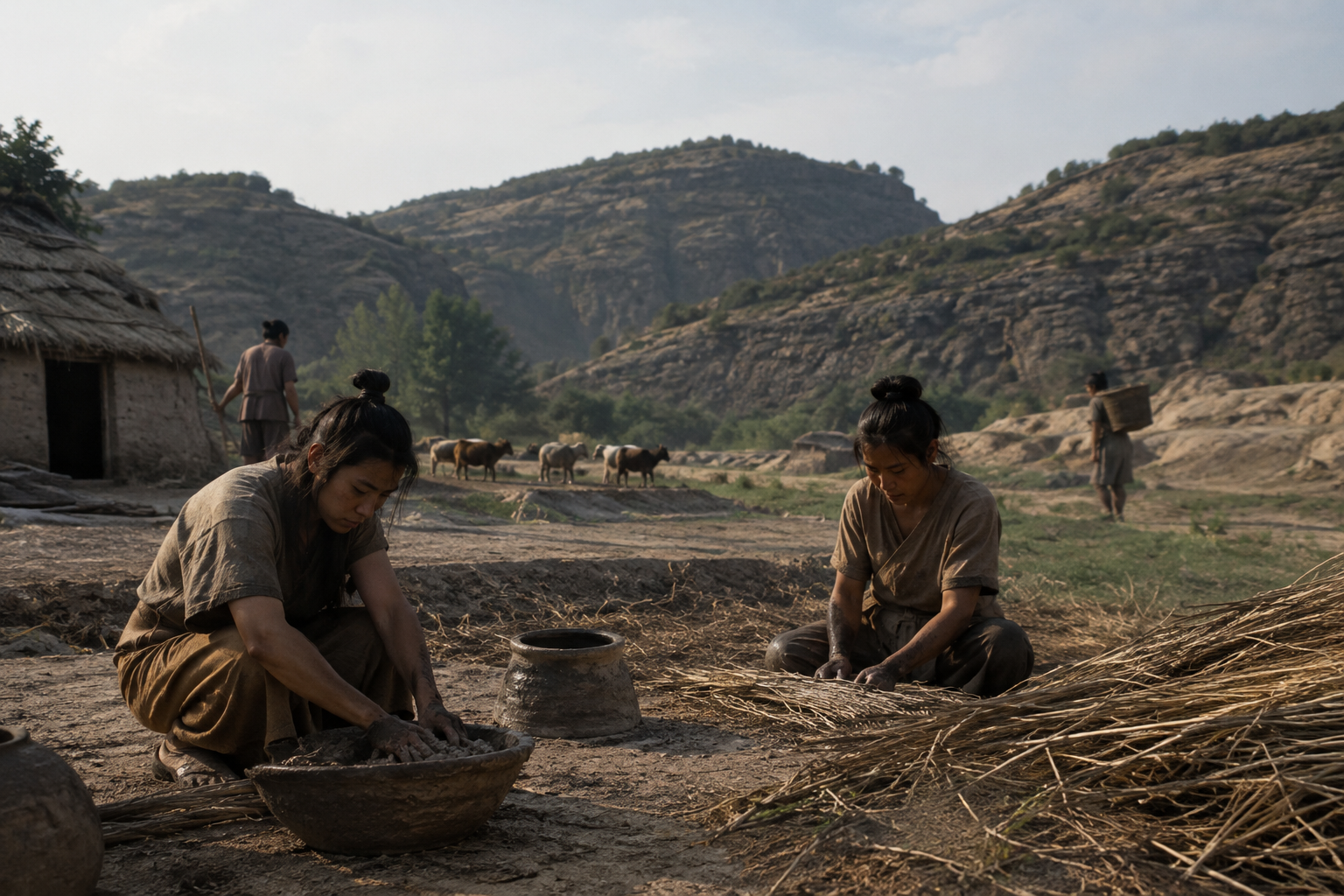
At Shimao, in northern Shaanxi, the Late Neolithic world of China looks anything but small. This was a vast stone-built center, active around 1900 BC, set on the edge of the Loess Plateau and tied to one of the most striking archaeological landscapes in early northern China. Among the ancient individuals recovered there is sample Shimao_HYW_4, reported in connection with the Y-DNA haplogroup O2a2b1a1a1a2a1a1.
That matters because Shimao is not just another burial site. It sits in a region crucial to the making of later northern Chinese populations, and paternal lineages like this one help anchor that history in real people. Y-DNA traces one direct male line only, not a person's whole ancestry, but when a branch turns up at a major site like Shimao it gives us a rare fixed point in a much larger historical puzzle.
Shimao has become famous for good reason. Long before the classic imperial capitals, this was already a large, fortified center with monumental architecture and evidence for a society capable of organizing labor on a serious scale. Archaeologically, it belongs to the late third and early second millennium BC world of northern China, a period when regional centers were growing, competing, and experimenting with new forms of power.
In that setting, Shimao_HYW_4 is valuable not because one skeleton can explain a civilization, but because one securely placed male lineage can be set beside settlement archaeology, regional exchange, and later population history. A genetic study of the broader region, published research on ancient genomes from northern China, helps frame just how important these northern populations were for later demographic developments.
The full label O2a2b1a1a1a2a1a1 is extremely specific. In practical terms, that means the article is dealing with a narrow twig on a much larger East Asian Y-chromosome tree. It would be careless to project the entire history of a broad parent lineage onto this exact branch unless the evidence specifically allows it.
What can be said more safely is that lineages within the wider O family are deeply important in East Asian paternal history, and ancient finds from northern China are central to understanding how those branches were distributed through time. A sample like Shimao_HYW_4 gives the branch an archaeological setting: Late Neolithic or very early Bronze Age northern China, at a site already associated with emerging social complexity.
That is a useful distinction for family historians. If you carry this haplogroup today, the ancient connection is not a claim that you descend from one named ruler, one clan, or one excavated man in a simple line. It is, rather, evidence that your direct paternal line belongs to a branch already present in the population world that helped shape northern Chinese history nearly four thousand years ago.
Shimao was not isolated. Its significance lies partly in geography. Northern Shaanxi was connected to the broader Middle Yellow River zone, one of the great engines of early Chinese demographic and cultural change. Ancient DNA from this wider region has increasingly shown that local continuity and regional interaction both mattered: populations were not static, but neither were they endlessly replaced by neat waves of newcomers.
That makes a lineage like O2a2b1a1a1a2a1a1 especially interesting when found at Shimao. It places the branch within a zone where farming societies, frontier interaction, and the rise of fortified centers were all reshaping the human landscape. Readers interested in that deeper regional background may want to look at the MyTrueAncestry discussion of the Middle Yellow River's long genomic history, which is directly relevant to how we interpret finds from northern China.
One of the temptations in writing about a very specific Y-DNA branch is to turn it into a heroic migration story. Usually the evidence is not that tidy. What Shimao shows instead is something more historically interesting: by around 1900 BC, northern China already contained populations embedded in large, organized communities, and those communities formed part of the ancestry structure from which later northern societies emerged.
This is why the Shimao sample should be read in a broader archaeological frame. The site belongs to a period when northern China saw strong regional traditions rather than a single unified culture. Fortifications, settlement hierarchies, and ritual activity all suggest competition and innovation across different centers. A paternal lineage found there is therefore a witness to that world of regional power, not a shorthand for a single ethnic or political label.
Later studies from neighboring parts of northern and northwestern China have added an important complement to the Shimao picture: they show that Bronze Age communities could include both continuity from earlier Yellow River populations and contacts with other zones further west and north. That wider setting helps explain why even one ancient Y-chromosome assignment can matter. It becomes part of a map of how male lines were distributed across interacting populations, rather than a badge pinned to one isolated site.
The value of this Shimao result becomes even clearer when placed beside the growing body of work on ancient East Asian Y chromosomes. That research has started to show that paternal history was shaped by both inland and coastal developments, and by regional expansions that do not always line up neatly with modern identities or languages. In other words, the male-line past of East Asia is recoverable, but only if we keep it tied to excavated places and dated individuals.
For O2a2b1a1a1a2a1a1, the secure point here is Shimao. It is better to say that this branch is represented at a major Late Neolithic center than to make grander claims the evidence cannot support. The broader interpretive value comes from comparison with other ancient Y-chromosome work across East Asia, including studies highlighted by MyTrueAncestry on how ancient paternal lines illuminate larger regional movements.
Ancient East Asian Y chromosomes
The distinctive thing about O2a2b1a1a1a2a1a1 in this article is not a royal claim or a legendary ancestor. It is that the branch is anchored, however modestly, in one of the most important prehistoric centers of northern China. Shimao_HYW_4 shows this paternal line in a real archaeological setting around 1900 BC, among communities living at a moment when early complex societies were taking shape on China's northern frontier.
For someone researching a direct paternal line today, that is already a substantial historical clue. It suggests that this branch belonged to the world of Late Neolithic northern China and forms part of the deeper male-line history behind later East Asian populations.


Comments