Haplogroup O2a2b1a1a1a1a1b1a1b

– 4 min read


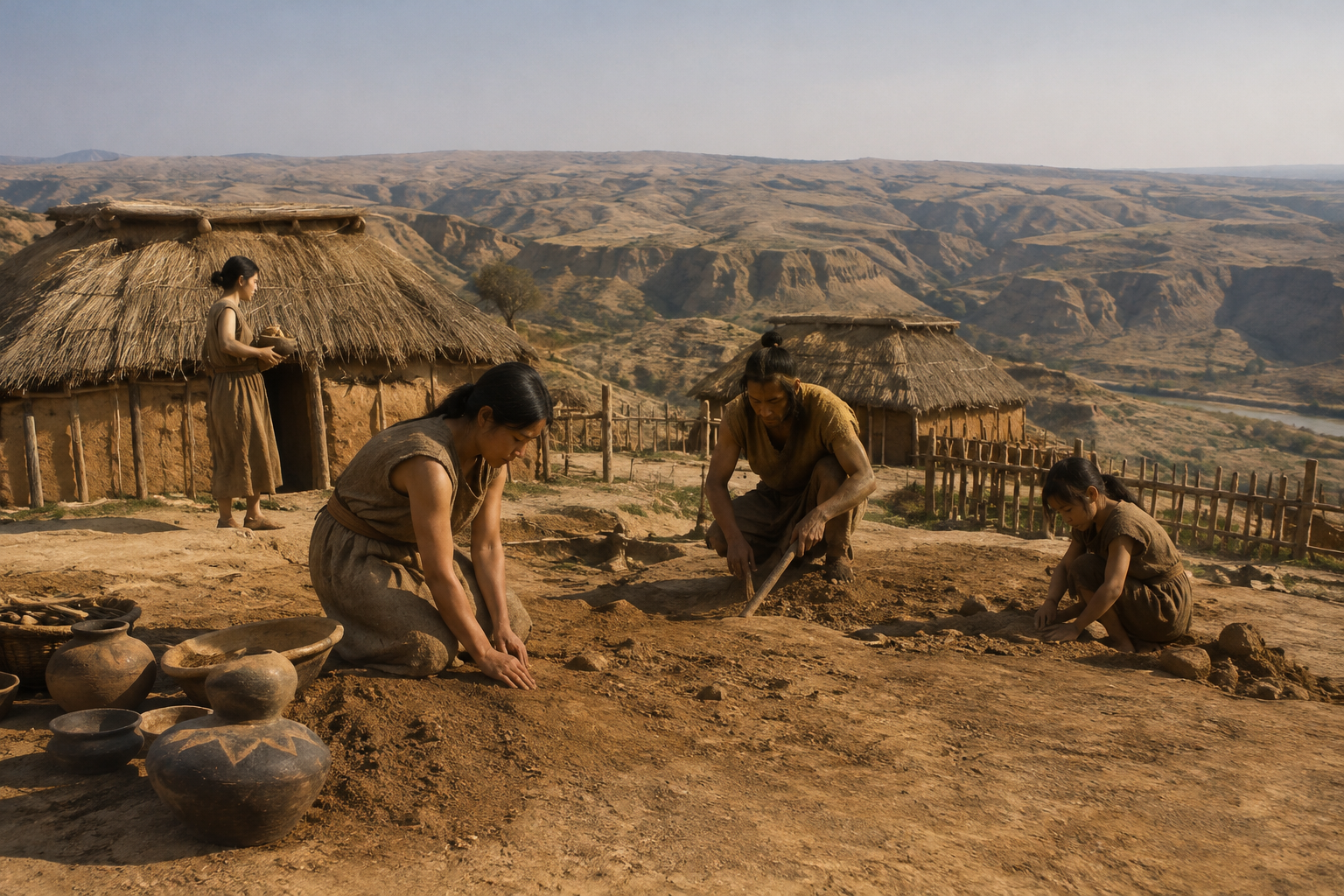
On the Loess Plateau of northern China, one ancient man offers a very precise glimpse into a deep paternal past. He is recorded as SM-SGDLM6 from Shengedaliang in Shenmu, dated to around 2110 BC. For people interested in the Y-DNA haplogroup O2a2b1a1a1a1a1b1a1b, that matters because this is not a vague modern distribution map or a surname tradition: it is a Bronze Age individual, anchored to a place, a period, and an archaeological landscape.
The setting is important. The Loess Plateau and the wider middle Yellow River region were not marginal country in the late 3rd millennium BC. They were part of a zone where farming communities, frontier interaction, and shifting social worlds met. A Y-chromosome like O2a2b1a1a1a1a1b1a1b traces only one direct paternal line, not the whole ancestry of a person, but even one securely placed ancient male can tell us something valuable about where a lineage was already present and active in prehistory.
SM-SGDLM6 comes from Shengedaliang, near Shenmu on the Loess Plateau, and is dated to about 2110 BC. That puts him in the centuries when northern China was anything but static. Communities in this broad region were living through changes in settlement, subsistence, exchange, and contact with neighboring populations to the north and west.
In practical terms, this means that the haplogroup assignment is historically more interesting than a bare code might suggest. Instead of meeting this paternal line first in an imperial tomb, a medieval genealogy, or a modern frequency table, we encounter it in a prehistoric landscape of villages, mobility, and regional interaction. That gives the branch chronological depth in North China and places it firmly within the human story of the Yellow River world before written history becomes abundant.
A genetic study of populations from the region, published in Nature Communications, helped clarify long-term population structure in northern China and the interaction zones around the Yellow River. Even without forcing more precision than the evidence allows for one individual, that broader research context makes clear that sites like Shengedaliang belong to a major arena of prehistoric demographic change.
The name O2a2b1a1a1a1a1b1a1b is, of course, extremely specific. It refers to a narrow twig on a much larger East Asian Y-chromosome tree. That is worth stating plainly, because readers are often tempted to let a very long haplogroup label do more historical work than it really can.
What we can say with confidence is modest but meaningful: a paternal line associated here with this branch appears in an ancient male from the Loess Plateau around the beginning of the Bronze Age. What we should not do is automatically turn that into a complete origin story for every man carrying the lineage today, or assume that the whole parent haplogroup had exactly the same history as this much narrower subclade.
Still, there is genuine value in specificity. Ancient DNA has changed the game because it lets us pin paternal lines to actual times and places. A branch like this is no longer just an abstract place on a phylogenetic chart. With SM-SGDLM6, it becomes part of a lived archaeological setting in northern China.
The Loess Plateau is one of those landscapes that can sound monotonous on paper and prove utterly central in history. Its deep windblown soils supported agriculture, but its position also connected farming communities with steppe-edge zones and inland corridors. In the late 3rd and early 2nd millennia BC, this mattered enormously.
Northern China at this time was shaped by local continuity and outside contact together. That is exactly why a paternal lineage from Shenmu deserves attention. It may represent persistence within regional communities, or it may sit within broader patterns of interaction that linked the middle Yellow River with neighboring northern zones. The important point is that such a sample belongs to an interface region where ancestry, economy, and culture were being renegotiated across generations.
That wider picture has become much clearer through ancient genomic work on northern and northwestern China, including studies of Bronze Age populations in frontier regions. These have repeatedly shown that prehistoric China was not built from a single uniform block, but from overlapping regional histories that later states would only partially smooth over.
There is a fair question here: can one sample really tell us much? On its own, one man cannot stand in for all Bronze Age northern Chinese populations. But one well-placed sample can establish presence, and presence is the foundation of any responsible historical interpretation.
SM-SGDLM6 shows that a paternal line linked here to O2a2b1a1a1a1a1b1a1b was already part of the human landscape of the Shenmu area by about 2110 BC. That matters especially for lineages now found among East Asian populations, because it helps move discussion away from purely modern patterns and toward dated prehistoric evidence. In other words, it gives the branch a foothold in time.
Archaeologists and geneticists increasingly work in just this way: building large pictures from carefully contextualized individual lives. A single burial, settlement, or cemetery rarely solves the whole puzzle. But each secure ancient chromosome narrows the range of guesswork.
One of the most useful ways to think about this haplogroup is to place it in northern China before the great imperial consolidations. Around 2110 BC, the political map familiar from later Chinese history did not yet exist in its classical form. What existed instead were regional populations with their own local histories, interacting across ecological boundaries and cultural frontiers.
That makes a Loess Plateau sample especially valuable. It reminds us that paternal lineages later absorbed into large historical populations had earlier, more local stories. The men who carried these lineages were not symbols of neat ethnic blocks. They were members of prehistoric communities living through technological change, shifting networks, and the slow formation of the societies that would later dominate the historical record.
The distinctive value of O2a2b1a1a1a1a1b1a1b in this case is not royal glamour or a grand migration tale too neat to be true. It is something better: a real ancient anchor. SM-SGDLM6 places this paternal line, or a lineage directly associated with it, in the Shenmu region of the Loess Plateau around the start of the Bronze Age, within one of the key prehistoric zones of northern China. For anyone researching this haplogroup today, that is a solid historical clue - a sign that this branch belongs to the long and regionally complex formation of ancient North China.

Comments