Haplogroup O2a2b1a1a1a1a1b1a1

– 5 min read


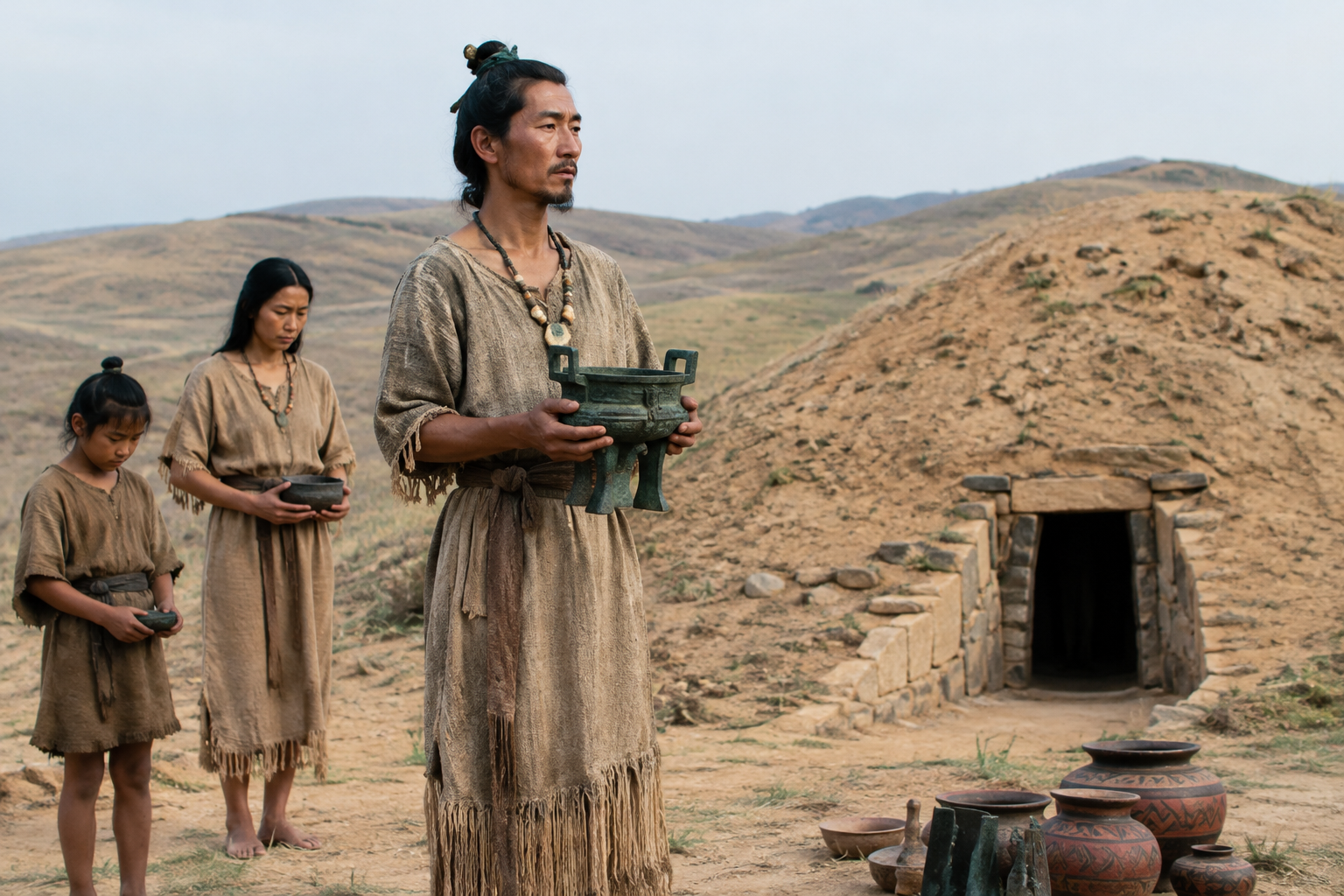
At Mogou cemetery in Lintan, in today's Gannan region of Gansu, one Bronze Age burial has become unexpectedly important for the study of East Asian paternal history. The individual labelled MogouM1133_1, dated to around 1450 BC and associated with the Qijia cultural horizon of northwestern China, has been reported in connection with the Y-DNA haplogroup O2a2b1a1a1a1a1b1a1. That is a very narrow branch name, but its real value lies in something quite concrete: it places one direct paternal line inside a frontier zone where farming communities, upland corridors, and wider Eurasian contacts were all meeting.
This is exactly the sort of case where ancient DNA becomes more useful when it is kept modest. Y-DNA traces one father's-father's-father line, not a person's whole ancestry or identity. Still, when a lineage like O2a2b1a1a1a1a1b1a1 turns up in a securely dated Bronze Age burial from Gansu, it gives us a fixed point in time and space for a branch that today belongs to the wider paternal landscape of East Asia.
Mogou is not just a dot on a map. It sits in a region that linked the upper Yellow River world with the routes running westward into the Hexi Corridor and beyond. By the second millennium BC, this was already a contact zone: agricultural traditions, local burial customs, and influences from pastoral populations to the north and northwest could overlap without collapsing into a single neat cultural story.
The Qijia culture, usually dated to the late third and early second millennia BC, has long interested archaeologists because it occupies this very threshold between the Central Plains and the Inner Asian world. The cemetery evidence from Mogou belongs to a later Bronze Age setting in Gansu that helps show how long that frontier character endured. A reported Y-chromosome assignment such as O2a2b1a1a1a1a1b1a1 matters here not because it "explains" the whole cemetery, but because it anchors one paternal descent line within that broader human landscape.
An ancient DNA study focused on burials from Bronze Age Gansu has helped push this discussion beyond older, culture-name arguments and toward actual biological relationships among buried individuals and populations. The relevant research archive is linked here: https://ngdc.cncb.ac.cn/gsa-human/browse/HRA014036.
O2a2b1a1a1a1a1b1a1 is a downstream branch within the much larger O family of Y-DNA lineages, one of the major paternal groupings across East and Southeast Asia. With ancient samples, though, there is always a practical problem: the narrower the branch name, the more careful we must be. Some publications resolve a lineage very finely; some databases or later compilations place a sample further down the tree than the original paper could confidently show.
That means the safest historical reading is not to imagine a neatly labelled "tribe" carrying this exact subclade across Bronze Age China. Rather, MogouM1133_1 shows that a paternal line associated with this branch was present in northwestern China in the later second millennium BC. That is already significant. It suggests that lineages belonging to the broader O2 paternal world were not confined to the agricultural heartlands farther east, but were also part of communities living in one of ancient China's major transition zones.
In other words, this is not a story about a single branch marching across a map. It is a story about how one paternal line appears inside a mixed and mobile archaeological setting where local continuity and wider connections both mattered.
There is a persistent temptation in writing Eurasian prehistory to treat Gansu as a mere passageway between "China" and "the steppe." Archaeologically, that is much too simple. Communities in this region were not just receiving influences; they were shaping regional lifeways of their own, combining millet farming, local burial traditions, and varying degrees of contact with neighboring worlds.
The Mogou evidence helps underline that point. A lineage like O2a2b1a1a1a1a1b1a1 in this setting does not look like an intrusive curiosity dropped into foreign soil. It looks more like part of the local demographic fabric of Bronze Age northwestern China, even if that fabric itself had threads running in several directions. That is an important distinction, because it resists the old habit of imagining frontier populations as somehow less settled or less central to history.
Recent MyTrueAncestry coverage of regional ancient genomes has made the same broader point from another angle: northwestern China was repeatedly shaped by population interaction, but not erased by it.
Single ancient men do not found civilizations in isolation, and one Y-line never stands in for an entire people. Yet isolated data points can be historically powerful when they fall in the right place. MogouM1133_1 sits in a region crucial for tracking how populations of the Yellow River sphere connected with communities farther west and north during the Bronze Age.
That is why this sample belongs in the same conversation as larger studies of ancient East Asian Y chromosomes. Those studies aim to reconstruct coastal and inland patterns of paternal expansion over long periods, showing that East Asian male-line history was regionally varied rather than the product of a single wave or center. A branch such as O2a2b1a1a1a1a1b1a1 gains meaning when seen against that wider background: not as a badge of ethnicity, but as one thread in the long formation of East Asian paternal diversity.
East Asian Y-Chromosome Migrations
The archaeological label "Qijia" can be misleading if we treat it as the name of a genetically uniform population. It was, first of all, a material culture tradition: a way archaeologists group pottery styles, settlement patterns, and other remains. The men buried in and around that world could carry different paternal lines, and their communities could have varying mixtures of ancestry even when they shared overlapping customs.
That is why later northern Chinese studies are useful as comparison, even when they belong to much later periods. They show again and again that social continuity, political change, and genetic history do not move in lockstep. A paternal lineage may persist through cultural change, or appear in new settings without implying mass replacement. For readers tracing this haplogroup today, that is perhaps the most sensible lesson from Mogou: direct male-line continuity can survive within societies that are themselves changing in language, alliance, economy, and identity.
Middle Yellow River Genomic History
The strongest ancient clue for O2a2b1a1a1a1a1b1a1 in this case is not a royal pedigree or a legendary founder, but a man buried in Bronze Age Gansu at Mogou. That is valuable precisely because it is ordinary in the archaeological sense: a real person from a real cemetery in a region where the worlds of the Yellow River and Inner Asia met. For someone researching this paternal line today, the responsible takeaway is that this branch had a place in the human history of northwestern China by around 1450 BC, within communities shaped by both local continuity and regional interaction.
Comments